Why Coues Deer Reward Patience Over Movement
Hunting Coues deer in Arizona can be one of the most rewarding, yet incredibly frustrating, experiences for a Western hunter. Many of us are conditioned to think that to find game, you have to cover ground, constantly moving through the landscape. But with Coues deer, often called the "gray ghosts" of the desert, this instinct is usually a recipe for seeing nothing but their white flag disappearing over a ridge. This guide is all about changing that mindset, diving deep into why a patient approach, focused on stillness and meticulous glassing, is the true path to success with these elusive creatures.
Understanding the "Gray Ghost" Mentality
To truly appreciate why patience is paramount when pursuing Coues deer, you first need to understand the animal itself. These aren't your typical whitetails that might hold in thick brush, or even the larger mule deer that sometimes let you make a mistake before busting. Coues deer are a breed apart, masters of their challenging desert domain, and every fiber of their being is geared towards survival.
Coues Deer: Masters of Camouflage and Evasion
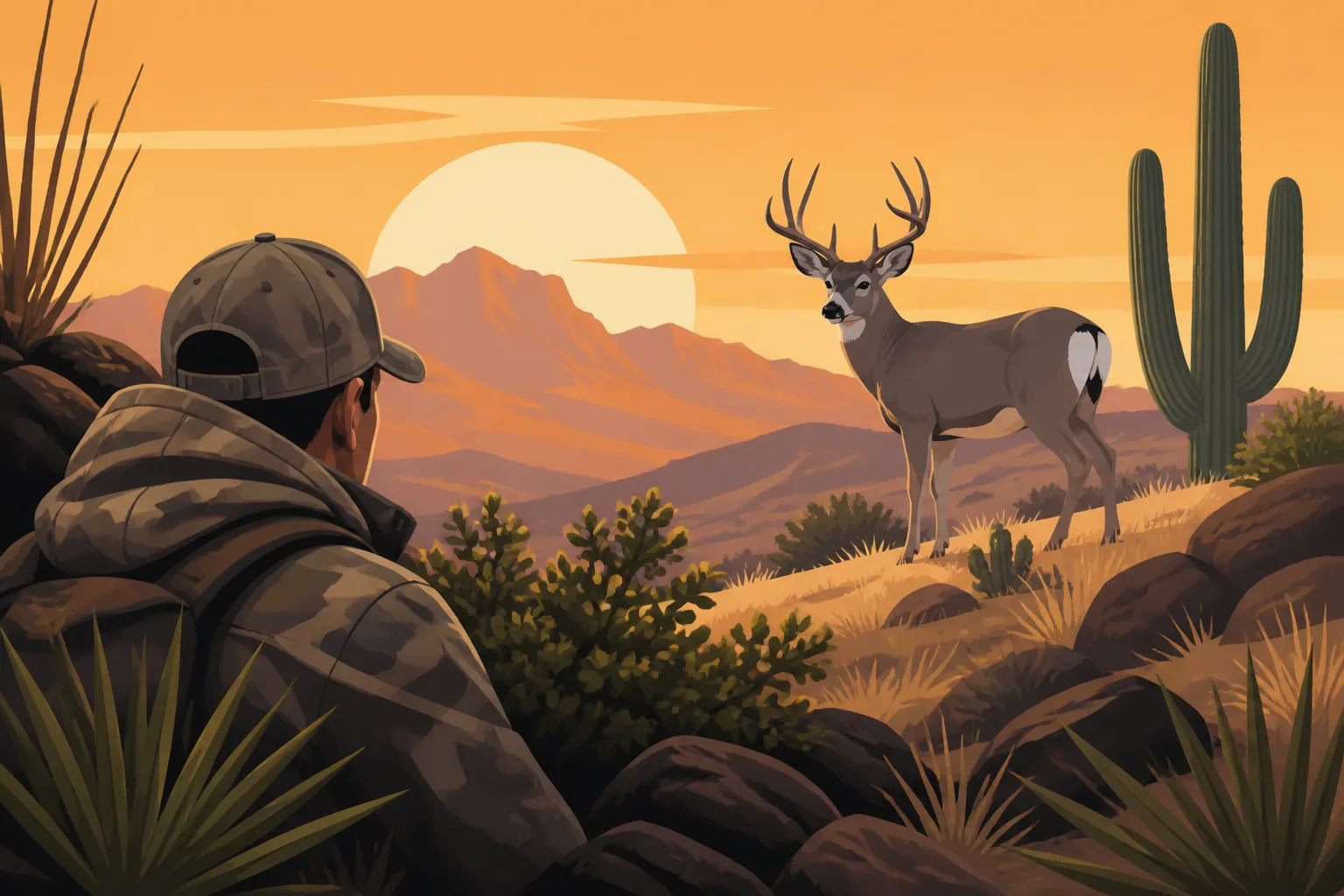
When you think of a Coues deer, picture something smaller than a mule deer, with a coat that perfectly mimics the dusty, rocky, and scrubby landscape of Arizona's Sky Islands. Their muted gray-brown fur blends seamlessly with the granite boulders, dry grasses, and sparse oak brush where they thrive. This natural camouflage is their primary defense, allowing them to literally vanish into seemingly minimal cover.
It’s not just their color, though. Their physical size, typically topping out around 100-120 pounds for a mature buck, means they can disappear behind a single prickly pear cactus or a small cluster of junipers that wouldn't hide a full-grown mule deer. Their ability to remain absolutely motionless, sometimes for hours, when they sense danger is uncanny. They rely on this stillness to let perceived threats pass, often watching you walk right by from a mere stone's throw away, completely undetected. Their very existence in such open, rugged country is a testament to their mastery of evasion, making them incredibly difficult to spot when they don't want to be found.
High Alert and Keen Senses
Coues deer possess senses that are nothing short of phenomenal. Their large, dark eyes are designed for detecting the slightest movement across vast distances, offering them an incredibly wide field of vision, estimated to be around 270 degrees. This means they can spot you cresting a ridge or moving through a wash long before you ever see them. If you’re constantly on the move, you are a glaring red flag in their peripheral vision, a definite sign of danger.
Their hearing is equally impressive. The slightest crunch of a boot on dry leaves, the subtle scrape of gear against a backpack, or even the whisper of wind against your clothing can be enough to alert a Coues buck. They often live in areas with natural ambient noise, like rustling leaves or wind, but they are expertly attuned to distinguishing unusual sounds that signal a predator. And then there's their nose – an olfactory system so sensitive it can pick up human scent from an incredible distance, especially when thermals are working against you. When you’re walking, you’re not just making noise and visible movement; you’re also spreading your scent trail, essentially sending a clear message to every deer downwind that a potential threat is in the area. These heightened senses mean that a hunter's movement, no matter how careful they think they are being, is often the single biggest reason for not finding deer.
The Pitfalls of "Still Hunting" Coues Deer
The term "still hunting" usually implies moving slowly and deliberately, pausing frequently to glass. However, with Coues deer, even this nuanced approach often involves too much movement and can lead to frustration and missed opportunities. Many hunters, especially those new to Coues, underestimate just how still these deer are and how easily they detect the smallest disturbance.
Unintentional Spooking and Blowing Opportunities
Imagine this: You’ve laced up your boots before dawn, grabbed your rifle, and started still-hunting up a promising ridge line, pausing every 50 yards or so to scan with your binoculars. You feel like you’re being stealthy, taking your time, but what’s actually happening? Every step you take, every time you lift your binoculars, you're exposing yourself. The Coues deer, with their unparalleled eyesight, are likely spotting you from their bed, perhaps hundreds of yards away, sometimes even closer.
By the time you reach where you thought a deer might be, they’ve already slipped away unseen, often over the backside of the mountain or into deeper cover. They don’t just run a short distance; a spooked Coues will often vacate an entire drainage, making the rest of your day in that area fruitless. This constant movement, even when slow, can push deer out of their preferred feeding or bedding areas, making them go nocturnal or simply relocate to more secure, harder-to-reach terrain. It's a classic scenario where your effort works directly against your goal, turning potential encounters into vanishing acts. Learning to read the wind on a Sky Island stalk is an absolute must to avoid this.
Overlooking Bedded Deer
One of the most profound lessons in Coues hunting comes from the realization that you’ve probably walked past dozens of bedded deer without ever knowing it. Because they are so small and so perfectly camouflaged, a bedded Coues deer is practically invisible, even at alarmingly close range. They choose their beds with meticulous care, often in seemingly sparse patches of brush or amidst rocks that to the human eye offer little concealment. However, from their low vantage point, they have a clear view of their surroundings while remaining almost entirely hidden.
When you're walking, your eyes are naturally scanning for movement or the distinct outline of a deer. But a bedded Coues provides neither. They will often hold absolutely still, sometimes for hours, letting you pass within feet of them. It's a common story among seasoned Coues hunters to recount finding a deer only after passing it, then turning around and seeing it stand up from what looked like an empty patch of ground. This frustrating reality underscores why movement is so detrimental: you simply cannot out-spot a bedded deer with your naked eye while walking. Instead, your best bet for finding them is to patiently pick apart the landscape with quality optics.
The Power of Patience: Glassing and Waiting
If actively moving through the landscape is largely ineffective, what's the alternative? For Coues deer, the answer lies squarely in patience, specifically through dedicated, long-range glassing and understanding the rhythm of their movements. This isn't just a suggestion; it's the bedrock principle of successful Coues hunting.
The Art of Long-Range Glassing
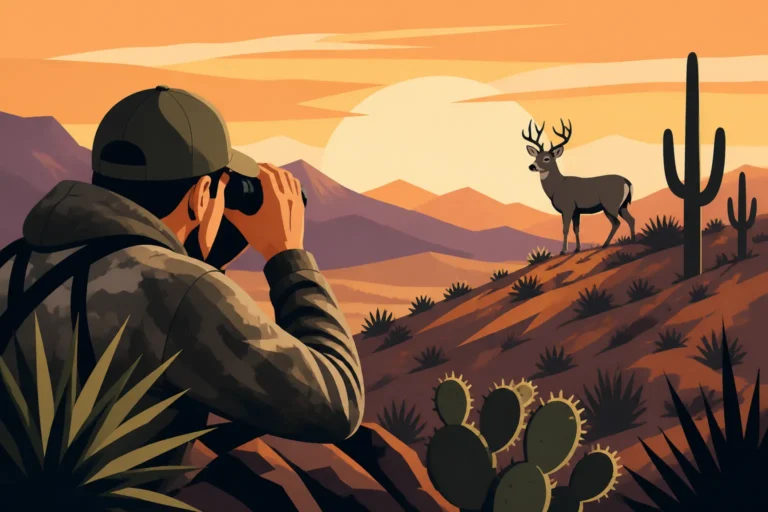
Long-range glassing isn't just looking through binoculars; it's a methodical, almost meditative practice. The idea is to find a high vantage point that offers expansive views of promising habitat—think south-facing slopes in winter, shady north-facing slopes in warmer months, or areas with good feed. Once you’ve picked your spot, you sit down. This is critical. Trying to glass effectively while standing or constantly moving strains your body and reduces your ability to hold optics steady. A solid tripod for your binoculars and spotting scope is non-negotiable for serious Coues hunting. You can also research topics like Optics Power for Arizona's Long Desert Sightlines to ensure you have the right tools.
From your chosen perch, you begin to systematically pick apart the landscape. This often means breaking down a distant hillside into small "grids" and meticulously scanning each section, looking for the flicker of an ear, the horizontal line of a back contrasting with vertical brush, or the tell-tale glint of an antler. You're not looking for a whole deer initially; you're looking for parts of a deer. Spend 20-30 minutes, or even an hour, on a single hillside. Then, give your eyes a break and return to it. This process should be slow, deliberate, and relentless. Platforms like GoHunt can be invaluable for e-scouting, helping you identify these potential glassing knobs and prime Coues habitat long before you even set foot in the field, saving you precious on-the-ground time.
Mastering the Sit-and-Stalk
Patience extends beyond just the initial glassing session. Once you’ve located a deer, especially a buck worth pursuing, the game shifts to the sit-and-stalk. This is where many hunters still rush, thinking they need to close the distance immediately. However, a patient approach here can mean the difference between a successful shot and a deer vanishing into thin air. After spotting a deer, take your time to observe its behavior. Is it feeding, bedding, or moving? Which way is the wind blowing? What escape routes does it have? How will the thermals shift as the day progresses?
Planning your approach is crucial. You might need to wait for the deer to move into a more favorable position, or for the thermals to switch in your favor. This could mean sitting for an hour or more, completely still, waiting for the right moment. When you finally do initiate your stalk, it must be agonizingly slow and deliberate, using every piece of available cover. Utilize natural washes and draws to minimize exposure, and understand that sometimes the best move is no move at all, simply waiting until conditions are perfect. The goal is to get close enough for an ethical shot without being detected. This is where topics like How Far to Stalk a Bedded Coues Buck become incredibly relevant, as knowing your effective range and the deer's comfort zone is paramount. Patience here isn't passive; it's an active, strategic waiting game.
Practical Strategies for Cultivating Patience
So, you understand the "why" behind patience, but how do you actually do it? In the field, the urge to move can be overwhelming, especially when you're not seeing anything. Cultivating patience is as much a mental game as it is a tactical one, requiring the right gear and a shift in expectations.
Gear for the Long Haul
Being patient means being comfortable, and being comfortable means having the right gear. First and foremost, a high-quality tripod is essential for both your binoculars and spotting scope. It eliminates shake and allows for sustained, comfortable viewing, which is impossible to achieve freehand. Next, consider a lightweight, foldable seat or even a small pad to sit on. Sitting on hard, rocky ground for hours is a quick way to get uncomfortable and start fidgeting, which leads to movement.
Hydration is also key. Pack more water than you think you’ll need, along with plenty of snacks. Hunger and thirst lead to impatience and distraction. Sun protection—hats, sunglasses, and sunscreen—are also vital for those long hours under the Arizona sun. The more physically comfortable you are, the longer you can stay put, focused on glassing, and the less likely you are to give in to the urge to move. Don't forget layers of clothing; desert temperatures can swing wildly, and being too hot or too cold is a surefire way to break your focus. This deliberate preparation for comfort allows you to maximize your time in one spot, significantly increasing your chances of finding one of these elusive bucks.
Mental Fortitude and Realistic Expectations
Perhaps the hardest part of Coues hunting is the mental game. It’s easy to get discouraged when you’ve been glassing a hillside for two hours and haven't seen a single thing. This is where a shift in expectations is crucial. You're not "hunting" by walking; you're "hunting" by patiently dissecting the landscape with your optics. Celebrate small victories: spotting a rabbit, identifying a hawk, or simply seeing a distant doe is all part of the process. Each successful spotting, no matter how small, reinforces the effectiveness of your method.
Remind yourself that Why Coues Deer Reward Patience Over Movement is a fundamental truth in this game. The best Coues hunters aren't the ones who cover the most miles; they're the ones who cover the most square inches with their glass. When boredom or frustration creeps in, take a short break, stretch, rehydrate, but then return to your systematic glassing. Trust the process. Understand that these deer are incredibly good at hiding, and it takes extreme patience and attention to detail to uncover them. Over time, you'll develop an "eye" for what looks like a deer, even when it's just a small patch of hair or the curve of an antler. This mental discipline is as important as any piece of gear you carry.
| Strategy | Pros | Cons | Key Takeaway |
|---|---|---|---|
| Active Still Hunting | Covers more ground, feels proactive | High risk of spooking deer, easily overlooks bedded deer, spreads scent | Often counterproductive for Coues deer. |
| Patient Glassing | Minimizes disturbance, allows for long-range detection, conserves energy | Can feel slow and monotonous, requires specific gear, limited ground cover | The most effective method for consistently finding Coues. |
Disclaimer
Please remember that hunting regulations, seasons, and access rules can change frequently. Always consult the most current Arizona Game and Fish Department regulations before planning any hunt. This article provides general information and recommendations, but it is the hunter's responsibility to know and follow all applicable laws.