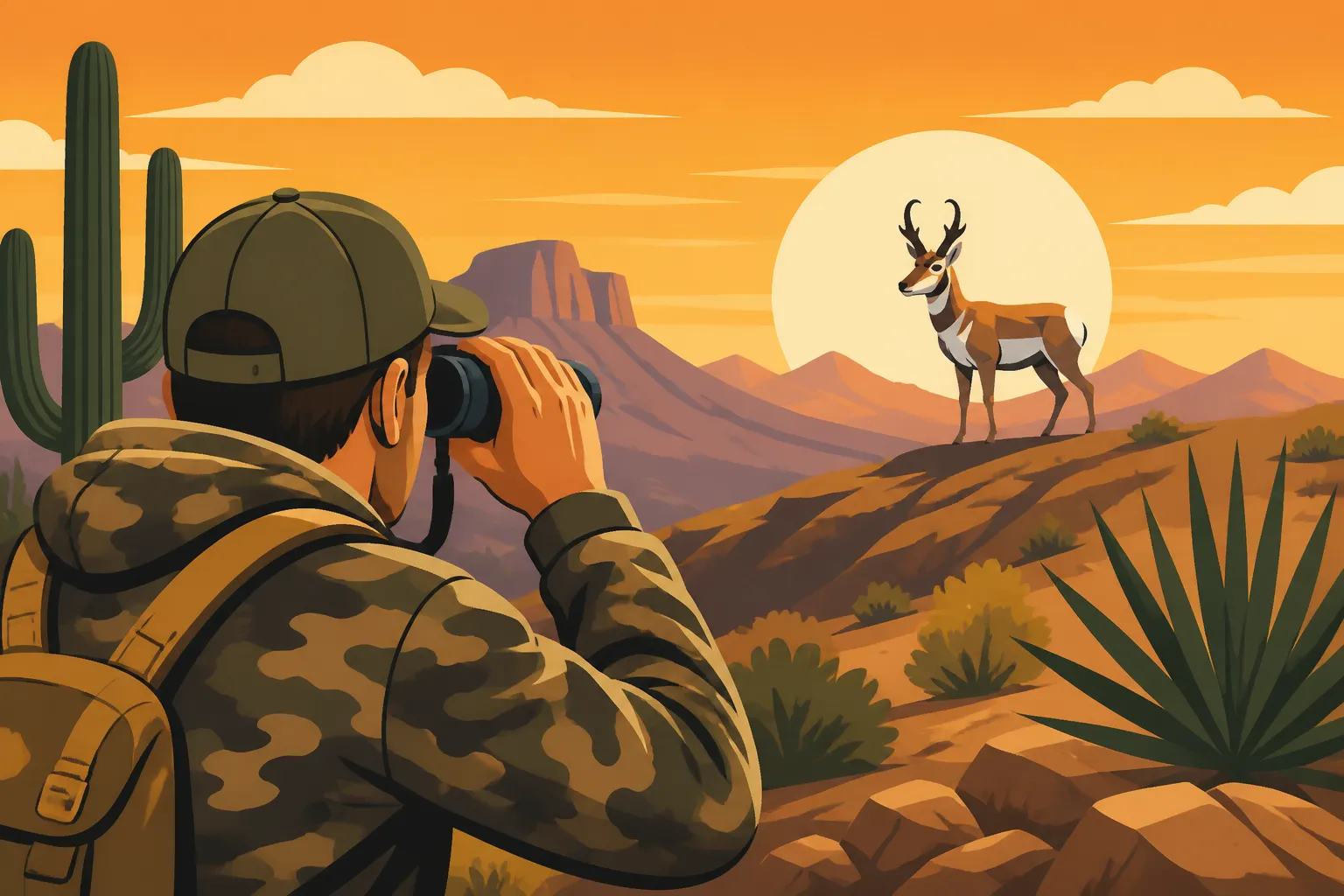
Field Judging a Pronghorn Buck From Distance
It's incredibly frustrating, isn't it? You spend hours glassing vast expanses of Arizona's grasslands, finally pick out a white patch in the distance that might be a pronghorn, and then the real challenge begins: trying to figure out if it's a buck worth putting a stalk on. The open country, the shimmering heat, the way those animals blend in—it all conspires to make field judging a pronghorn buck from a mile away feel like an impossible task. This guide is here to break down the nuances of what you should be looking for, helping you make those critical decisions from afar and saving you precious time and effort in the Arizona desert.
Why Field Judging Pronghorn Is So Challenging in Arizona
Arizona's pronghorn often inhabit some of the most wide-open, treeless country imaginable. This habitat, while beautiful, presents unique hurdles when you're trying to assess a buck's potential trophy quality. You're rarely going to be close enough for a quick glance, and often, the conditions are working against you.
One of the biggest culprits is the mirage effect. When the sun beats down on those vast, flat plains, the heat waves rise and distort anything you're trying to look at through your optics. What might appear as thick, tall horns can become wavy and appear much larger or smaller than they actually are. It's like looking through water, and it can seriously play tricks on your eyes, leading to wasted stalks on smaller bucks or, worse, passing up a truly exceptional animal because the mirage made it look mediocre. This is a common frustration for anyone spending time glassing during Arizona Pronghorn Season Timing or any of our warmer weather hunts.
Beyond the mirage, pronghorn themselves are built for speed and distance. They don't linger around, and they often travel in groups, making it hard to isolate one particular buck for a thorough evaluation. Their horns, unlike deer or elk antlers, are a unique blend of bony core and keratinous sheath, and they can look surprisingly similar between mature bucks and younger animals if you're not focusing on the right details. Add to that the sheer scale of the landscape – what looks like a few hundred yards could easily be three-quarters of a mile – and you can see why many hunters find themselves second-guessing their judgment. High-quality optics and knowing what to look for are paramount to overcoming these inherent difficulties in the field.
Key Characteristics to Look For: Mass, Length, and Prongs
When you're staring through your spotting scope at a distant pronghorn, every detail matters. Unlike deer antlers where tine length and width are dominant, pronghorn horns require a different set of assessment criteria. We're primarily focused on three key aspects: the mass of the horn, its overall length, and the shape and placement of the prong itself. Getting a handle on these will significantly improve your ability to identify a shooter.
Horn Mass and Overall Thickness
Mass is arguably the most crucial factor when judging a quality pronghorn buck. A truly exceptional buck will have thick, heavy horns that carry that mass throughout their length, not just at the base. You want to see horns that appear robust and substantial, not spindly or thin. A great way to gauge mass, especially at a distance, is to compare the horn's circumference at its base to the width of the buck's ear. A good buck will have horns at the base that are at least as thick as, or even thicker than, the widest part of its ear. If the horns look significantly skinnier than the ear, you're likely looking at a younger or less mature animal. As the horn grows upward, pay attention to how well it maintains that initial girth. Does it quickly thin out, or does it hold its thickness well before tapering to a point? This sustained mass contributes heavily to a buck's overall score and visual appeal.
Remember that mirage can severely distort this perception, making a thick horn appear thin or vice-versa. Patience and observing the animal for an extended period, perhaps when it's standing broadside or turning its head, can help you get a more accurate assessment. Sometimes waiting for a cloud to pass, or for a slight shift in the air, can momentarily clear the view and give you a truer picture of the horn's mass.
Horn Length and Height Above the Ears
After mass, the length of the horns is the next critical factor. For pronghorn, length is measured from the base of the horn to its tip, following the curve. From a distance, the easiest way to estimate length is by how far the horns extend above the buck's ears. A mature buck's horns will typically extend well above its ears, often appearing to be at least twice the length of the ear, if not more. Imagine drawing an imaginary line across the top of the buck's ears; how far do the horn tips protrude beyond that line? You're looking for that impressive skyward reach.
Another visual cue for length is the overall impression of height. Do the horns make the buck look tall and statuesque, or do they seem somewhat stubby in proportion to its body? Long horns will often have a graceful, sweeping curve backward before turning sharply inward at the tips, creating that distinctive "hook" shape. Shorter horns tend to be straighter or have a less pronounced curve. When you're looking for Boone and Crockett quality, you're hoping for horns that really stack up, appearing very tall in comparison to the animal's head and neck. This also feeds into the aesthetic appeal, making the buck look more impressive and dominant on the landscape. Using an app like GoHunt to check unit data for pronghorn harvest success rates can give you an idea of the average size of bucks taken in a given area, helping set realistic expectations for horn length.
Prong Shape, Location, and Size
The prong—that forward-facing point that gives the animal its common name "pronghorn"—is another vital characteristic to evaluate. You're looking for a distinct, well-defined prong that extends noticeably from the main horn. Its location on the horn is important too; ideal prongs are typically located at least halfway up the horn, often closer to two-thirds of the way up. If the prong is very low on the horn, close to the head, it usually indicates a younger or less developed buck.
The size and shape of the prong itself also contribute to the overall score and aesthetic. You want to see a decent length to the prong, rather than just a small bump, and it should have a clear, distinct point. Some bucks will have what are called "cutter" prongs, which are very sharp and long, adding significantly to their appeal. Others might have split or unique prongs, which while not always adding to score, can make for a very distinctive trophy. A weak or non-existent prong on one or both sides can quickly downgrade a buck that might otherwise have decent length and mass. Taking the time to observe these subtleties through your optics will serve you well.
Putting It All Together: Practical Tips for the Field
Field judging pronghorn is an art that improves with practice, but there are definitely strategies you can employ to become more efficient and accurate. It’s not just about knowing what to look for, but how to look for it, especially when conditions are tough. Arizona's open country demands patience and the right tools.
Optimize Your Optics and Glassing Setup
In Arizona, your optics are your best friend when it comes to field judging pronghorn. Investing in a high-quality spotting scope on a sturdy tripod is non-negotiable for serious pronghorn hunters. Binoculars are great for initial scanning and locating animals, but for detailed judging, you need the magnification and stability that a spotting scope provides. A stable platform on a tripod mitigates the handshake and mirage-induced jitters, allowing you to hold steady on a distant buck for the critical minutes needed to assess its horns properly. Consider how your Optics Power for Arizona's Long Desert Sightlines will impact your ability to zoom in on those fine details.
When setting up to glass, try to find a vantage point that minimizes the amount of heat rising between you and the pronghorn. Sometimes, getting slightly higher, even just a few feet on a small rise, can make a significant difference. Also, try to glass early in the morning or late in the evening when the ground isn't radiating as much heat, reducing the mirage effect. Using a system like the "Grid Glassing Method, Step by Step" can help you systematically cover ground and ensure you don't overlook any animals that might be tucked away in subtle depressions.
Compare and Contrast with Known References
One of the most effective techniques for judging any animal from a distance is to compare it to known references. For pronghorn, the buck's ears are your most consistent measuring stick. As mentioned earlier, use the ear length and width to gauge horn mass and how far the horns extend above the head. It's helpful to see multiple animals, if possible, even does or younger bucks, to establish a baseline of "average" ear size in the group. This helps calibrate your eye for scale.
Another valuable reference is the other bucks in the same herd. If you see a smaller buck with noticeably thinner, shorter horns, and then spot another that just dwarfs it in every category, that's a strong indicator you might be looking at a mature animal. Avoid fixating on just one buck in isolation. By comparing it to its peers, you can often get a more accurate relative assessment of its size and horn development. Take your time and observe how different animals in the herd measure up against each other.
The Power of Patience and Observation
Rushing a field judgment is one of the quickest ways to make a mistake. Pronghorn don't often stand perfectly broadside with their head up, allowing you to get a clear view. You'll likely need to watch a buck for several minutes, or even longer, as it feeds, walks, and eventually turns its head in a way that reveals the details of its horns. Look for moments when it might dip its head to graze, then lift it, providing different angles that can highlight horn length or the shape of the prong.
Sometimes, all you need is a brief moment where the mirage breaks, or the animal steps into a clearer line of sight. Being patient and willing to observe for an extended period, perhaps 15-20 minutes or more, can make the difference between a confident decision and a regretful one. This patience also ties into effective e-scouting, where platforms like GoHunt can help you understand the terrain beforehand and identify potential vantage points. Knowing the Pronghorn on the Northern Grasslands and their typical behavior in that habitat, even before you step foot in the unit, can give you a significant advantage in the field.
Utilizing Technology and Tools
Modern hunting tools can be incredibly helpful in refining your field judging. A good rangefinder is indispensable. Knowing the exact distance to a pronghorn can significantly influence your perception of its size. What looks like a massive buck at 400 yards might appear average at 700 yards. Always range the animal as soon as you can, and keep that number in mind as you glass.
Mapping applications on your phone or GPS device, particularly those with satellite imagery, can also aid in judging. If you’re unsure of the exact terrain between you and the animal, you can use these apps to get a better understanding of the ground. This helps in mentally bracketing the animal and judging its position relative to known landmarks. For example, understanding how far away a particular bush or rock is can give you another reference point for assessing the pronghorn's scale. Planning your scouting trips by E-Scouting an Arizona Unit Before the Season will give you a leg up, allowing you to pre-identify potential glassing knobs and areas where pronghorn are likely to be found, thus reducing the amount of on-the-fly decision making under pressure.
Finally, consider the general trophy quality of the unit you are hunting. Some units are known for producing larger bucks than others. While you should always judge the animal in front of you, having an understanding of the overall potential of the area, informed by data you can find on platforms like GoHunt, can help temper expectations or encourage you to be more selective. This background knowledge, combined with careful field judgment, will increase your chances of finding that Arizona trophy you've been dreaming of.
Disclaimer
This article is for general informational purposes only and does not constitute professional advice. Laws, prices and regulations vary by location and change over time. Consult a qualified professional for guidance on your specific situation.