Rifle Zero Distance for Open Desert
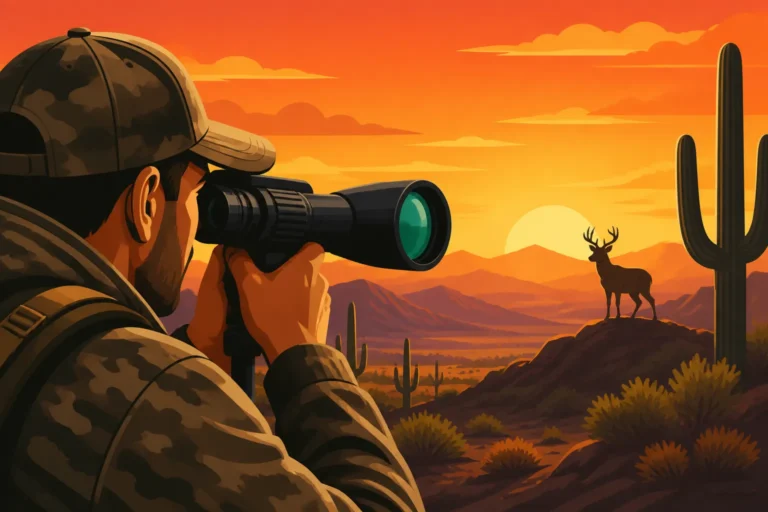
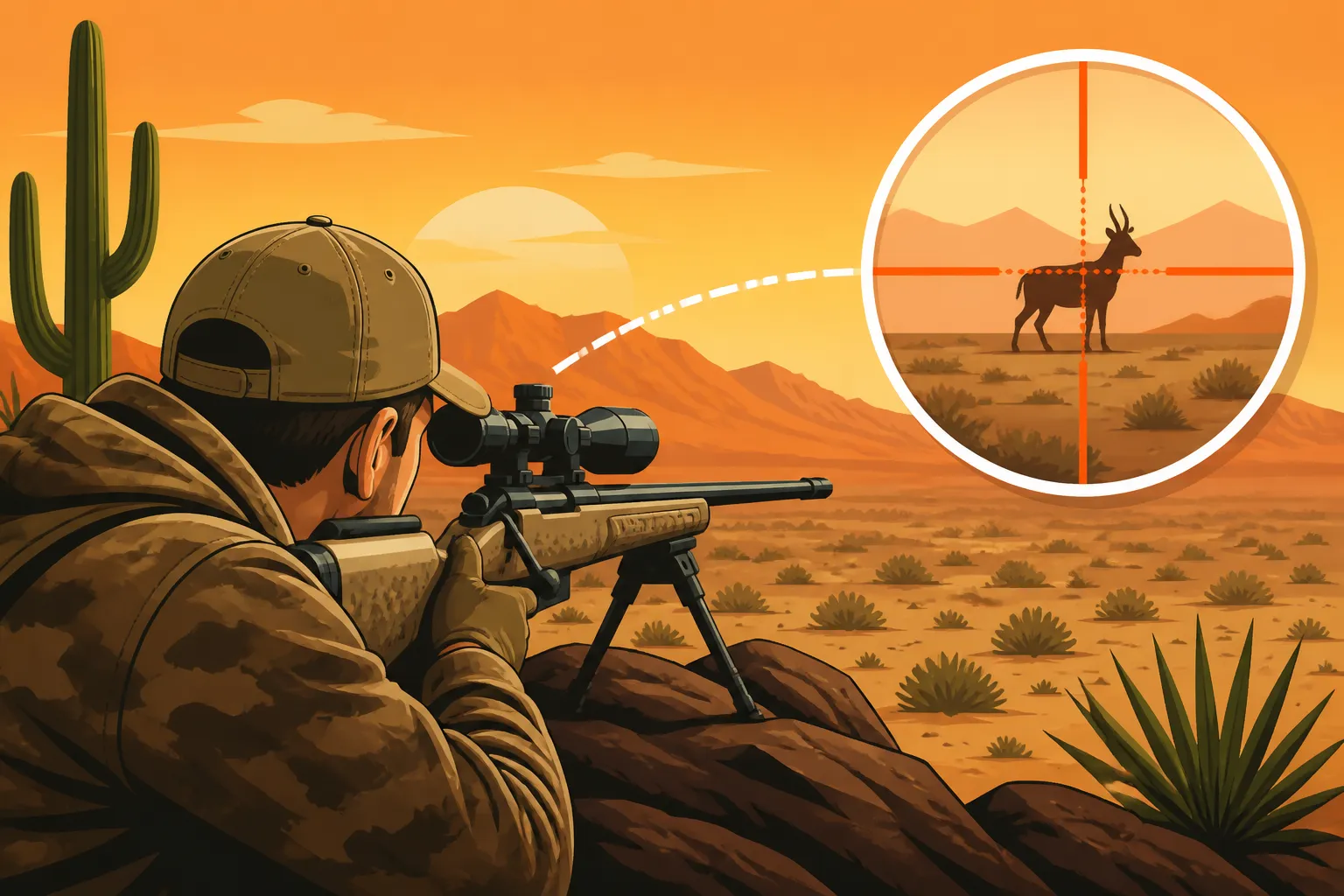
One of the most vexing challenges for any hunter venturing into Arizona's vast, open desert is the sheer distance. Unlike timbered country where shots are often measured in yards, here in the desert, those yards quickly turn into hundreds, and what felt like a manageable zero back home can leave you scratching your head when a nice mule deer steps out at 400. This guide will walk you through how to properly zero your rifle for those wide-open spaces, helping you build confidence in your shot when it truly counts.
The Unique Demands of Open Desert Shooting
Hunting in Arizona's desert isn't just about spotting game; it's about being prepared for the shot that might present itself at ranges far beyond what many hunters are accustomed to. The terrain is often flat, broken only by low-lying brush, washes, and distant hills, meaning animals can appear across incredible expanses. What looks like a short shot through the scope might actually be 350 yards, and that's where a traditional 100-yard zero can quickly get you into trouble. You're constantly battling gravity and wind, which become far more significant factors as the distance stretches out. This isn't your grandfather's deer stand in the Midwest; this is a place where every variable gets magnified, and understanding your rifle's capabilities at these extended ranges is paramount to ethical hunting.
Why Standard Zeroes Fall Short
Many hunters grow up with the adage of a 100-yard zero, and it's a perfectly valid starting point for many hunting scenarios. However, in the vastness of Arizona's desert, relying solely on a 100-yard zero can create unnecessary complications and increase the potential for a missed shot or, worse, a wounded animal. The primary issue is bullet drop. With a 100-yard zero, your bullet starts dropping significantly past that mark. This means you're constantly holding over, making estimations that can be tricky under pressure, especially when adrenaline is high and you're trying to calculate holdovers on the fly. The mental gymnastics required to remember your specific bullet's drop at 200, 300, or even 400 yards, while simultaneously trying to estimate distance and account for wind, can lead to mistakes.
Another often overlooked factor is the velocity difference due to temperature. Arizona's desert temperatures can fluctuate wildly, from scorching summer scouting trips to crisp fall mornings. Higher temperatures can slightly increase muzzle velocity, while colder temperatures can decrease it. While this might seem minor, over long distances, these small changes can alter your point of impact enough to make a difference. A precise zero needs to account for the environment you'll be hunting in, not just the controlled conditions of a shooting range at home. Moreover, the lack of immediate backstops or clear indicators in open country means confirming your shot placement after the fact can be difficult without a reliable zero and good spotting.
Understanding Ballistics in Arid Environments
Before you even touch your rifle, it's crucial to grasp the fundamental ballistic principles that govern bullet flight, especially in an environment like the Arizona desert. A bullet doesn't fly in a straight line; it follows a parabolic arc, constantly battling gravity and air resistance.
The Impact of Altitude and Temperature
Arizona's hunting grounds span a wide range of elevations, from the low deserts around Phoenix to the high plateaus and mountains like the Mogollon Rim. Air density decreases with increasing altitude and temperature. Thinner air offers less resistance to the bullet, allowing it to maintain velocity for longer and therefore shoot "flatter" than it would at sea level or in colder conditions. This means a rifle zeroed at sea level might shoot slightly high in the higher elevations of Arizona. While the difference might be negligible at 100 yards, it becomes more pronounced at 300-400 yards. Always try to zero your rifle as close as possible to the average altitude and temperature you expect to encounter during your hunt. If you're planning an elk hunt up on the Kaibab Plateau, zeroing at 7,000 feet near Flagstaff is going to be far more effective than zeroing at 1,000 feet down in the desert.
The Ever-Present Challenge of Wind
If there's one thing the open desert has in abundance, it's wind. Even a slight breeze can push a bullet off course significantly at longer ranges. Understanding how wind affects your specific bullet is critical. Heavier, higher ballistic coefficient (BC) bullets tend to drift less than lighter, lower BC bullets. However, even the best bullets will be moved by the wind. Estimating wind speed and direction accurately across a wide canyon or an expansive flat is one of the most difficult skills to master. Wind doesn't always blow uniformly from one direction; it can swirl, gust, and change intensity across the bullet's flight path. This is where diligent practice and understanding your rifle's trajectory become invaluable. Tools like a Kestrel wind meter can provide real-time data, but learning to read the wind through vegetation, dust, or even mirage is a skill developed over countless hours in the field. Remember, for every 10 mph of full-value crosswind, you could be looking at inches of drift at 300 yards, turning into feet at 500 yards. This is why learning to judge wind is as crucial as knowing your bullet drop; perhaps even more so when considering "Holding for Wind Across a Wide Canyon".
Optimizing Your Zero for Long-Range Desert Shots
Given the distances often encountered in the Arizona desert, a "maximum point blank range" (MPBR) zero or a slightly extended zero (like 200 or 250 yards) is often far more practical than a traditional 100-yard zero. The goal here is to keep your bullet's trajectory within a certain acceptable vertical deviation (often +/- 3 inches for big game, meaning a 6-inch kill zone) over the longest possible range without needing to hold over or under significantly.
The Maximum Point Blank Range (MPBR) Concept
The MPBR zero is designed to keep your bullet within a specified vital zone (e.g., a 6-inch diameter circle representing the vitals of a deer or elk) from the muzzle out to the furthest distance possible. To achieve this, your bullet will be sighted in to hit slightly high at mid-range, peak, and then fall back down into the vital zone before dropping out of it. This strategy allows for simple "point and shoot" engagements on game out to a significant distance, often eliminating the need for complex holdover calculations on typical hunting shots.
For example, many popular big game cartridges like a .30-06 Springfield or a .300 Win Mag, when zeroed for MPBR, might be sighted in to hit 2-3 inches high at 100 yards. This effectively pushes their maximum "point blank" range out to 250-300 yards or even more, depending on the cartridge and bullet choice. You can use online ballistic calculators or apps to determine the optimal zero distance for your specific rifle, ammunition, and desired vital zone size. Websites and apps from companies like Hornady, Federal, or even generic ballistic calculators are excellent resources. They help you input your bullet's ballistic coefficient, muzzle velocity, and sight height, then simulate trajectory, allowing you to fine-tune your zero. This preparatory work can be done from the comfort of your home, and then verified at the range.
Choosing Your Zero Distance
While MPBR is excellent, some hunters prefer a static 200 or 250-yard zero because it simplifies things, especially if they are comfortable dialing their scope or using ballistic reticles.
Here’s a breakdown of common zero choices for desert hunting:
| Zero Distance (yards) | Pros | Cons | Ideal Use Case |
|---|---|---|---|
| 100 yards | Very precise at close range | Requires significant holdover/dialing past 200 yards | Thick brush, timbered areas (rare in open desert), short-range varminting. |
| 200 yards | Flatter trajectory, minimal holdover to 250 | Still requires some holdover/dialing past 300 yards | General purpose desert hunting, good balance for varied terrain, often a good zero for a cartridge like a 6.5 Creedmoor or a .308 Winchester. |
| 250 yards | Very flat out to 300-350 yards | Hits high at closer ranges (e.g., 2-3" high at 100 yards) | Most common for large, open desert units targeting deer or elk. Excellent for cartridges like a .270 or .30-06. |
| MPBR (e.g., 300+ yards) | Maximize point-and-shoot distance | Bullet path may be significantly high mid-range; needs verification | True long-range hunting, when precise ranging equipment is always available, and you're confident in your setup. |
For many Arizona desert hunts, especially for animals like mule deer or even Coues deer, a 200-250 yard zero often strikes the best balance. It keeps your bullet relatively flat for shots out to 300-350 yards, which covers a significant portion of typical desert hunting scenarios. For anything beyond that, you should be using a rangefinder and either dialing your turrets or using specific holdovers on a ballistic reticle. This kind of preparation goes hand-in-hand with "E-Scouting an Arizona Unit Before the Season", allowing you to anticipate potential shot distances.
Practical Application and Field Adjustments
Once you've decided on your zero distance, the real work begins at the range. Don't just show up and expect to be sighted in within a few shots. Precision takes time, patience, and attention to detail.
The Importance of a Solid Zero
When you head to the range to establish your zero, don't rush it. Use a solid rest – sandbags, a bipod, or a lead sled – to eliminate as much human error as possible. Shoot at least three-shot groups, letting your barrel cool between groups, especially with lighter profile barrels which can walk as they heat up. The goal is consistent, repeatable groups. If your groups are inconsistent, it's not the zero that's the problem; it's fundamental shooting technique or equipment issues. Remember, a tight 1-inch group at 100 yards becomes a 3-inch group at 300 yards. Knowing your rifle's mechanical accuracy is crucial.
After you've established your desired zero, it's absolutely vital to verify that zero at other distances. If you've zeroed at 200 yards, shoot a group at 100 yards to see where it impacts. Then, if possible, shoot at 300 or 400 yards to verify your ballistic calculator's predictions. This gives you invaluable real-world data and confidence. Using a ballistic app like those found on the GoHunt platform can help you predict these impacts, but always verify them with live fire. It’s also important to confirm your zero after traveling to your hunting area, as bumping scopes or changes in temperature/altitude can subtly shift your point of impact.
Dealing with Environmental Factors
Even with a perfect zero, the desert environment will throw curveballs. Mirage, for instance, is a common phenomenon where heat waves rising from the ground distort the image through your scope. It can make a target appear to shift, making precise aiming incredibly difficult. Learning to shoot when the mirage is least impactful (early morning or late evening) or aiming through the upper third of the mirage can help. Again, the more you practice in varied conditions, the better you'll become at recognizing and compensating for these factors.
Wind, as mentioned, is the biggest challenge. Invest in a good rangefinder that can provide not only distance but also angle compensation if you're shooting up or down a slope. A small, portable Kestrel weather meter can give you real-time wind speed and direction, which you can then input into your ballistic calculator. It's a game-changer for those longer shots. Also, consider the specific terrain; a shot across a wash might have different wind dynamics than one across an open flat. You'll want to practice "Holding for Wind Across a Wide Canyon" to truly understand its effects. Many hunters find using onX Layers for Arizona Public Land helpful not just for navigation but also for identifying potential shooting lanes and understanding terrain that might funnel or block wind.
Ultimately, ethical long-range hunting in the desert requires a combination of precise equipment, a meticulous zero, extensive practice, and a deep understanding of external ballistics. Don't push your limits beyond what you've confidently practiced. Knowing when to pass on a shot that's too far or too windy is the mark of a truly responsible hunter.
Disclaimer
The information provided in this guide is for educational purposes only and is not a substitute for professional instruction. Always consult the most current Arizona Game and Fish Department regulations before hunting. Ensure you understand and comply with all local, state, and federal laws. Safety should always be your top priority when handling firearms.