How Arizona Bison Tags Are Allocated
Dreaming of an Arizona bison hunt is a powerful vision for any hunter, but actually securing one of those incredibly coveted tags often feels less like a dream and more like trying to decipher an ancient scroll. The reality is, Arizona bison tags are among the rarest and most sought-after big game permits in the West, leading to a lot of confusion and frustration for those looking to apply. This comprehensive guide is here to demystify the allocation process, breaking down everything you need to know about how these once-in-a-lifetime opportunities are distributed, from application to draw.
Understanding Arizona's Bison Hunting Opportunity
Hunting bison in Arizona isn't just about pursuing a magnificent animal; it's about connecting with a piece of true American wilderness history. These tags are exceptionally rare, making the application process highly competitive, but the experience of hunting these majestic creatures in their native habitat is unparalleled. Knowing what makes these hunts so unique and where these bison live is the first step in understanding the tag allocation.
The Rarity and Allure of Arizona Bison Tags
Arizona offers a very limited number of bison tags each year, which contributes significantly to their legendary status and low draw odds. Unlike deer or elk tags, which are issued in the hundreds or thousands across various units, bison tags are typically in the single digits for most hunts. This scarcity means that only a handful of hunters will get the chance of a lifetime to pursue a bison in the Grand Canyon State annually. The allure isn't just in the rarity; it's in the immense challenge and reward of taking an animal of this size and power, often in rugged, remote landscapes. It’s a true test of physical endurance, marksmanship, and a deep understanding of wild animals. For many, it's not just a hunt, but a bucket-list adventure that represents the pinnacle of Western big game hunting. This "once-in-a-lifetime" opportunity truly lives up to its name, as drawing a bison tag generally means you won't be eligible to draw another in Arizona.
Where Arizona's Bison Herds Roam
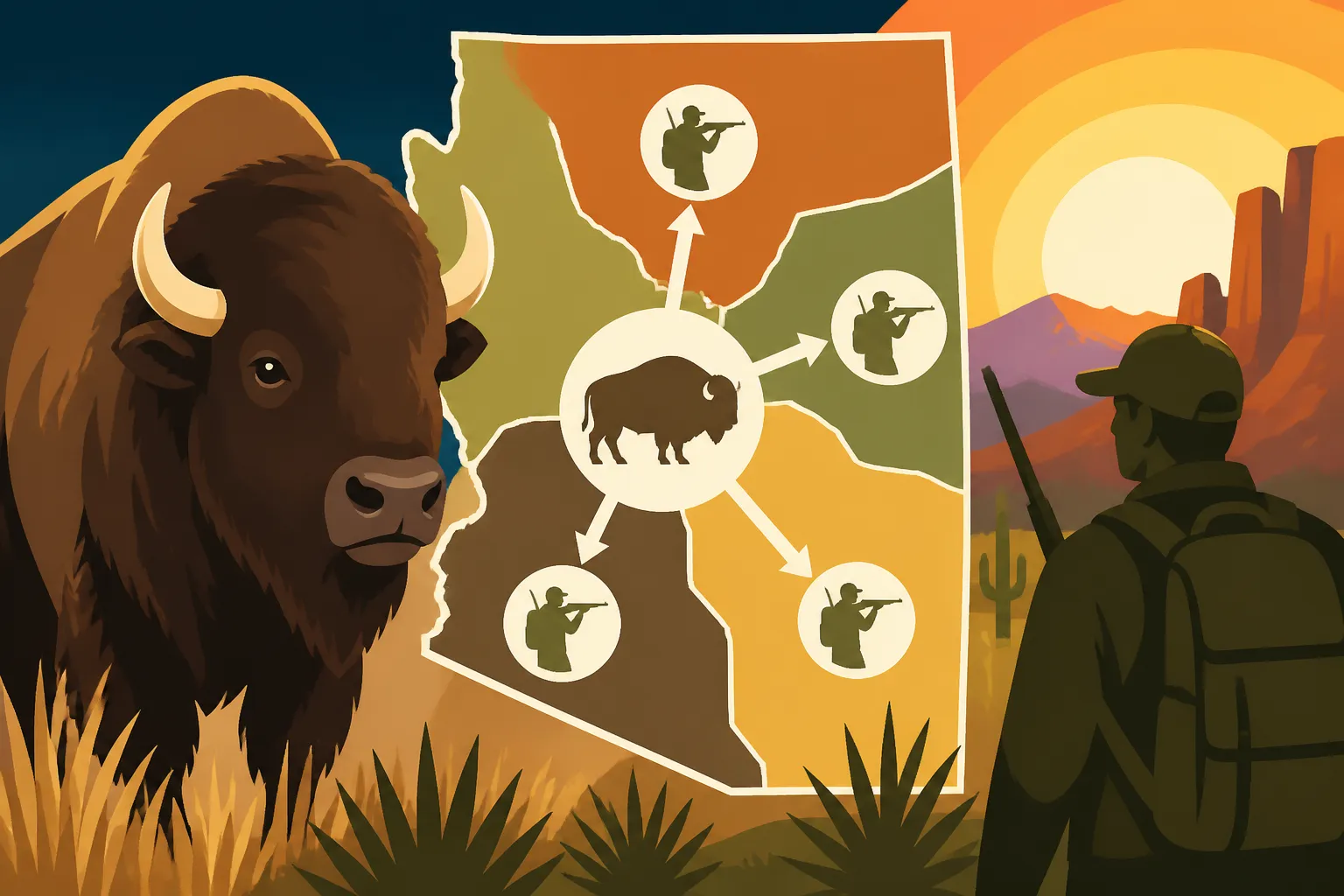
Arizona is home to two primary free-ranging bison herds managed for hunting, each offering a distinct experience and requiring a specific tag:
- House Rock Wildlife Area: Located north of the Grand Canyon, this herd is perhaps the most well-known. These bison roam a vast, mostly unfenced area of juniper, sagebrush, and pinyon-pine country. The hunts here are incredibly challenging due to the expansive terrain, the bison's nomadic nature, and the sheer size of the animals. Hunters often need to cover vast distances, utilizing good optics and a resilient mindset. Tags here are highly coveted and represent a classic Western bison hunting experience. You can find more specific details on "Hunting Bison on House Rock Wildlife Area".
- Grand Canyon National Park Herd: This herd, often referred to as the "North Rim" herd, largely resides within the boundaries of Grand Canyon National Park, specifically in areas along the North Rim and adjacent Kaibab National Forest. While these bison are within the park, which is typically off-limits to hunting, the Arizona Game and Fish Department (AZGFD) partners with the National Park Service for specific, highly controlled hunts designed for population management. These hunts are even more limited and unique, often involving specific logistical requirements and guidance due to the sensitive nature of the park environment. It’s a truly unique opportunity to hunt within the stunning backdrop of one of the world's natural wonders. For more information, consider reading "Bison Inside Grand Canyon National Park".
Each location offers a different terrain, access, and challenge, making detailed research into the specific hunt code and unit crucial once you decide to apply.
Navigating the Arizona Bison Tag Application Process
The journey to an Arizona bison tag begins long before you ever set foot in the field, starting with a meticulous application process. Arizona's draw system is notoriously complex, and bison tags, with their extreme rarity, add another layer of strategic consideration. Missing a deadline or overlooking a small detail can mean another year on the sidelines.
Key Deadlines and Application Windows
Arizona operates on two distinct draw cycles for big game tags, and bison applications fall into both, depending on the hunt. It’s absolutely critical to pay close attention to which cycle your desired bison hunt falls into:
- Spring Bison Hunts: These tags are typically for hunts occurring in the spring months. The application deadline for these often aligns with the February draw cycle, which is primarily for spring elk, turkey, and spring bison. For most hunters, the thought of spring bison conjures images of emerging green-up and still-cold mornings on the North Kaibab or House Rock. You'll need to submit your application well in advance of the early February deadline, usually in January.
- Fall Bison Hunts: These tags are for hunts scheduled for the fall. The application deadline for fall bison hunts typically falls within the June draw cycle, alongside deer, bighorn sheep, and fall elk. This means applications are usually due in May. The fall hunts often coincide with cooler weather and potentially more concentrated animals as they move into winter ranges, though this varies greatly by year and location. Understanding "Arizona Fall Bison Against Spring Bison Hunts" can help you decide which season best fits your hunting style and goals.
The AZGFD publishes its hunt regulations booklet well in advance of each application period, which is your ultimate source for exact dates. Always double-check the current year's regulations on the official AZGFD website, because dates can shift slightly from year to year. Missing the application window by even an hour means no bison tag for you that year, regardless of your bonus points.
Application Requirements and Fees
Applying for an Arizona bison tag, like any other big game tag, requires a few crucial components:
- Arizona Hunting License: First and foremost, you must possess a valid Arizona hunting license. For non-residents, this is a significant upfront cost ($160 as of recent years) that is non-refundable. You can’t even apply for the draw without this license in hand. Residents pay a much lower fee.
- Application Fee: There is a non-refundable application fee for each species you apply for. For bison, this is typically around $15. This fee covers the administrative costs of processing your application.
- Tag Fee (Contingent): This is where it gets interesting and can be a source of anxiety for many. When you apply for a bison tag, you are essentially pre-authorizing the state to charge your credit card the full tag fee if you are successful in the draw. For a non-resident bison tag, this can be substantial, often in the range of $1,000 to $1,500. For residents, it's considerably less, but still a significant sum. This means you need to ensure you have sufficient funds available on your card at the time of the draw to cover the tag fee. If your card declines, you forfeit the tag, and it goes to the next applicant. It's a cruel twist of fate for those who have waited years to draw! Understanding "The All-In Cost of an Arizona Nonresident Elk Hunt" can give you a sense of other big game costs, though bison are generally higher.
It’s a good practice to research draw odds and historical data before applying, which resources like GoHunt can provide, helping you make informed decisions about whether to apply for a particular hunt or build more points. They often break down "Arizona Bison Draw Odds" by unit and applicant type, offering valuable insights.
The Arizona Bison Draw System Explained
Arizona's draw system is a hybrid bonus point and random draw. While the state aims for fairness, the sheer demand for bison tags means that drawing one is still a long shot for most, even with many bonus points. Understanding how this system works is key to managing your expectations and strategizing your applications.
How Bonus Points Influence Your Chances
Arizona uses a bonus point system that significantly favors applicants with more points, especially for highly desirable tags like bison. Here’s how it generally works:
- Earning Points: You earn one bonus point for each year you apply for a species and are unsuccessful. If you don't want to hunt a specific year but still want to build points, you can choose to apply for a point-only option. There are also opportunities to earn bonus points through courses like "The Ethically Hunting Arizona Course Earns a Permanent Point".
- Point Pass: For highly allocated hunts like bison, the system typically dedicates a portion of the tags to a "point pass." This means a percentage of the available tags (often 20%) are allocated strictly to the applicants with the most bonus points. For bison, where so few tags are available, this pass is absolutely crucial. If you have 20+ points, you have a vastly better chance here than someone with only a few.
- Random Pass: After the point pass, the remaining tags are allocated in a random draw. In this phase, every applicant (including those who didn't draw in the point pass) receives one entry, plus an additional entry for each bonus point they possess. So, if you have 10 points, you get 11 entries in the random draw. While still random, having more points statistically increases your odds in this phase as well.
- Species Specificity: It's vital to remember that bonus points are species-specific. Your 15 elk points won't help you draw a bison tag; you need bison-specific points. This is why "Why Arizona Bonus Points Never Cross Species" is a critical concept to grasp when applying for different big game species.
For bison, the number of tags is so low that even hunters with a substantial number of points might wait decades. It’s truly a long game, demanding patience and persistence.
Non-Resident Quotas and Group Applications
Arizona has specific rules that impact non-residents and those applying as a group, further shaping the bison tag allocation:
- Non-Resident Cap: Arizona law mandates that no more than 10% of any species' tags can be allocated to non-residents. For bison, where tags are already in single digits, this often means only one non-resident tag (or sometimes none) is available for an entire hunt series. This makes drawing a non-resident bison tag exponentially harder. This cap is a major factor in "Arizona Caps Nonresidents at Ten Percent of Every Hunt".
- Group Applications: You can apply for a bison tag as part of a group application. When applying in a group, the AZGFD averages the bonus points of all applicants in the group. For example, if one hunter has 10 points and another has 0, their group application would have an average of 5 points. This means that if you're a high-point holder, applying with a low-point partner will effectively lower your chances in the draw. Conversely, if you're a low-point holder, applying with a high-point partner will boost your chances. This strategy is often used by families or friends who want to hunt together, but for extremely rare tags like bison, most serious applicants prefer to apply solo to maximize their individual point advantage. It’s a trade-off between hunting with a buddy and maximizing draw odds.
Spring vs. Fall Bison Hunt Tag Allocation
While the general draw mechanics remain consistent, the specific tag allocation can vary between spring and fall bison hunts, largely due to management objectives and herd locations.
- Spring Hunts: These hunts are often geared towards specific management goals, sometimes targeting certain age classes or sexes to maintain herd health and population balance. The number of tags might be slightly higher or lower depending on the previous year's harvest and population surveys. Early season conditions can also be a factor, with bison potentially more spread out or in different areas compared to later in the year. The experience can be quite different, with spring's unpredictable weather and budding flora.
- Fall Hunts: Fall hunts typically align with more stable weather conditions and often target animals as they prepare for winter. The bison might be more concentrated in specific areas, which can influence hunting strategies. The tag numbers for fall hunts are also determined by annual herd assessments. It's not uncommon for AZGFD to allocate different numbers of tags, or even different types (e.g., bull vs. cow), between the spring and fall seasons based on detailed wildlife management plans. For specific details on these variations, carefully consult the current year's "Arizona Bison Hunt Codes Explained" (though specific to elk, the principle of hunt codes defining details is the same for bison).
It's crucial to study the specific hunt codes in the annual regulations to understand the nuances of each potential tag—whether it's an any-bison, bull-only, or cow-only tag, as well as the season dates and unit boundaries.
After the Draw: The Next Steps for Bison Hunters
The draw results are a moment of intense anticipation for every hunter, but especially for those chasing an Arizona bison tag. Whether you're successful or not, there are distinct next steps to take. The elation of drawing is quickly followed by the need for meticulous planning, while an unsuccessful draw means resetting your strategy for the future.
Notification of Success and Tag Fees
If you are one of the incredibly fortunate few to draw an Arizona bison tag, congratulations! The notification process typically goes like this:
- Email Notification: AZGFD will usually send out email notifications to successful applicants shortly after the draw results are finalized. This email will confirm your successful draw and often include initial instructions.
- Credit Card Charge: This is often the first real indicator of success, even before the email. As mentioned earlier, if you draw, the full tag fee (e.g., $1,000-$1,500 for non-residents) will be charged to the credit card you provided during the application process. Keep a close eye on your bank account around the time draw results are scheduled to be posted. For many, seeing that charge come through is when the reality truly sets in. This charge usually happens around the time "When Arizona Charges Your Card for a Tag" is communicated by AZGFD.
- Online Portal Update: Your AZGFD online portal account will also be updated to reflect your draw success. This is typically where you can print your tag and other necessary documents. It’s a good habit to check your portal regularly once draw results are expected.
- Tag Delivery: While some states mail physical tags, Arizona often allows you to print your tag directly from your online portal. Make sure you understand the requirements for carrying and validating your tag in the field.
Once you have that tag in hand, the real work begins. You'll need to immediately dive into detailed hunt planning, including scouting (e-scouting initially, then potentially in person), understanding access points, and preparing physically and mentally for a demanding hunt. Resources like GoHunt can be invaluable for detailed unit analysis and creating a strategy.
What to Do If You Don't Draw a Bison Tag
For the vast majority of applicants, the outcome of the bison draw will be disappointment. This is simply the reality of applying for such rare tags. But an unsuccessful draw doesn't mean the end of your hunting aspirations; it means it's time to refine your strategy:
- Earn Your Bonus Point: The most immediate consolation prize is earning another bonus point for that species. This point accumulates and increases your odds for future draws. Remember, it's a long game for bison, and every point counts.
- Review Draw Odds: Take the time to review the draw odds for the current year. Websites like GoHunt publish detailed draw statistics for all Arizona hunts, breaking down success rates by number of points, resident/non-resident status, and specific hunt codes. Analyzing this data can help you understand why you didn't draw and inform your strategy for the next year. It might reveal that certain hunt codes are slightly less competitive, or that you're still several points away from a realistic chance.
- Consider Leftover Tags (Unlikely for Bison): While highly, highly improbable for bison, Arizona does sell leftover tags for some species after the main draw. These are usually tags that were either not applied for or were drawn but then declined (often due to credit card issues). Bison tags are almost never available as leftovers due to demand, but it's always worth checking "When Arizona Surplus Tags Go on Sale", just in case a miracle happens.
- Plan for Next Year: Start planning your application for the following year. Decide if you want to continue accumulating points for bison, or if you want to shift your focus to another species. Patience and persistence are key when chasing Arizona bison. Many successful applicants have been applying for 20+ years, so settling in for the long haul is part of the process. Remember, "What Happens to Arizona Points When You Draw" is that your points for that species are reset to zero, so cherish them while you have them!
Here's a quick overview of Arizona's bison hunting opportunities:
| Hunt Type | Primary Location | Season Timing | Typical Tags/Year (Est.) | Average Draw Odds (Low Point) | Key Challenge |
|---|---|---|---|---|---|
| Spring Bison Bull | House Rock / N. Kaibab | March – April | 1-3 | <0.1% | Extreme rarity, vast terrain, unpredictable weather |
| Spring Bison Cow | House Rock / N. Kaibab | March – April | 1-5 | <0.2% | Extreme rarity, vast terrain, finding specific animals |
| Fall Bison Bull | House Rock / N. Kaibab | Oct – Nov | 1-2 | <0.1% | Extreme rarity, rugged canyons, potential early snow |
| Fall Bison Cow | House Rock / N. Kaibab | Oct – Nov | 1-3 | <0.2% | Extreme rarity, herd movement, identifying cows |
| Grand Canyon Permit | Grand Canyon NP (North) | Specific windows | 1-10 (Management) | <0.1% | Restricted access, strict rules, unique logistics |
Note: Tag numbers and draw odds are estimates and fluctuate annually based on population surveys and management objectives. Always consult current AZGFD regulations for precise details.
Disclaimer
Please remember that hunting regulations, seasons, and application procedures in Arizona are subject to change. While every effort has been made to provide accurate and up-to-date information in this guide, it is your responsibility as a hunter to consult the most current Arizona Game and Fish Department (AZGFD) hunting regulations booklet and their official website before applying or heading afield. This guide is for informational purposes only and should not be considered a substitute for official AZGFD documentation.