How Elk Herds Recover After a Burn
When you see the devastating images of wildfires tearing through Arizona's magnificent forests, consuming vast tracts of prime elk country, it's natural to feel a pang of worry, perhaps even despair, for the wildlife that calls those places home. We've all watched the news, seen the plumes of smoke, and wondered what that means for our beloved elk herds. This guide aims to pull back the curtain on the natural process of ecological recovery and provide a realistic look at how resilient Arizona's elk can be, even after the most intense infernos.
The Immediate Impact of Wildfire on Elk and Their Habitat
It’s a tough pill to swallow to witness a landscape you cherish, a place where you've spent countless hours glassing or calling, suddenly engulfed in flames. The immediate aftermath of a wildfire is undeniably brutal, and the first thought for many of us is, "What about the elk?" Their world is turned upside down in an instant, and the effects are far-reaching, from their physical safety to their long-term survival strategies.
Initial Disruption and Displacement
When a fire ignites and begins its march across the landscape, elk are forced to make immediate and drastic decisions. Their instinct for self-preservation kicks in, and they will move, often rapidly, to escape the advancing flames and smoke. This isn't just a casual stroll to a new feeding ground; it's a frantic evacuation that disrupts every aspect of their lives. Traditional bedding areas, known travel corridors, and preferred water sources become unusable or dangerous. Imagine having your entire pantry, bedroom, and bathroom suddenly vanish—that's the scale of disruption for these animals.
This displacement isn't just physical; it's deeply stressful. Elk are creatures of habit, relying on established routines and a deep knowledge of their home range. When they're pushed into unfamiliar territory, they're more vulnerable to predators, both four-legged and two-legged. They might encounter competing elk herds, or simply struggle to find adequate resources in areas already supporting their own populations. Their social structures can be thrown into disarray, particularly for cows with young calves or during the rut when bulls are establishing dominance. It's a chaotic time for them, and it takes a toll.
Loss of Shelter and Forage
Beyond the immediate threat of the fire itself, the most profound impact is the destruction of their habitat. Mature timber, especially in high-elevation areas like the Mogollon Rim or the White Mountains, provides crucial thermal cover. This dense canopy offers shade during the blistering Arizona summers, helping elk regulate their body temperature, and provides a barrier against harsh winter winds and heavy snow. When these forests burn, that essential cover is gone, leaving elk exposed to the elements.
Furthermore, a significant portion of their immediate food supply can be incinerated. While elk are adaptable browsers and grazers, the sudden loss of preferred browse, understory vegetation, and even crucial mast crops can lead to immediate nutritional stress. Water sources, already a precious commodity in Arizona, can become choked with ash and debris, making them undrinkable or inaccessible. The very foundation of their existence—food, water, and shelter—is compromised, and it's this loss that often leaves hunters feeling the most concerned for the herds.
The Regenerative Power of Fire and New Opportunities for Elk
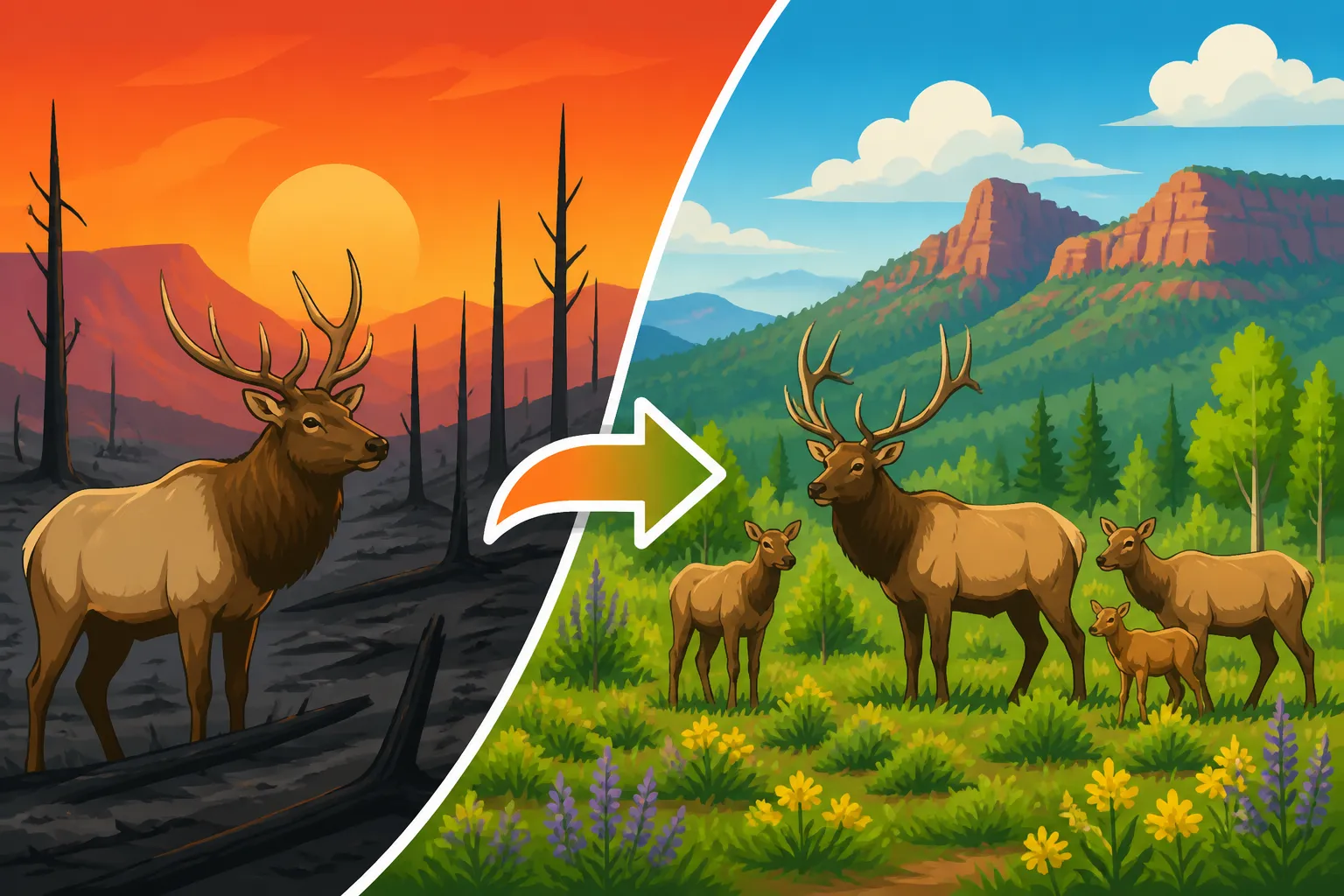
While the initial scene of a burned landscape can be stark and desolate, it's important to remember that fire is a natural and often necessary component of many ecosystems, particularly in the West. Nature has an incredible capacity for renewal, and within months, or even weeks, of a fire burning out, the regenerative process begins. For elk, these renewed landscapes can surprisingly offer new and improved opportunities, a testament to their adaptability and the land’s resilience.
Nutritional Boost from Early Successional Plants
One of the most significant benefits of wildfire, from an elk's perspective, is the massive nutritional boost that follows. Fire clears out the old, dense undergrowth, allowing sunlight to penetrate the forest floor like never before. This influx of light, combined with nutrient-rich ash from the burned vegetation, acts like a powerful fertilizer. Soon, a vibrant tapestry of early successional plants begins to emerge—fresh grasses, succulent forbs, and tender young shrubs.
These new growths are often far more palatable and digestible than the mature, lignin-heavy vegetation they replace. They burst with protein and essential minerals, providing a critical dietary surge for elk. Cows, in particular, benefit from this enriched forage, leading to better body condition, which directly translates to healthier calves and higher conception rates. It’s not an overnight transformation, but the change can be dramatic enough to see elk actively seeking out these burn areas for feeding. How Monsoon Rain Affects Antler Growth often plays a key role in accelerating this new growth, turning a scarred landscape green with life.
Improved Access and Visibility
For an animal the size of an elk, dense, overgrown forests can be challenging to navigate. Thick timber and tangled brush, while offering cover, can impede movement. A wildfire, by clearing out much of this understory, can paradoxically make it easier for elk to move through areas that were once impenetrable. Travel corridors can become more open, allowing them to access new pockets of forage or move more efficiently between bedding and feeding sites.
Of course, this improved visibility is a double-edged sword, especially for hunters. While elk might find it easier to move, they also become more visible. This is where a hunter's skills in using optics and Glassing Grids for Arizona Coues Deer (a technique applicable to any open country) become even more crucial. Elk might adjust their patterns, perhaps feeding more heavily in burned areas during low-light hours or seeking the small, unburned pockets for cover within the larger burn. Understanding these nuanced behaviors is key to finding success in post-fire landscapes.
Patchwork Habitat and Increased Biodiversity
Perhaps the most fascinating aspect of post-fire recovery is the creation of a "patchwork habitat." Wildfires rarely burn uniformly. Instead, they leave a mosaic of intensely burned areas, moderately burned sections, and often significant unburned pockets, fingerling stretches of timber along drainages, or islands of green on north-facing slopes. This unevenness, while appearing random, is incredibly beneficial for wildlife.
This mosaic increases habitat biodiversity. Elk can find refuge and thermal cover in the unburned sections, then quickly move into the newly regenerated areas for prime feeding. This offers a balance of security and sustenance within a relatively small area. A truly healthy ecosystem isn't a monoculture; it's a diverse landscape, and fire helps create that diversity, encouraging a broader range of plant and animal life. This dynamic environment can actually support a greater number of elk in the long run than a stagnant, overly dense forest. Water Development Projects Built for Wildlife in or near these patchwork zones can further enhance their value.
Long-Term Recovery and Management Strategies
The recovery of an elk herd and its habitat after a wildfire isn't a quick sprint; it's a marathon that plays out over years and even decades. But understanding this longer timeline, and the strategies employed to aid it, can offer a lot of perspective and hope. Our game and fish biologists are constantly monitoring, assessing, and adapting, ensuring that these iconic animals continue to thrive.
Timeframes for Habitat Restoration
The speed and nature of habitat restoration are highly dependent on several factors: the intensity of the burn, the pre-fire vegetation type, soil conditions, and crucially, post-fire weather patterns. A low-intensity ground fire in a ponderosa pine forest might see significant understory regrowth within a year or two, with mature trees surviving and providing shade. A high-intensity crown fire that incinerates everything in a mixed-conifer forest will take much longer, potentially decades, for the timber component to return to its former glory.
However, the rapid growth of grasses and forbs, so critical for elk forage, can be seen in the very next growing season, especially with favorable monsoons. Trees that re-seed or sprout from existing roots will take years to reach substantial size, but even young saplings begin to offer some cover. Human intervention through reseeding efforts, planting, or even controlled burns in adjacent areas can help accelerate the process, but largely, it's nature's clock that dictates the pace.
Adaptive Elk Behavior and Population Dynamics
Elk are incredibly adaptable creatures, and their survival through countless natural disturbances, including fires, is a testament to this resilience. They will quickly learn where the new food sources are, where the remaining cover lies, and how to navigate the altered landscape. Their movements might shift, with traditional migration routes or seasonal ranges being temporarily or even permanently altered. As hunters, understanding these shifts is key. Tools like GoHunt provide valuable insights into changes in unit usage and animal behavior after major events, helping us adapt our scouting and hunting plans.
While a severe fire can cause an initial dip in elk populations due to stress, displacement, or direct mortality (though direct fire mortality is often lower than perceived, as elk typically flee effectively), the improved forage quality in the long run often leads to a rebound. Better nutrition supports stronger cows and higher calf survival rates. Game agencies closely monitor these population dynamics through aerial surveys, field observations, and harvest data. They use this information to inform future hunt allocations, ensuring sustainable management practices. How Biologists Count a Desert Big Game Herd is a continuous effort that becomes even more critical after a major event.
Human Role in Post-Fire Management
Arizona Game and Fish Department, along with federal land management agencies like the Forest Service and BLM, play a critical role in post-fire recovery. Their efforts go beyond simply monitoring; they actively engage in habitat restoration. This might include emergency stabilization efforts to prevent erosion, reseeding native plant species, removing hazardous snags that block access, or developing new water sources. Reading a Herd Unit Management Plan will often show how these efforts are integrated into broader strategies for specific areas.
For hunters, it means that while the landscape has changed, the commitment to the resource has not. The department relies on our license and tag fees to fund many of these critical conservation efforts. By studying current regulations and hunt unit reports, hunters can gain a deeper understanding of how specific fires have impacted their chosen units and what management actions are underway. This collective stewardship is what ensures the future of Arizona's spectacular elk hunting opportunities.
Scouting and Hunting Considerations in Burned Areas
As hunters, our relationship with the land is deeply personal. A wildfire changes that relationship, at least temporarily. But a burn scar isn't necessarily a death knell for a hunting season; it's a challenge, and an opportunity, to learn and adapt. Hunting in a post-fire landscape requires a different approach, a keen eye for detail, and an understanding of how elk exploit these altered environments.
Reading the Burn Scar
The first step in hunting a burned area is to understand the burn itself. Not all fires are created equal. Some are mosaic burns with varying intensity, leaving patches of green and black. Others might be "moonscapes" where everything was incinerated. Start your research by obtaining burn perimeter maps, which are often available from land management agencies or through advanced hunting apps like GoHunt. These maps, when layered over topography and historical elk data, can reveal a lot about where elk might have gone or where they are likely to return. E-Scouting an Arizona Unit Before the Season is more important than ever when dealing with a heavily altered landscape.
Look for patterns. Did the fire burn hotter on south-facing slopes, leaving north-facing slopes relatively untouched? Are there drainages or riparian corridors that acted as natural firebreaks, creating unburned strips of critical cover? Pay attention to elevation changes; sometimes elk are pushed into higher, unburned pockets, or conversely, find new green growth lower down. Understanding the nuances of the burn allows you to predict where the "new normal" for elk habitat might be.
Locating Elk in Regenerated Areas
Elk in a burn scar will inevitably gravitate towards the highest quality forage and the best available cover. This often means focusing your efforts on the edges of the burn, where unburned timber meets new growth. These transition zones offer the best of both worlds: security and food. Look for pockets of unburned timber, especially on north-facing slopes or in deep canyons, which will provide thermal regulation and bedding areas. Elk will use these as sanctuaries, venturing out into the regenerating areas to feed.
Water sources become even more critical in burned landscapes. With less shade, surface temperatures are higher, and elk need to drink more frequently. Ash can contaminate some sources, so finding clean water is paramount. Look for springs, stock tanks, or even ephemeral seeps that weren't impacted by the fire. Observing these water sources, often with trail cameras (always check Trail Camera Rules on Arizona Public Land), can give you invaluable clues about elk movement patterns. When Where Elk Water During Early Archery is a key factor, a burn can make these spots even more magnetic.
Safety and Practical Concerns
Hunting in a burn scar comes with its own set of unique safety concerns and practical challenges. Perhaps the most significant danger is "snags"—burned, dead trees that can fall unpredictably, especially on windy days or after heavy rains. Always be aware of your surroundings, and avoid setting up camp or spending extended periods directly under large standing dead trees. The ground itself can be unstable, with ash and loose soil making footing treacherous, particularly on steep slopes. Washouts and erosion are common, which can alter familiar trails and roads.
Navigation can also be a challenge. With landmarks like specific trees or dense groves gone, the landscape can appear drastically different. Rely heavily on GPS and detailed maps (like those provided by GoHunt with burn overlays) to avoid getting disoriented. The lack of cover means you'll be more exposed to the sun and elements, so planning for adequate water, sun protection, and appropriate layering is crucial. While hunting a burn can be productive, prioritizing safety must always come first.
| Feature | Pre-Fire Environment | Post-Fire Environment | Impact on Elk |
|---|---|---|---|
| Forage | Mature browse, dense understory | New growth: grasses, forbs, young shrubs | Initial loss, then increased nutrition and palatability |
| Cover/Shelter | Dense canopy, mature timber | Reduced canopy, scattered unburned patches | Loss of thermal cover, increased exposure; new cover emerges |
| Water Quality | Generally stable, shaded sources | Potential ash contamination, erosion | Can be compromised, increasing reliance on clean sources |
| Visibility | Limited, dense vegetation | Increased, more open | Easier travel, but also more vulnerable to predators |
| Predation Risk | Moderate, dependent on cover density | Potentially higher due to lack of cover | Elk adapt by using remaining cover or night movement |
| Travel Routes | Established paths, dense areas | More open in some areas, obstructed by snags | New corridors may form, older ones may be blocked |
| Human Access | Dependent on roads/trails | Roads may be closed or damaged, new access | Can be restricted or, in some cases, improved for foot travel |
This article is for general informational purposes only and does not constitute professional advice. Laws, prices and regulations vary by location and change over time. Consult a qualified professional for guidance on your specific situation.