Reading Terrain Before You Pick a Camp
There’s nothing quite like finally pulling into a hunting unit after a long drive, the anticipation thick in the air, only to realize the "perfect" spot you picked for camp on a map is actually a boulder field, a steep slope, or worse, a bone-dry wash prone to flash floods. We've all been there, and it's a frustrating start to any hunt. This guide is all about helping you avoid those headaches by teaching you how to read the terrain like an open book before you ever set up your tent or park your rig, ensuring your Arizona camp is a comfortable, safe, and strategically smart base for your adventure.
Why Terrain is Your Best Camp Companion (or Worst Enemy)
Choosing a campsite in Arizona isn't just about finding a flat spot; it's a calculated decision that can impact your safety, comfort, and ultimately, your hunting success. The wrong terrain can expose you to unexpected dangers, make daily life miserable, or put you miles from where you need to be when the action starts. Understanding how the land lies is foundational to a good camp.
Safety First: Protection from the Elements and Wildlife
Imagine waking up to your tent floating in a sudden downpour, or your entire camp being buffeted by relentless wind, or worse, realizing you've set up right on a game trail that’s now frequented by a curious bear. These aren't just inconveniences; they can be serious safety hazards. Arizona's weather can be extreme and unpredictable, from intense monsoon deluges that turn dry washes into raging rivers in minutes, to high winds that rip through exposed ridges, to baking sun that can make an open camp unbearable. Selecting terrain that naturally offers protection – whether it's the lee side of a ridge for wind, higher ground away from drainages for rain, or shade from a stand of juniper – is paramount. You're not just looking for a place to sleep; you're looking for a temporary sanctuary in the wild.
Beyond the weather, wildlife interaction is another critical consideration. While most animals will give humans a wide berth, setting up camp too close to primary water sources, active game trails, or dense bedding areas can lead to unwanted encounters, especially with bears or javelina, which are often curious and can be destructive if they smell food. By understanding the typical movements and habits of the game in your unit, you can choose a spot that minimizes these risks, keeping both your camp and the wildlife undisturbed. You want to be close to the game, but not in their living room when you're sleeping.
Strategic Advantage: Proximity to Hunt Areas and Water
A smart camp location isn't just safe; it’s a strategic asset. You want your camp to be a functional launchpad for your daily hunts, not a barrier. This means considering how easily you can access your primary hunting areas, whether that's a key glassing point for Coues deer, a bedding area you plan to still hunt, or a water source you intend to sit. Long, arduous walks just to get to your starting point each morning can quickly burn you out, especially in Arizona's rugged, often steep, and unforgiving terrain.
Furthermore, water is life in the desert. While you'll certainly be hauling in your own, knowing the location of natural water sources (even seasonal ones) near your camp can be a huge bonus. Perhaps it's a reliable spring, a stock tank, or even a deep pocket in a wash that holds water after a rain. These aren't just for your emergency use; they also dictate where game will be concentrated. Setting up camp within a reasonable distance, while still far enough not to pressure the animals, gives you flexibility and options. Think of your camp as the hub of your hunting wheel, with spokes reaching out to all the critical areas you plan to scout and hunt.
Comfort and Logistics: Flat Ground, Drainage, and Access
Let’s be honest, after a long day of hiking steep canyons or glassing endless mesquite flats, the last thing you want is to come back to a camp that's a pain to live in. Practical comfort is often overlooked but profoundly impacts your overall experience. Flat ground is crucial for setting up tents, cots, or even parking a camper level. Trying to sleep on a slope quickly gets old, and a slight incline can turn into a mud pit with a sudden downpour if it doesn't drain properly. You need a spot where water will naturally shed away from your sleeping areas, not collect underneath them.
Vehicle access is another big one, especially if you're not backpacking in. Can you get your truck or UTV into the campsite without tearing up the trail or getting stuck? Is there enough room to turn around, unload gear, and park out of the way? Consider the condition of forest roads – they can be rough, rocky, or become impassable mud bogs during wet weather. Reviewing maps like those from Reading an Arizona Forest Service Road Map can give you an early heads-up. Finally, think about the overall flow of your camp: space for a cook area, a place to process game, and simply room to move around without tripping over everything. A well-chosen piece of terrain simplifies all these daily logistics, allowing you to focus on the hunt.
Key Terrain Features to Scout for Your Arizona Camp
Arizona's diverse landscape means that the "ideal" camp spot will look different whether you're chasing Coues deer in the Sky Islands or elk on the Mogollon Rim. However, certain terrain features consistently offer advantages or present challenges that every hunter needs to recognize.
Elevated Ridges and Saddles: Overlooking Your Hunting Ground
Setting up camp on an elevated ridge or a strategic saddle can offer incredible advantages, particularly in glassing-intensive hunts like those for Coues deer. From a ridge, you often have expansive views of the surrounding country, allowing you to scout for game directly from camp during the early morning or late evening hours. This saves you valuable hiking time and puts you in the game as soon as you step out of your tent. These spots can also offer good natural drainage, keeping your camp dry. When planning for a Coues hunt, understanding Spotting Scope Power for Coues Country becomes critical to maximizing this advantage.
However, ridges and saddles aren't without their drawbacks. They are often exposed to wind, which can be brutal, especially during the colder months or during unexpected weather fronts. The higher you are, the more susceptible you are to extreme temperatures and harsh conditions. Water access can also be a significant issue; springs and tanks are typically found in lower elevations, meaning you might have a long haul for water if your ridge camp isn't near a reliable source. Furthermore, while excellent for glassing, a ridge camp can be highly visible to game and other hunters, depending on the cover available. You'll need to weigh the strategic benefits of elevation against the potential for exposure and logistical challenges.
Washes, Canyons, and Drainages: Double-Edged Swords
In Arizona, washes, canyons, and drainages are ubiquitous, particularly in the desert units. These features are incredibly important because they often serve as travel corridors for game and can sometimes hold precious water. Setting up camp near these features can put you in prime position to intercept animals moving from bedding to feeding areas, or simply traveling between water sources. They also often offer excellent concealment and shelter from the wind due to their sunken nature, and the vegetation within them can provide much-needed shade. Consider how Water Sources That Concentrate Arizona Desert Game are often found within these very drainages.
But here’s the critical warning: washes, especially broad, flat ones, are flash flood magnets. During monsoon season or even after a distant storm, a dry wash can become a torrent in moments, sweeping away everything in its path. Never, under any circumstances, set up your primary camp directly in a wash or drainage. Always find higher ground, even if it's just a few feet up on the bank. While a dry wash might seem like a sheltered, flat spot, the risk is simply not worth it. Use them for travel and stalking, but never for sleeping. Learning to recognize the signs of past flood activity – scoured banks, debris high in trees – is crucial.
Timberlines and Rock Formations: Shelter and Concealment
When you're looking for a camp that offers both protection and a low profile, timberlines and large rock formations are your best friends. In the high country, a camp tucked just inside the edge of a ponderosa pine forest offers excellent wind protection, shade from the sun, and concealment from other hunters and game. The forest floor tends to be softer, making for a more comfortable night's sleep, and you're typically on stable ground. The ambient noise of the wind in the trees can also mask small camp sounds, making you less detectable to wary animals.
Similarly, large rock outcroppings, caves, or even just massive boulders can create natural windbreaks and provide shade. In the desert, where tall timber is scarce, these formations become even more valuable. They can help break up the visual outline of your camp, making it harder to spot from a distance. Just be mindful of loose rocks on steep slopes above your camp, as rockfalls can be a real danger, particularly after heavy rains or high winds. Finding that sweet spot where timber or rocks offer cover without creating new hazards is key to a comfortable and secure camp.
Water Sources: A Blessing and a Curse
There’s a natural inclination to camp right next to a water source. After all, it's convenient for cooking, cleaning, and filtering drinking water. In Arizona, where Finding Water in Arizona's Dry Country can be a challenge, this seems like a no-brainer. However, for a hunting camp, proximity to water is a double-edged sword. While it’s essential for your own needs, water sources are also magnets for game. Setting your camp directly on top of a spring or stock tank is generally a poor idea for hunting purposes. You'll constantly be pressuring animals, making them skittish and likely to move on to other, undisturbed areas.
Instead, aim to camp near a water source – within a reasonable walking distance for daily water runs – but far enough away that your presence doesn't completely shut down game activity. This allows you to visit the water silently at prime times (dawn and dusk) or set up an ambush nearby, while your main camp remains a non-threatening presence. It's about finding that balance: accessible for you, but still feeling wild and safe for the animals. Sometimes, the best water source for your camp might be a small, less-frequented seep that doesn't draw in the trophy buck you're after.
Leveraging Technology and Boots-on-the-Ground Scouting
In today's hunting world, our planning arsenals are far more sophisticated than just paper maps, though those are still incredibly valuable. Combining digital tools with real-world reconnaissance is the most effective way to pinpoint your ideal camp location.
Digital Maps and Satellite Imagery: Your Pre-Hunt Reconnaissance
Before you ever put boots on the ground, modern mapping applications like onX Hunt and GoHunt are indispensable for e-scouting potential camp locations. These tools allow you to pore over satellite imagery, which can reveal subtle terrain features that might be missed on a traditional topographic map. You can identify flat benches, dense timber pockets, the flow of washes, and potential access roads. Want to see where a ridge might offer a hidden pocket of trees for cover, or a small flat that's just off a main trail but out of sight? Satellite imagery will show you. These platforms also have public land layers, helping you understand Using onX Layers for Arizona Public Land to avoid trespassing and ensure your chosen spot is legal.
You can drop pins on promising spots, measure distances to key hunting areas, and even track your intended routes for accessing camp. Imagine finding a small, flat mesa top adjacent to a known elk travel corridor. You can use onX Hunt to see if a faint two-track leads up to it, or if it's only accessible via a challenging hike. This level of detail allows for incredibly efficient E-Scouting an Arizona Unit Before the Season, saving you countless hours of driving and hiking once you're actually in the unit. By studying contour lines, aspect, and vegetation types virtually, you can narrow down your options significantly, creating a shortlist of camp possibilities that are likely to be good candidates in person.
Topographic Maps and Contour Lines: Understanding the Lay of the Land
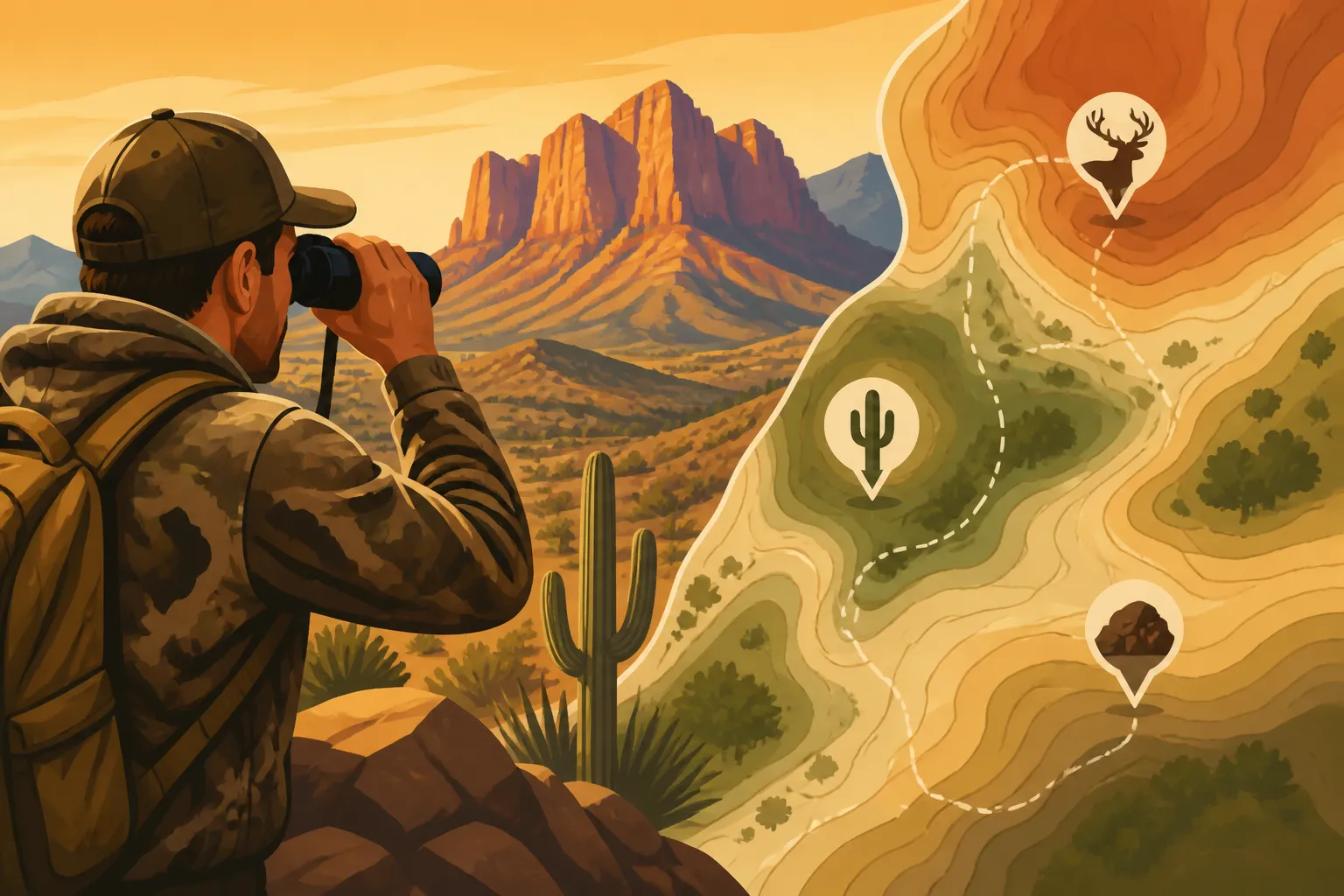
While satellite imagery gives you a visual representation, topographic maps with their contour lines provide the essential understanding of elevation change and slope. A digital topo map, often integrated into apps like onX Hunt or GoHunt, is your key to interpreting the "feel" of the land without being there. Closely spaced contour lines indicate steep terrain – great for hiding, perhaps, but not so good for pitching a tent or setting up a comfortable cooking area. Widely spaced lines suggest flatter ground, much more suitable for a campsite.
Learning to read these lines allows you to identify saddles, benches, and drainage patterns. You can see how water would flow off a particular slope, helping you avoid flood-prone areas. For instance, a small bench or terrace just above a canyon rim might look flat on satellite imagery, but the topo lines will confirm it’s genuinely level and not just an optical illusion. This fundamental skill is crucial for understanding the three-dimensional reality of your hunting unit and ensuring you're not surprised by an unexpected incline or a hidden ravine when you arrive.
Ground Truthing: Confirming Your Digital Discoveries
No amount of digital scouting can fully replace the value of boots on the ground. Satellite images can be old, vegetation can change, and what looks like a perfect flat spot from above might be riddled with rocks, thorny brush, or be surprisingly sloped when you're actually standing on it. This is why a dedicated scouting trip, if possible, is invaluable. You can walk into those pinned locations, kick some dirt, and get a true feel for the ground. Reading a Unit Before You Ever Walk It is a fantastic start, but a follow-up visit truly cements your understanding.
During a scouting trip, you can assess the actual accessibility of the camp, check for reliable water sources, gauge the wind patterns in person, and even look for fresh game sign to confirm your hunting strategy. You can also evaluate things like cell service (a factor to consider if you need to stay in touch, see Cell Coverage Across Arizona Hunt Units) and overall privacy. If a scouting trip isn't feasible, try to arrive a day or two early before the hunt starts. This gives you time to drive or walk into your top two or three potential camp spots and make an informed decision before committing.
Legalities and Regulations: Knowing Where You Can Camp
Before you even dream of pitching your tent, it's absolutely critical to understand the legalities of camping in your chosen unit. Arizona offers a vast amount of public land, including National Forests, BLM land, and State Trust Land, but each comes with its own set of rules. For example, while much of it is open to dispersed camping, some areas may have specific restrictions, such as designated campgrounds or "no camping" zones, especially near developed recreation sites or private property boundaries. Checking the regulations for Camping on Forest Ground During Hunting Season is a good starting point.
Wilderness Areas, while offering incredible hunting opportunities, often have stricter rules regarding mechanized travel and camp size. You'll also need to be aware of any Fire Restrictions During Hunting Season, which are common in Arizona, especially during dry periods. These restrictions can range from no campfires at all to specific types of fuel. Ignorance of the law is no excuse, and unknowingly setting up camp where it's not allowed can lead to fines, frustrating encounters with law enforcement, or even inadvertently pushing game onto private land where you can't pursue it. Always double-check the land management agency's website for the most current information on your specific unit before you go.
Practical Considerations for Setting Up Camp
Once you've identified a promising piece of terrain, the job isn't quite done. The way you actually set up your camp, influenced by the immediate surroundings, can make or break your comfort and efficiency during the hunt.
Water Management: Hauling, Storing, and Filtering
Even if you’ve selected a camp location "near" water, actual water management is an ongoing daily task. In many Arizona units, especially in the desert, you're going to be hauling in the vast majority of your water. This means considering where you can safely store large water containers in camp – ideally in the shade to keep it from getting too hot, and away from curious critters. If you're relying on filtering or treating natural sources, ensure your chosen camp spot has enough nearby vegetation or cover that you can approach the source discreetly without spooking game.
Having a robust filtering system is crucial, as even seemingly clean desert water sources can harbor bacteria. Always treat any natural water before consuming it. Think about the logistics of refilling your smaller daily water bottles – can you do it easily in camp, or will you need to make a trip to your main vehicle cache? And don't forget personal hygiene; a minimal amount of water can make a huge difference in comfort, but all grey water needs to be disposed of properly, away from natural water sources. Understanding just how much Water You Must Carry on a Day Hunt will give you a good baseline for your camp's overall water needs.
Wind, Sun, and Shade: Optimizing for Comfort
Arizona's sun can be relentless, and its winds, particularly during cold fronts, can cut right through you. When picking the exact spot for your tent or cooking area within your chosen terrain, observe the immediate surroundings for natural protection. A stand of trees, a large boulder, or even a slight depression in the ground can offer surprising shelter from the wind. Orient your tent so that its weakest side isn't directly facing the prevailing wind. The opening should ideally be sheltered, allowing you to enter and exit without getting blasted.
Shade is equally vital. Placing your tent and food storage areas in the shade, especially for early season hunts, can make a huge difference in keeping your gear cool and your food from spoiling. Even a few hours of afternoon shade can dramatically lower the internal temperature of your tent, making for a much more comfortable resting place after a long day. If natural shade is scarce, consider bringing a small tarp or shade structure that can be easily set up to create your own oasis. Ignoring these elements can lead to an uncomfortably hot camp, or one where you're constantly battling the elements, distracting you from the real reason you're out there.
Leave No Trace Principles: Minimizing Your Impact
Finally, selecting a camp spot is intrinsically linked to our responsibility as hunters to adhere to Leave No Trace principles. A good camp spot allows you to minimize your impact on the environment. This means choosing durable surfaces for your camp – existing clearings, hard-packed dirt, or rocky areas – rather than disturbing sensitive vegetation. Avoid setting up right next to fragile stream banks or in areas where your presence will cause erosion.
Pack out everything you pack in, and then some. This includes all trash, food scraps, and even human waste (digging catholes at least 200 feet from water, trails, and camp). If you have a campfire (and fire restrictions allow it), keep it small, contained, and use only dead and downed wood. Scatter cold ashes when you leave. The goal is that when you break camp, someone else coming along later wouldn't even know you were there. Our privilege to hunt on public lands comes with a profound responsibility to care for them, and that starts with mindful camp selection and behavior.
| Terrain Feature | Pros for Camp Selection | Cons for Camp Selection | Ideal Use Case |
|---|---|---|---|
| Elevated Ridge | Excellent glassing views, good drainage, natural concealment. | Exposed to wind, long walk to water, highly visible to other hunters. | Glassing-intensive hunts (Coues), when water isn't a major issue. |
| Timber Pocket | Wind protection, shade, good concealment, soft ground. | May have limited views, dense cover can attract wildlife, bug-heavy. | Elk/Mule Deer hunts, cold weather, when concealment is paramount. |
| Flat Bench | Easy to pitch tent, comfortable sleeping, often good access. | Can be exposed to wind/sun, potential for water pooling if not drained. | General-purpose camp, vehicle accessible, comfortable base camp. |
| Dry Wash/Drainage | Shelter from wind, can be hidden, natural game travel routes. | Extreme flash flood risk, often poor drainage, limited views. | Avoid for main camp. Use for temporary cover or stalking only. |
| Near Water Source | Convenient for water collection, strategic for hunting game. | Risks pressuring game, potential for bugs, muddy conditions. | Strategic outpost, with camp set back 200+ yards from water. |
Disclaimer
This article is for general informational purposes only and does not constitute professional advice. Laws, prices and regulations vary by location and change over time. Consult a qualified professional for guidance on your specific situation.