Elevation Bands Worth Understanding in Arizona
One of the biggest eye-openers for new hunters in Arizona, and even a few seasoned ones from other states, is just how dramatically the landscape changes within a single unit, sometimes over only a few miles. You can start your morning sweating in saguaros and end it shivering in ponderosa, all before lunch. This guide will walk you through the critical elevation bands that define Arizona's diverse hunting habitats, helping you understand where to find your quarry and how to adapt your strategies to these distinct high and low environments.
The Layered Landscape of Arizona's Hunting Units
Arizona isn't just one big desert, despite what many outsiders might think. It's a land of incredible contrasts, from scorching low deserts to alpine peaks. This dramatic topography means that understanding elevation isn't just a nice-to-know; it's absolutely fundamental to successful hunting here. Failing to grasp how elevation impacts everything from vegetation to game behavior is a surefire way to spend your hunt in the wrong place at the wrong time.
Why Elevation Matters More Than You Think
Imagine planning a deer hunt based purely on a unit map, not realizing that half the unit is barren desert floor and the other half is steep, timbered mountain slopes. You might show up with optics suited for wide-open country, only to find yourself struggling to see ten yards in dense timber. Elevation directly dictates the type of habitat available, which in turn determines what game species call that area home, what they eat, and how they move.
For instance, the lush, high-elevation forests of the White Mountains offer a completely different experience than the sun-baked, rocky canyons of the Sonoran Desert. Misjudging elevation can lead to wasted effort, chasing phantom deer that prefer the scrub oak a thousand feet higher, or setting up for elk in a basin too low for their typical summer range. It's not just about what grows where; it's about water sources, thermal currents, snowpack, and even the air temperature that game animals seek out for comfort and survival. This understanding also ties into How Elevation Shapes Arizona Hunting Seasons, as seasons are often designed around these very elevation-driven movements.
A Hunter's Guide to Arizona's Major Climatic Zones
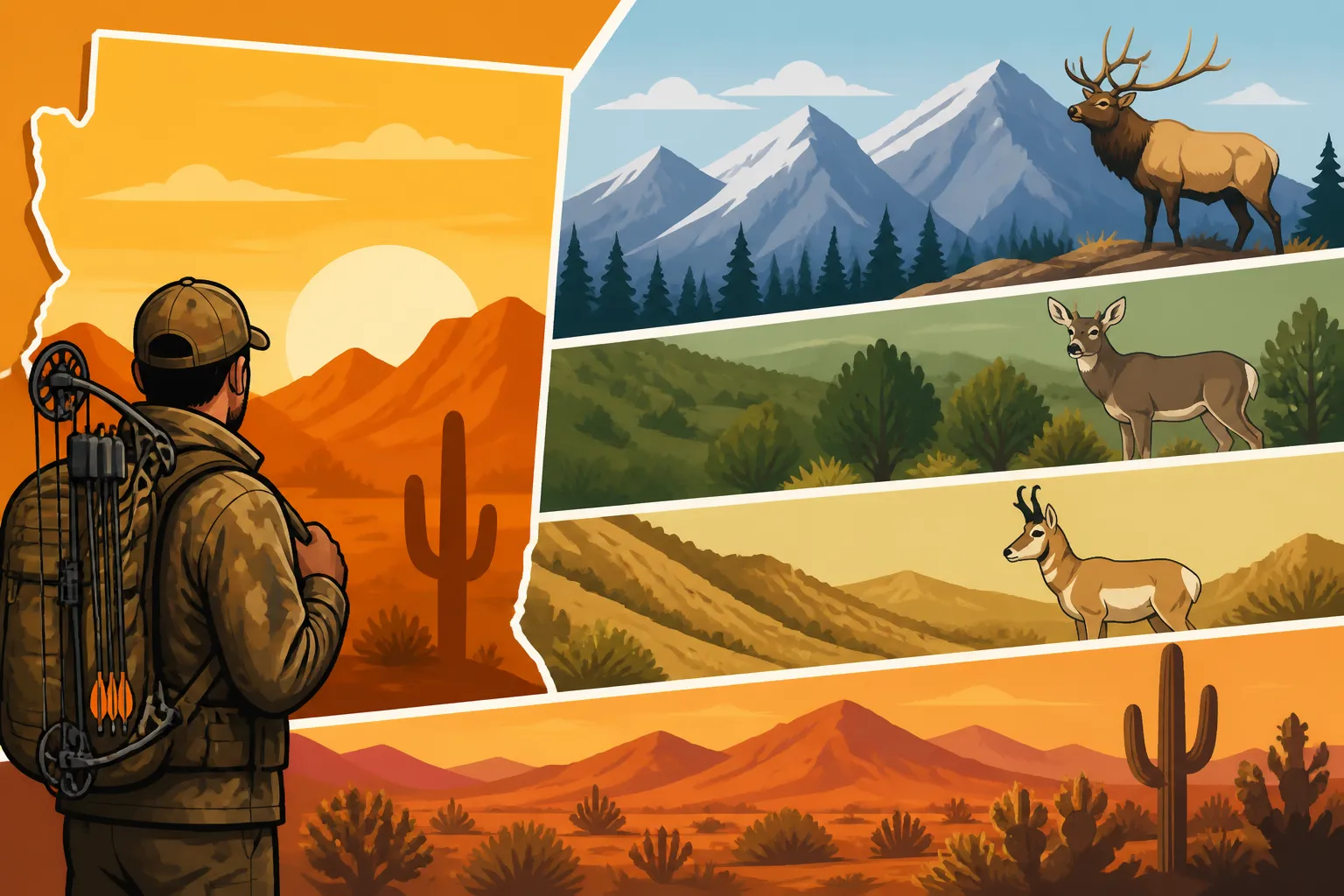
To simplify, Arizona can be broadly divided into three major climatic zones, which correspond quite neatly with elevation bands:
- The Sonoran Desert (Low Desert): This is what most people picture when they think of Arizona. Hot, dry, dominated by cacti, palo verde, and mesquite. Elevations here are typically below 3,000 feet, sometimes stretching up to 4,000 feet in the rolling foothills.
- The Transition Zone (Upland Desert to Ponderosa): As you gain elevation, typically from 3,000 to 7,000 feet, you move through grasslands, chaparral, juniper-pinyon woodlands, and finally into the lower reaches of ponderosa pine forests. This is often where you find a mix of desert and mountain species.
- The Mogollon Rim and High Country (High Elevation Forests): Above 7,000 feet, and especially above 8,000 feet, you enter the true high country. Here, dense ponderosa pines, spruce, fir, and aspens thrive. This is where you find cooler temperatures, more consistent moisture, and often, more rugged terrain.
These zones aren't rigid lines on a map but rather gradual changes that influence everything from the types of boots you wear to the optics you carry. Recognizing which zone you're in, and what that means for the local wildlife, is a huge step toward becoming a more effective Arizona hunter.
Deciphering Arizona's Key Elevation Bands for Game
Now let's dive into the specifics of what each major elevation band offers the Arizona hunter. Each one comes with its own set of challenges, rewards, and resident game species.
The Low Desert (Under 3,000 feet)
This is the quintessential Arizona landscape: vast, often flat or gently rolling terrain punctuated by iconic saguaro cacti, brittlebush, creosote, and ironwood trees. Water is scarce, and temperatures can be extreme, especially during early seasons. This environment is home to species incredibly adapted to its harsh conditions.
- Typical Vegetation: Saguaro, cholla, prickly pear, palo verde, mesquite, creosote, ironwood.
- Primary Game: This is prime habitat for javelina, often found rooting in small herds. You'll also find desert mule deer, typically smaller-bodied and lighter in color than their high-country cousins, though still a formidable challenge. Cottontail rabbits are abundant, as are Gambel's quail, often found near washes.
- Hunting Considerations: Heat management is paramount, especially during early archery seasons. Water sources, whether natural tanks or man-made drinkers, become critical magnets for game. Glassing is your most important skill here, scanning vast expanses for movement against the muted desert palette. Stalking can be difficult due to sparse cover and crunchy ground, making careful wind assessment essential. For those seeking these unique critters, Where Javelina Live in the Sonoran Desert offers deeper insight into their habits, and Finding Water in Arizona's Dry Country is key to success.
The Upland Desert & Grasslands (3,000 – 5,000 feet)
As you begin to climb out of the lowest desert floors, the vegetation shifts. Cacti become less dominant, replaced by more grasses, scrub oak, juniper, and various brush species. This is a zone of transition, often characterized by more broken country, rolling hills, and mesa formations.
- Typical Vegetation: Various grasses, scrub oak, juniper, mesquite, catclaw acacia, cholla, agave.
- Primary Game: This elevation band is the heart of Coues deer country, particularly in the "sky island" ranges of southeastern Arizona. These elusive deer are masters of camouflage in this mixed vegetation. Mule deer also thrive here, often using the broken terrain for cover. You'll find good numbers of javelina still, and in the flatter, more open grassland areas, pronghorn can be present.
- Hunting Considerations: This terrain often demands more walking and climbing than the low desert. Long-range glassing is still crucial, but you'll need to be adept at picking apart brushy hillsides and oak thickets. Stalking requires patience and a good understanding of thermals and wind patterns in canyons and draws. The challenge of the "gray ghost" is well-documented in What Makes a Coues Deer Different, and for those after speed goats, Pronghorn on the Northern Grasslands explains where to look.
The Transition Zone (5,000 – 7,000 feet)
This is where Arizona truly starts to feel like mountain country, even if it's not yet the highest peaks. Ponderosa pine trees begin to appear, mixing with junipers, various oaks, and chaparral. This zone often forms the lower slopes of larger mountain ranges, including the iconic Mogollon Rim.
- Typical Vegetation: Ponderosa pine, juniper, various oak species, manzanita, chaparral, pinyon pine.
- Primary Game: This is excellent habitat for elk, particularly during the rut when bulls are vocal and active. Mule deer are common, especially on north-facing slopes and in canyons. Black bear frequently use these mixed forests for forage, and Merriam's turkey can be found scratching in the pine needles. Lower down, you might still encounter Coues deer where the oak brush is thick.
- Hunting Considerations: Navigation becomes more critical in the denser timber. While long glassing is still valuable from ridges, still hunting and tracking skills become more important. Understanding elk behavior, especially during the rut, is key. Gear considerations shift towards durable footwear and layering for cooler temperatures. You'll find prime elk hunting in Elk Country Along the Mogollon Rim, and learning about Black Bear Density Across Arizona can help locate bears in this zone.
The High Country (Above 7,000 feet)
The highest elevations in Arizona are truly a world apart. Here, dense forests of ponderosa pine give way to mixed conifer forests of spruce, fir, and aspen. This is often rugged, steep terrain, characterized by cooler temperatures, more frequent precipitation, and significant snowpack in winter.
- Typical Vegetation: Ponderosa pine, Engelmann spruce, Douglas fir, subalpine fir, aspen, mixed conifer.
- Primary Game: This is prime elk country, particularly for mature bulls seeking seclusion. Trophy mule deer also inhabit these higher reaches. Merriam's turkey will range through these forests, and black bear are common, especially when berries are ripe.
- Hunting Considerations: Physical fitness is crucial here. The air is thinner, and the terrain is demanding. Navigation skills are paramount, as dense timber can disorient. Weather can change rapidly, with afternoon thunderstorms in summer and significant snowfall in fall. Hunters need to be prepared for colder conditions and often more remote access. Areas like White Mountains Elk Country are prime examples of this high-country environment, and for turkey hunters, Merriam's Turkey Through Arizona's High Country details their presence here.
Practical Application for Hunters: Using Elevation to Your Advantage
Understanding these elevation bands isn't just academic; it's about making smart, on-the-ground decisions that lead to success.
Scouting and Planning with Elevation in Mind
Before you ever set foot in the field, elevation should be a primary consideration in your scouting and planning. Modern mapping tools are incredibly powerful for this. Using a platform like onX Hunt, you can overlay topographic maps and satellite imagery to visualize elevation changes, identify steep slopes, and pinpoint potential game corridors. Look for transitions between elevation bands—these "edge" habitats are often incredibly productive. For instance, a draw that starts in low desert scrub and climbs into juniper-pinyon offers both water and varied forage, attracting a wider array of species or providing a travel route.
You can predict game movement based on seasonal elevation patterns. As temperatures drop and snow begins to fall in the high country, elk and mule deer will typically move to lower elevations, following the snow line and seeking more accessible forage. Conversely, during hot early seasons, animals might push higher to find cooler temperatures and more abundant water sources. Brands like GoHunt provide valuable draw odds and unit information that often details habitat types, which directly correlates to elevation. Integrating this with E-Scouting an Arizona Unit Before the Season and learning how to interpret Reading an Arizona Unit Boundary Before You Apply will give you a significant advantage.
Adapting Your Tactics to Each Elevation Band
Your gear, physical conditioning, and hunting techniques need to shift dramatically as you move between Arizona's elevation bands.
- Gear Choices: In the low desert, lightweight, breathable clothing, plenty of water capacity, and tough, snake-proof boots are priorities. In the high country, layers become critical – waterproof outerwear, insulated mid-layers, and sturdy, waterproof hiking boots are essential to handle temperature swings from freezing nights to warm afternoons, and sudden storms. Layering for Rim Country Temperature Swings is a must-read for anyone heading to the high country.
- Physical Demands: Hiking at 8,000 feet with a pack is far more strenuous than walking rolling desert hills. Higher elevations mean less oxygen, requiring better physical conditioning. Don't underestimate the impact on your body; start training well in advance, especially if you're coming from sea level. Consider what's involved in Physical Conditioning for a Sky Island Hunt for Coues deer, and amplify that for elk.
- Hunting Techniques: In the open desert or grasslands, your focus will be on long-range glassing and patient observation, followed by a meticulous stalk. In denser timber of the transition or high country, still hunting, tracking, and understanding wind and thermals for close-quarters encounters become paramount. Calling strategies for elk will differ in open parks versus thick timber, too.
Understanding How Weather and Water Affect Elevation Use
Weather patterns are intimately tied to elevation and critically influence how game animals utilize different bands.
- Monsoon Season: Arizona's summer monsoon brings torrential rains, primarily impacting the low and mid-elevations. While providing crucial water, it can make roads impassable and create temporary lush pockets of forage. Animals may spread out when water is abundant, but these new growth areas can become hotspots. For insights into this, look into How Monsoon Rain Affects Antler Growth.
- Snowfall: In the high country, significant snowfall can push game like elk and mule deer down to lower elevations, often concentrating them in transition zone areas that provide more food and less snow. Understanding these winter ranges is vital for late-season hunts.
- Water Sources: Regardless of elevation, water is always a limiting factor in Arizona. In the low desert, every stock tank, natural seep, or man-made drinker is a lifeline. In higher elevations, natural springs and rivers become more common, but game still often congregates around reliable water sources. Utilizing maps to identify these, especially with tools like onX Hunt or GoHunt, is a non-negotiable step. Knowing about Water Sources That Concentrate Arizona Desert Game is invaluable.
This table provides a generalized overview of Arizona's hunting elevation bands, their characteristics, and typical game. Remember, there's always overlap, and local conditions can vary wildly.
| Elevation Band (Approx.) | Typical Climate & Habitat | Key Vegetation | Primary Game Species | Hunting Considerations |
|---|---|---|---|---|
| Below 3,000 feet | Hot, arid desert; flat to gently rolling; sparse water. | Saguaro, palo verde, mesquite, creosote, cholla. | Javelina, Desert Mule Deer, Cottontail, Gambel's Quail. | Extreme heat, glassing vast areas, limited cover, water sources are critical. |
| 3,000 – 5,000 feet | Upland desert to semi-arid grasslands; broken terrain. | Grasses, scrub oak, juniper, agave, various cacti. | Coues Deer, Mule Deer, Javelina, Pronghorn (in open areas). | Long stalks, understanding thermals, detailed glassing of brushy hillsides. |
| 5,000 – 7,000 feet | Transition zone; mixed forests; moderate temperatures. | Ponderosa pine, juniper, diverse oaks, chaparral, pinyon. | Elk, Mule Deer, Black Bear, Turkey, Coues Deer (lower end). | Denser timber, still hunting, tracking, adapting to rapid weather changes. |
| Above 7,000 feet | High country forests; cool, more moisture, rugged. | Spruce, fir, aspen, tall ponderosa pine. | Elk, Mule Deer, Merriam's Turkey, Black Bear. | High physical demands, navigation in thick timber, cold weather preparation. |
Understanding Arizona's elevation bands isn't just about geography; it's about unlocking the secrets of where, when, and how to effectively hunt its incredibly diverse landscapes. By tailoring your scouting, gear, and tactics to these unique environments, you'll significantly increase your chances of success and gain a much deeper appreciation for what makes hunting in Arizona so special.
Disclaimer
This article is for general informational purposes only and does not constitute professional advice. Laws, prices and regulations vary by location and change over time. Consult a qualified professional for guidance on your specific situation.