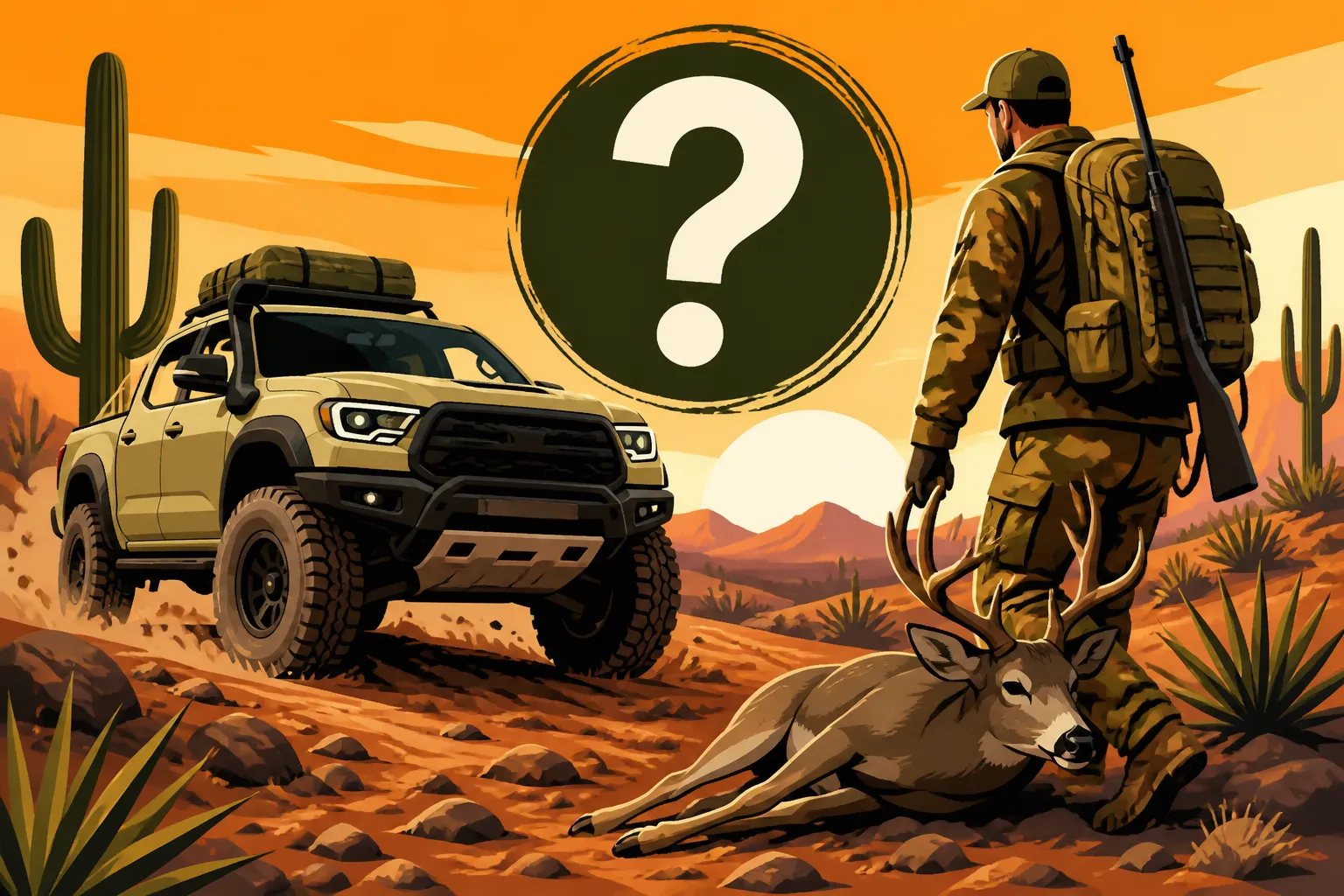
Can You Drive Off Road to Retrieve Game?
There’s nothing quite like the rush of a successful shot, especially after a challenging stalk or a long day on the glass. But that moment of triumph can quickly turn into a knot of anxiety when you realize your downed game is in a spot that seems impossible to reach. You look at your truck, then at the rugged terrain, and the thought inevitably pops into your head: "Can I just drive off-road to get it?" This guide is going to walk you through the nuances of vehicle use on Arizona's public lands for game retrieval, helping you navigate the rules and, more importantly, make ethical and legal decisions to ensure your harvest is respected and your hunting career isn't jeopardized.
Understanding Arizona's Vehicle Use Regulations on Public Land
Arizona's public lands, managed by entities like the Bureau of Land Management (BLM) and the Forest Service, are vast and offer incredible hunting opportunities. However, with that access comes a significant responsibility to understand and adhere to the regulations governing vehicle use. These aren't just arbitrary rules; they're in place to protect fragile ecosystems, prevent habitat degradation, and ensure sustainable use for everyone.
The MVUM: Your Off-Road Bible
If you're going to hunt on National Forest or BLM land in Arizona, consider the Motor Vehicle Use Map (MVUM) your absolute go-to resource. It's not just a suggestion; it's the law. An MVUM specifically designates which roads, trails, and areas are open to motor vehicle travel, what types of vehicles are allowed, and for what time of year. Anywhere not explicitly shown as open on an MVUM is, by default, closed to motorized vehicles. This includes driving directly off a designated road or trail, even if it's just a few yards, to retrieve an animal.
You can often find these maps for free at local ranger stations, BLM field offices, or often download them directly from the Forest Service or BLM websites. Many hunters, myself included, rely heavily on digital versions that overlay these designated routes onto satellite imagery, which is incredibly helpful in the field. Tools like onX Hunt, for example, integrate these MVUM layers directly into their mapping applications, making it easy to see precisely where you can and cannot drive. Taking the time to study these maps before your hunt begins is not just good practice; it's essential for staying legal and avoiding costly mistakes. You'll want to be intimately familiar with Motor Vehicle Use Maps for Forest Ground in your chosen unit.
Designated Routes vs. Off-Road Travel
The core principle behind vehicle use on public land is straightforward: if there isn't a designated, numbered route, you can't drive there. This concept is often referred to as the "Travel Management Rule." It means that simply because a piece of ground looks traversable, or because you see old tracks, it doesn't mean it's legal to drive your truck or ATV on it. Designated routes are clearly marked on MVUMs, and they're the only places where you're permitted to operate a motorized vehicle.
Driving off a designated route, even to retrieve game, can lead to severe environmental damage. Vehicle tracks can create new, unauthorized roads, leading to erosion, habitat fragmentation, and disturbance to wildlife. Imagine everyone driving just 100 yards off the main road to pick up their deer. Soon, that single road would look like a spiderweb of illegal trails, utterly destroying the landscape. The rules are in place to prevent this cumulative impact and preserve the wild character of these areas for future generations.
The Legal Ramifications of Illegal Off-Roading
Thinking about bending the rules "just this once" for game retrieval? Reconsider. The penalties for illegal off-road vehicle use on public land in Arizona can be steep. You could face significant fines, potentially hundreds of dollars or more, depending on the severity and location of the violation. In some cases, your vehicle could even be impounded. Beyond the financial burden, you could lose your hunting privileges, gain a criminal record, and certainly earn a black mark on your reputation within the hunting community.
Enforcement officers, whether from the Arizona Game and Fish Department (AZGFD), Forest Service, or BLM, are out there, and they take these regulations seriously. They're often on patrol, especially during hunting seasons, and are equipped to track and identify vehicles that deviate from designated routes. It's simply not worth the risk, not only for your wallet and freedom but for the integrity of our public lands and the future of hunting itself. Understanding Motorized Travel Rules on Arizona Public Land is paramount.
Specific Scenarios and Considerations for Game Retrieval
Given the strict rules, it's natural to wonder if there are any scenarios where driving off-road for retrieval is permissible. The short answer for public land in Arizona is almost always "no."
When "Driving Off-Road" Might Be Allowed (and it's almost never)
Let's clarify what "driving off-road" truly means in the context of retrieval. It means leaving a legally designated, mapped road or trail. On Arizona's public lands, this is generally prohibited without a very specific, rare, and usually administrative permit that hunters typically won't possess. There isn't a blanket "game retrieval" exception written into the regulations for public land that allows you to drive wherever your animal falls. If your deer or elk drops 50 yards off a designated forest road, you are still expected to pack it out on foot.
The only time you might legitimately drive off what appears to be a main road is if you're on private land and have explicit, prior permission from the landowner to do so. Even then, the landowner might have restrictions or designated tracks they want you to use. Never assume; always ask first. For the vast majority of public land hunting in Arizona, driving off a marked route is illegal, full stop. The question of Can You Drive Off Road to Retrieve Game? is generally answered with a firm 'no' on public land.
The Reality of Retrieval: Foot Travel and Game Carts
So, if you can't drive your vehicle to the animal, what's the alternative? The reality for most Arizona hunters is that retrieval means good old-fashioned foot travel and smart planning. This is where your physical conditioning and preparedness truly pay off. A downed elk or a mule deer in rugged desert terrain can be an incredibly demanding pack-out, often requiring multiple trips or the help of hunting partners. Many experienced hunters invest in quality game bags to protect the meat, sturdy pack frames designed for heavy loads, and even game carts for flatter, more open terrain.
Planning for retrieval starts long before you pull the trigger. When you're scouting a unit or making a stalk, you should be constantly assessing potential escape routes for game, but also potential retrieval routes for yourself. Think about ravines, washes, or ridges that might offer easier access, even if it's still on foot. Consider the distance back to the nearest legal road and the difficulty of the terrain. Having the right gear, understanding how to break down an animal in the field, and knowing your physical limits are crucial. For challenging backcountry situations, having a plan for Packing an Elk Out of Rim Country Alone can be the difference between success and a spoiled harvest.
Working with Private Landowners
Private land presents a distinctly different set of rules, though the principle of permission remains paramount. If you're hunting adjacent to or on private property, and your game runs onto that land, you absolutely must obtain permission from the landowner before pursuing or retrieving it. Trespassing, even to retrieve a legally harvested animal, is illegal and can lead to severe consequences.
Many ranchers and private landowners are understanding if approached respectfully. Be prepared to show your license and tag, explain where the animal was shot, and be flexible with their requests. They might ask you to retrieve it in a specific way, at a particular time, or they might even offer assistance with an ATV or tractor if the situation warrants it. Never enter private land without permission, and certainly don't assume that just because your animal is on their property, you can drive your vehicle wherever you please. Having a clear understanding of Retrieving Game From Private Land in Arizona can save you a lot of heartache and potential legal trouble. For researching land ownership, resources like GoHunt or onX Hunt can provide invaluable insights into property boundaries and landowner information, allowing you to identify who to contact well in advance.
Ethical Hunting and Responsible Retrieval Practices
Beyond the letter of the law, responsible game retrieval is a cornerstone of ethical hunting. It speaks to our respect for the animal, the land, and the perception of hunting by the non-hunting public.
Minimizing Impact and Respecting the Land
Every hunter has a responsibility to minimize their impact on the land. Driving off-road creates ruts, damages vegetation, contributes to erosion, and can disrupt other wildlife and recreational users. These scars on the landscape can last for years, undermining conservation efforts and giving ammunition to those who oppose public land access for hunting. An ethical hunter understands that the privilege of hunting on public land comes with a duty to leave it better than, or at least as good as, they found it.
This commitment extends to ensuring a clean and thorough retrieval. Wounding an animal and then being unable or unwilling to retrieve it is a profound ethical failure. This is why shot placement, knowing your effective range, and having a solid retrieval plan are all intertwined with the concept of fair chase. The desert environment, with its fragile soils and unique flora, is particularly susceptible to damage from vehicles. Practicing Water Sources and Ethics in Arizona Desert Hunting means not just how you hunt, but how you treat the land after the shot.
Planning Ahead for Retrieval Challenges
The best way to avoid the temptation of illegal off-roading for retrieval is to plan for a tough pack-out from the very beginning. This starts with thorough preseason scouting. Get boots on the ground in your unit, understand the terrain, identify potential access points (legal roads!), and mentally map out how you would get an animal out of various drainages or ridges. Modern e-scouting tools like onX Hunt are fantastic for this, allowing you to examine topography, identify legal roads, and even mark potential retrieval routes or nearest access points before you ever step foot in the unit. E-Scouting an Arizona Unit Before the Season is a critical step.
Carry the right gear: a quality backpack with a frame, game bags, a sharp knife, rope, and enough water and emergency supplies for an extended stay if needed. Understand that early season hunts in Arizona can mean extreme heat, so cooling meat quickly is vital. Having a plan for Field Dressing in Desert Heat and getting that meat back to a cooler should be part of your pre-hunt strategy. Don't forget that Preparing Physically for a Desert Hunt is also paramount, as a heavy pack-out in challenging terrain will test your limits.
When to Call for Help (and who)
There are times when a retrieval situation might genuinely be beyond your capabilities, whether due to extreme terrain, unexpected injury, or simply a massive animal in a terrible spot. In such cases, it's far better to call for legal help than to attempt an illegal or unsafe retrieval. This might mean contacting hunting partners, friends, or even professional retrieval services if they are available and operate legally.
If you find yourself in a truly impossible situation, reaching out to the AZGFD for advice is an option. While they cannot always provide direct assistance, they can offer guidance on legal next steps and, in rare circumstances, may have resources to help. Never abandon an animal, and always prioritize safety and legality. Your hunting community is also a valuable resource, and many hunters are willing to lend a hand for a fellow sportsman in a pinch.
Here's a quick summary of the common approaches to retrieval:
| Retrieval Method | Legality on Public Land (Arizona) | Key Considerations | Pros | Cons |
|---|---|---|---|---|
| Foot Travel (Pack-out) | Legal and Expected | Physical fitness, proper gear (pack frame, game bags) | Minimal impact, deeply satisfying, most common | Physically demanding, time-consuming, requires appropriate gear |
| Game Cart/Wheeled Carrier | Legal on designated trails/roads | Flat or gently sloped terrain, clear paths | Easier than packing on back for some terrain | Limited by terrain, often cannot go truly "off-road" |
| Horses/Pack Animals | Legal on designated trails/roads | Requires animals, experience, special permits in some areas | Can carry heavy loads over long distances | Expensive, requires specialized knowledge/animals, limited by terrain and specific regulations |
| ATV/UTV on Designated Routes | Legal on MVUM-marked routes | Follow MVUMs strictly, OHV decal required | Faster, less strenuous than foot travel | Limited to marked routes, still requires off-vehicle packing to reach animal if off route |
| Driving Off-Road (Vehicle) | Generally Illegal | Never on public land, only private with explicit permission | Fastest to the animal (if allowed) | High risk of fines, vehicle impoundment, environmental damage, ethical violation, loss of privileges |
Remember, a responsible hunter respects the game, the land, and the rules. While the desire to get your hard-earned animal out efficiently is strong, never let it overshadow your ethical and legal obligations. Proper planning, physical preparation, and a commitment to responsible land use will ensure your hunt is memorable for all the right reasons.
Disclaimer
This article is for general informational purposes only and does not constitute professional advice. Laws, prices and regulations vary by location and change over time. Consult a qualified professional for guidance on your specific situation.