Why Arizona Coues Hunting Is a Glassing Game
Many hunters head into Arizona's vast and rugged landscapes expecting to find deer around every corner, but when it comes to the notoriously elusive Coues deer, approaching the hunt with anything less than a dedicated glassing strategy is a recipe for tired legs and persistent frustration. These small, wily whitetails, often called "gray ghosts," melt into their mountainous habitat with uncanny ability, making traditional still-hunting tactics incredibly inefficient. This comprehensive guide will illuminate why glassing and spotting are not merely useful, but absolutely paramount for consistent success when pursuing Coues deer in Arizona.
Why Coues Deer Demand Patience and Optics
The unique characteristics of Coues deer and the challenging terrain they inhabit mean that hunters must adapt their approach significantly. You can't just wander around hoping to stumble upon one; you need a strategic, optics-first mindset.
The "Gray Ghost" Reputation
Coues deer earned their famous nickname, "gray ghost," for a very good reason: they are masters of disappearing acts. Their coats, a subtle blend of gray and brown, perfectly mimic the rocky, brush-covered slopes they call home. Unlike their larger mule deer cousins, which might stand out against a backdrop, a Coues deer can vanish into what seems like impossibly sparse cover in mere seconds. This camouflage makes attempts at still-hunting or walking through the woods in hopes of jumping a deer a largely futile exercise. You're almost certainly going to spook them long before your unaided eyes ever confirm their presence.
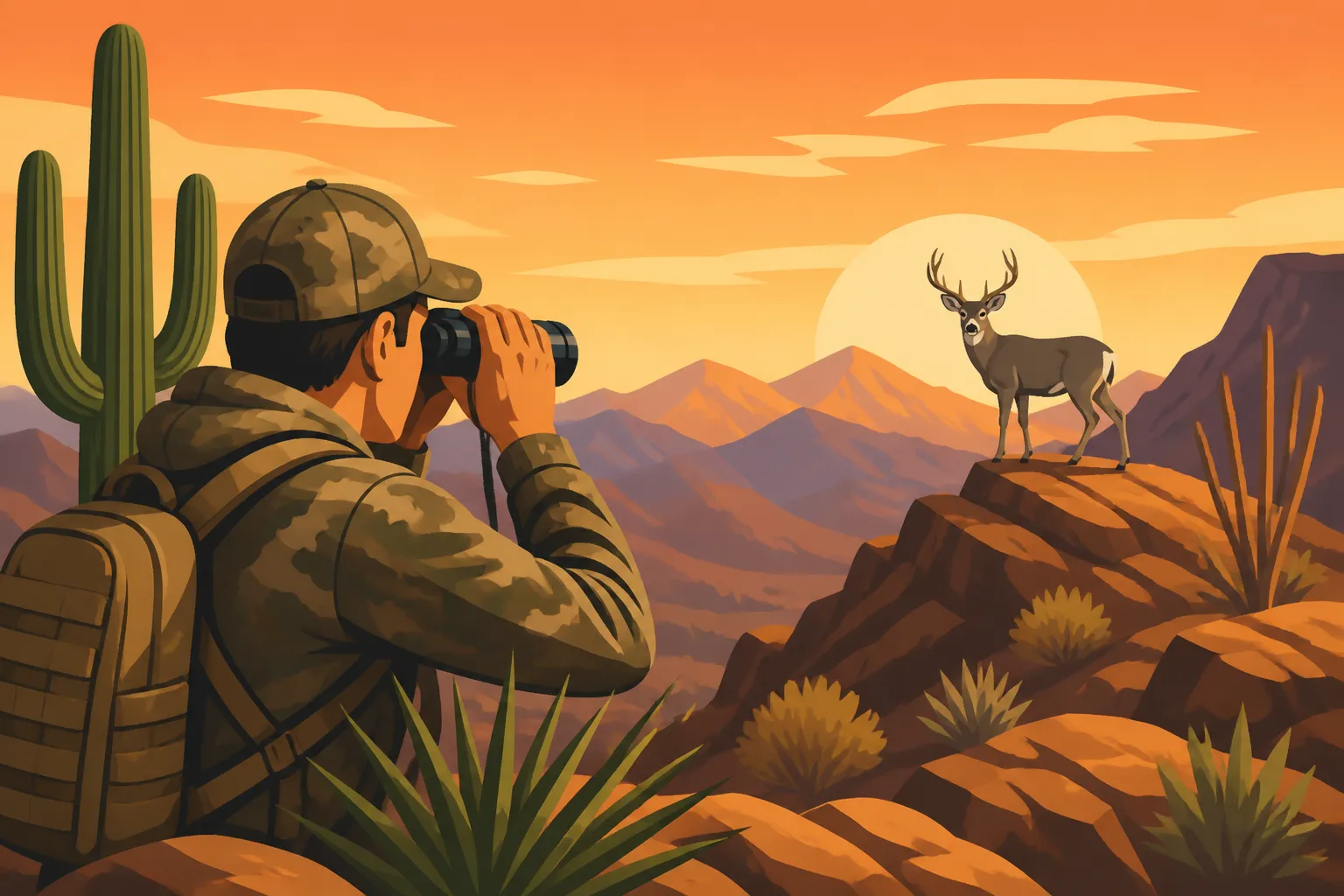
This incredible talent for blending in means that your natural eyesight, no matter how sharp, is rarely enough on its own. The immense, sprawling, and broken terrain where these deer thrive demands that you scan vast distances with meticulous care, picking apart every shadow, every patch of scrub oak, and every rock formation. Without a top-tier pair of binoculars or a powerful spotting scope, you’re essentially navigating a minefield blindfolded, and those "mines" are deer that are already acutely aware of your approach. This is precisely why veteran Coues hunters dedicate the vast majority of their time – often 90% or more – to patiently scouring the landscape through their optics, knowing the deer are there, just incredibly well-hidden.
Their Elusive Nature in Rugged Terrain
Arizona’s Coues deer predominantly call the "Sky Islands" home. These are isolated mountain ranges that dramatically rise from the desert floor, creating unique ecological zones. Ranges such as the Chiricahua Mountains or the Santa Rita Mountains are defined by steep, broken country, frequently covered in dense oak brush, rocky canyons, and scattered pines at higher elevations. This isn't flat, open grassland; it's a complex maze of draws, ridges, and countless hidden pockets where a small deer can disappear without a trace. They use this intricate topography to their absolute advantage, moving silently through heavy cover and leveraging every contour to remain out of sight of predators – including hunters.
Hunting in this type of environment demands a fundamental shift in strategy. Instead of noisily pushing through thick brush, which is both exhausting and counterproductive, the most effective method is to gain an elevated position. Find a high vantage point that offers expansive views into multiple drainages and across several opposing hillsides. Coues deer will often be moving, feeding, or bedded on those distant slopes, and without powerful optics, those subtle movements or even stationary forms are simply impossible to detect. Their elusive nature in these rugged environments means you literally cannot cover enough ground on foot to find them efficiently; you must allow your optics to "do the walking," revealing activity in hidden corners that your boots could never reach.
Understanding the Coues Deer Habitat
To effectively glass for Coues deer, you first need a deep understanding of the habitats they prefer and the specific features within those habitats that they utilize. This knowledge informs where you should focus your precious glassing time.
Sky Island Ecosystems
The Sky Island ecosystems of southeastern Arizona are, without question, the core of prime Coues deer country. These impressive mountain ranges, separated by broad stretches of desert, function much like true biological islands, fostering distinct habitats with unique plant and animal life. For Coues deer, this translates into a rich mosaic of scrub oak, juniper, manzanita, and various grasses at lower to mid-elevations, gradually transitioning into ponderosa pine and mixed conifer forests as you climb higher. The deer expertly utilize these diverse vegetation types for forage, cover, and bedding throughout the day and across the seasons. Understanding this vertical stratification of habitat is absolutely critical for knowing precisely where to direct your glassing efforts.
During the cooler periods of the day, particularly in the early morning and late evening, Coues deer are frequently observed feeding in more open, grassy areas or along the fringes of denser brush lines. However, as the sun ascends and temperatures inevitably climb, especially during the challenging early season hunts, they will instinctively retreat into the thickest available cover or seek the shade and cooler air found on north-facing slopes. These movements are incredibly subtle and often only become detectable through the flicker of an ear, a brief flash of a white rump, or a minute change in the textural pattern on a distant hillside – all minute details that demand the resolution and magnification of quality optics to pick up. For a more comprehensive understanding of these vital areas, exploring The Sky Island Ranges That Hold Coues is highly recommended for any serious Coues hunter.
Water Sources and Cover
In the unforgiving Arizona desert, water is the undeniable lifeblood, and Coues deer, despite their remarkable adaptations to arid conditions, are no exception. They require water, especially during the sweltering hotter months and throughout the demanding rut when bucks expend immense amounts of energy. Consequently, canyons, washes, and drainages that either retain ephemeral water sources, house natural springs, or feature man-made stock tanks become critical focal points for hunting. Deer will typically bed within a reasonable proximity to these water sources, utilizing the surrounding thickets and rough terrain for security and concealment.
Beyond the vital necessity of water, impenetrable cover is paramount for Coues deer survival. They don't just use it for bedding; they employ it for concealed travel, for safe feeding, and, most importantly, for evading predators. When glassing, always prioritize areas boasting dense, thorny brush, intricate rock outcroppings, and steep, broken terrain that provides abundant visual obstruction. These are the havens where a Coues deer feels most secure. When you're diligently glassing, train your eyes not just to spot an entire deer, but to look for parts of a deer. A telltale horizontal line disrupting the vertical or irregular patterns of the landscape, the almost imperceptible flick of an ear, the distinctive shine of an antler tip, or a darker patch of a deer's body against the deep shadows of a thorny mesquite thicket – these are the subtle, fleeting cues that only trained eyes, aided by superior optics, can consistently reveal.
Mastering the Art of Glassing for Coues
Glassing is far more than just pointing your binoculars at the mountainside. It's a deliberate, systematic skill that, when mastered, unlocks the hidden world of Coues deer.
Setting Up Your Glassing Position
Locating the perfect glassing spot is arguably half the battle won when chasing Coues deer. You absolutely need a vantage point that offers expansive, unobstructed views of the specific country you intend to hunt. Ideally, position yourself with the sun at your back or at least to your side, which will significantly minimize debilitating glare and allow for clearer viewing. High points, such as prominent mountain peaks, commanding ridges, or even a shrewdly chosen knob on a lower hill, are typically ideal. The overarching goal is to be able to systematically scan multiple slopes, canyons, and draws without the need for constant movement, as this frequent shifting can easily alarm and spook nearby game. Once you reach your chosen location, take your time to set up properly. Don't just stand there attempting to hold your binoculars steady for extended periods; this is precisely where a high-quality tripod and a comfortable, portable seat become absolutely invaluable assets.
A stable platform for your optics is not just helpful, it's an undeniable necessity for enduring, productive glassing sessions. Whether you're utilizing powerful 10x or 12x binoculars, or a high-magnification spotting scope, any degree of wobble or instability will inevitably lead to rapid eye fatigue and render it nearly impossible to discern the subtle, critical details at long distances. Investing in a sturdy tripod and a robust binocular adapter for your binos is every bit as crucial as the quality of the glass itself. Once everything is securely set up, take a few moments to survey the entire landscape with your naked eye first. Identify key geological features, potential deer travel corridors, and probable bedding areas. This initial, broad scan helps you break down the vastness into more manageable, digestible sections, which is an essential preparatory step before you dive into the painstaking detail work with your magnified glass.
Effective Glassing Techniques
Now, let's talk about the actual execution of glassing – and trust me, it’s far more involved than simply sweeping your optics randomly across the landscape. The most consistently effective method is a systematic, disciplined grid search. Begin your scan at the closest part of the terrain you're observing, typically starting at the very bottom of a distant slope, and then slowly and methodically work your way across in a horizontal line. Once you reach the end of that specific horizontal section, drop your glass ever so slightly, and then methodically scan back across, moving with precision and unhurried deliberation. Envision it much like reading a book, carefully going line by line, page by page. This highly disciplined approach ensures that you significantly reduce the chances of overlooking any crucial details or movements.
During this meticulous process, pay exceptionally close attention to any subtle changes in color, texture, and contour that deviate from the natural patterns of the landscape. A deer's body will often create an unnatural, distinctly horizontal line amidst an otherwise vertical or irregular environment. Look intensely for the characteristic curve of an antler, the sharp, angular line of a leg, or even the almost imperceptible twitch of a tail. Do not rush this process; dedicate a significant amount of time to thoroughly examining each section before incrementally moving your optics. What might initially appear to be just another rock could, with prolonged and focused observation, gradually resolve itself into a bedded deer. Remember, Coues deer are small animals and can be entirely obscured by even a single, seemingly insignificant bush, so train your eyes to look through the cover, rather than just superficially at it. This systematic and patient process is wonderfully detailed in articles like The Grid Glassing Method, Step by Step.
Interpreting What You See
The moment you successfully spot something, your work isn't over; in fact, it's just begun. The initial sighting is often just a fleeting glimpse – a patch of hide, the tip of an antler, or a distant, barely perceptible flicker of movement. Now comes the crucial task of interpreting what exactly you're seeing. Is it undeniably a deer, or merely an oddly shaped rock or shadow? If it is a deer, is it a buck or a doe? How large is it? Immediately utilize your spotting scope to zoom in, if you have one readily available, and diligently search for any distinguishing features. Look specifically for the characteristic white patch on a Coues deer's throat or the dark, prominent preorbital glands. When attempting to judge the size or sex of an animal, patience is truly paramount. Wait for it to move, to stand up, or to turn its head to provide you with a clearer, more definitive view.
Quite often, you might spot a single deer, but it’s a wise axiom in Coues country that where there’s one, there are usually more. Coues deer frequently travel in small family groups or bachelor groups, so after you’ve positively identified your initial target, immediately re-scan the entire surrounding area with your binoculars. Another deer might be bedded nearby, just slightly obscured from your initial line of sight. Learning to accurately Judge an Arizona Coues Buck at Distance requires considerable practice and a keen eye, but developing an understanding of their general antler characteristics and body size can significantly aid you in making swift, informed decisions. And never forget this crucial tip: even if you spot "just a doe," patiently observing her behavior and movements can often lead you directly to a buck, particularly during the intense period of the rut.
Strategic Approaches to Spot-and-Stalk
Once your optics have delivered, the next phase – the spot-and-stalk – is where your physical and mental fortitude are truly tested. It's a game of calculated moves and unwavering determination.
The Challenge of Closing the Distance
After you've successfully located a Coues deer through your glass, the true and often arduous challenge begins: closing the distance for an ethical shot. Unlike hunting in dense timber where a few hundred yards might suffice, in the vast, open, and broken terrain of Arizona's mountains, your target could easily be a mile or more away, separated by a complex series of draws, steep ridges, and unforeseen obstacles. This is precisely where a detailed and meticulously planned stalk becomes absolutely critical. Begin by utilizing your map and binoculars to meticulously identify a route that offers the maximum amount of cover, simultaneously minimizes your exposure, and most importantly, avoids any potential, unpredictable wind shifts. Pay exceptionally close attention to any terrain features that will effectively break up your silhouette against the skyline.
The very terrain itself can be either your most steadfast ally or your most formidable foe. Steep hillsides, while demanding physically, also provide invaluable opportunities to remain out of sight by utilizing the bottoms of canyons or sticking to the backside of ridges. Rocky ground, while offering some cover, can be incredibly noisy, so every step must be chosen with deliberate care. If at all possible, always strive to approach from above the deer or, at the very least, from the same general elevation. Always be thinking several steps ahead and consider an immediate exit strategy should the deer unexpectedly move or the wind shift unfavorably. Remember, these deer possess an innate wariness, and one misstep, one jarring noise, or one glint of sunlight off your equipment can send them bounding away into oblivion. The insightful article How Far to Stalk a Bedded Coues Buck powerfully underscores the critical importance of a patient and meticulously calculated approach.
Playing the Wind and Thermals
Disregarding the wind when hunting Coues deer is a guarantee that you will alert every single animal in the unit to your presence. These deer possess an extraordinary sense of smell, and the swirling, often unpredictable winds characteristic of the Arizona mountains can quickly become your most potent adversary. Always, and I mean always, initiate your approach with the wind directly in your face or at least quartering to you. Never, under any circumstances, attempt a stalk with the wind at your back, even if it means electing a significantly longer, more physically demanding route. A quick and frequent check of a wind indicator or even a simple handful of dust tossed into the air should become a constant, ingrained habit throughout your entire stalk.
Thermals introduce an additional layer of crucial complexity to the equation. In the mornings, as the ground gradually warms under the rising sun, air currents typically rise, carrying your scent uphill. Conversely, in the evenings, as the air cools, thermals drop, carrying your scent downhill. This means that a morning stalk might necessitate you staying low within a drainage to prevent your scent from blowing up to deer situated on a ridge, while an evening stalk could demand that you stay high to keep your scent from dropping into a deep canyon. Comprehending and adeptly utilizing these natural air currents is absolutely paramount to success. If both the wind and thermals are unmistakably against you, your only logical options are to either identify an entirely new approach route or patiently wait for more favorable conditions to emerge. The article Playing Thermals on a Canyon Stalk offers exceptional insights into mastering this critical skill.
Patience is Your Stalking Partner
Successful Coues deer hunting, particularly during the demanding stalk phase, is an ultimate test and testament to a hunter's patience. Rushing any part of the process will almost invariably lead to outright failure. Once you have initiated your stalk, move with extreme slowness, deliberate intent, and make frequent stops to continuously re-evaluate the situation. Consistently use your binoculars to verify the deer's exact location, ensuring it hasn't shifted position or, more critically, become aware of your cautious approach. The terrain can present a vastly different appearance once you are physically on the ground compared to your initial elevated glassing vantage point, and you might need to make fluid, real-time adjustments to your chosen route.
This entire endeavor is not a race against the clock; it is, without exaggeration, a meticulous chess match against an incredibly wary opponent. Take one carefully chosen step, then pause and assess the situation, then take another measured step. Maximize the utilization of every available piece of cover – boulders, dense bushes, and even the subtle, natural folds and undulations in the terrain. If the deer decides to bed down, be prepared for what could be a very lengthy wait. It is almost always a superior strategy to sit tight, remain completely hidden, and patiently wait for the deer to stand or move to a more advantageous position, rather than impulsively pressing forward and risking a catastrophic spook. Remember, you have already invested potentially hours of diligent glassing to pinpoint this animal; do not sabotage all that hard work by rushing the final, most delicate approach. This profound level of patience is precisely why the mantra Why Coues Deer Reward Patience Over Movement rings so true for every serious Coues deer hunter.
The Essential Gear for a Successful Glassing Hunt
Your gear selection for Coues deer hunting, especially your optics and related accessories, must be deliberate and high-quality. These tools are the foundation of your success.
High-Quality Optics are Non-Negotiable
When the pursuit turns to Coues deer, your optics transcend mere accessories; they become your primary and most critical hunting tool. It is simply impossible to cut corners here without severely handicapping your chances. A dependable pair of 10x or 12x binoculars represents the absolute bare minimum for acceptable performance, but for any hunter truly committed to serious Coues hunting, a high-quality spotting scope (with magnifications typically ranging from 20-60x or 20-70x) is an unequivocally essential piece of equipment. Esteemed brands like Swarovski, Zeiss, Leica, and Vortex consistently offer some of the finest glass available on the market, delivering unparalleled clarity, superior light-gathering capabilities, and exceptional edge-to-edge sharpness. All of these attributes are absolutely crucial for discerning the miniscule flicker of a deer's ear from a mile away in the challenging low-light conditions of dawn and dusk.
The stark difference between mediocre glass and top-tier optics becomes strikingly evident when you are diligently straining your eyes for hours on end, attempting to pick out subtle details at extreme distances. Cheaper, lower-quality optics will invariably lead to rapid eye strain, debilitating fatigue, and render it nearly impossible to resolve the fine, nuanced details required to positively identify a distant deer. You demand optics that can perform flawlessly in the dim, critical light of dawn and dusk, precisely when Coues deer are most actively moving and feeding. Think of your optics not as an expense, but as a direct, tangible investment in your hunting success; they are the literal window through which your hunting opportunities will appear in Coues country. This emphasis on optical superiority is precisely why articles delving into Optics Power for Arizona's Long Desert Sightlines highlight their vital role so prominently.
Tripods, Bipods, and Stability
Possessing the finest glass in the world is rendered utterly useless if you cannot hold it perfectly steady. A robust, yet lightweight tripod is an absolute, non-negotiable necessity for stabilizing both your binoculars and your spotting scope. Such a setup empowers you to systematically grid search the expansive landscape for prolonged periods without suffering from arm fatigue, and crucially, it maintains a rock-solid, unwavering view, which is essential for resolving those minute, elusive details that indicate the presence of a deer. Many discerning hunters favor carbon fiber tripods for their advantageous combination of light weight and inherent rigidity, qualities that are invaluable when packing gear into rugged, remote terrain. Furthermore, ensure that your chosen tripod head operates smoothly and allows for effortless panning and tilting, facilitating fluid movement across the vast landscape you are observing.
For your rifle, the importance of a reliable bipod or a sturdy set of shooting sticks cannot be overstated. Following a strenuous and demanding stalk, your heart will inevitably be pounding, and your breathing will be heavy and labored. Attempting to execute an unsupported shot at a Coues deer, which are frequently small targets often encountered at extended ranges, is an almost certain recipe for inaccuracy and potential disaster. A bipod or shooting sticks provide the essential stability required for an ethical, precise shot, particularly when you are required to shoot from a prone or kneeling position on uneven, challenging ground. Prior to your hunt, dedicate significant time to practicing your shooting from these supported positions, thereby building the confidence necessary for when the critical moment of truth finally arrives. The reference Shooting Sticks or Bipod on Rocky Ground provides an excellent resource for honing this vital skill.
Mapping and Navigation Tools
In the expansive, often trackless and confusing terrain characteristic of Arizona's Coues deer country, reliable mapping and advanced navigation tools are every bit as critical to your success as your high-quality optics. A dedicated GPS device or, increasingly, a smartphone equipped with a robust mapping application like GoHunt, is an indispensable asset for understanding your precise position relative to unit boundaries, identifying crucial private land parcels, and, critically, tracking the movements of the deer you are actively stalking. These sophisticated tools allow you to accurately mark your advantageous glassing points, record the last known location of the deer, and meticulously plan potential routes for your stalk, thereby ensuring you never become disoriented in the vast and often featureless landscape.
Digital maps, particularly those that incorporate detailed topographic overlays and distinct public/private land ownership layers, are absolutely essential. They serve as invaluable aids in helping you identify optimal cover for your stalk, pinpointing vital water sources, and meticulously planning your approach while simultaneously ensuring you scrupulously avoid any restricted or private areas. Before you even set foot in your chosen hunting unit, make it an absolute priority to download comprehensive offline maps for your GPS or smartphone, as dependable cell service is often completely nonexistent in these remote and rugged regions. Beyond the technological aids, always carry a traditional physical map and a reliable compass as an indispensable backup. Batteries can fail, and electronic devices are prone to malfunction, but a paper map and compass will always reliably guide your way. Proactive hunt planning through meticulous E-Scouting an Arizona Unit Before the Season can furnish you with an immense, decisive advantage long before you ever step foot into the field.
| Optic Type | Magnification | Primary Use Case | Pros | Cons |
|---|---|---|---|---|
| Binoculars | 8x, 10x, 12x | General landscape scanning, closer range observation, quick checks | Lightweight, highly portable, natural two-eye viewing, wide field of view | Limited magnification for extreme distances, harder to judge small details |
| Spotting Scope | 20-60x, 20-70x | Detailed long-range observation, precise trophy judging, distant identification | High magnification, exceptional detail resolution, precise targeting | Heavier, bulkier, single-eye viewing, narrower field of view, needs tripod |
| Image-Stabilized Binoculars | 10x, 12x, 15x | Enhanced handheld stability, reduced eye fatigue for quick scans | Great for quick, stable glassing without immediate tripod setup | Heavier than standard binos, considerably more expensive, requires batteries |
Disclaimer
The information provided in this guide is for general educational and informational purposes only, and does not constitute legal advice. Hunting regulations, seasons, and requirements in Arizona are subject to change. Always consult the most current Arizona Game and Fish Department regulations and official sources before planning any hunting activity. The author and publisher are not responsible for any errors or omissions, or for any actions taken based on the information provided herein.