Sabot Bullets in an Arizona Muzzleloader
Navigating the regulations for muzzleloader hunting can feel like trying to decipher ancient texts, especially when it comes to modern projectiles like sabot bullets. Many states have very stringent rules, often limiting hunters to traditional patched round balls or conical bullets, leaving you wondering if those high-tech sabots you bought are even legal. This guide is here to clear up that confusion specifically for Arizona, walking you through the regulations, the advantages of sabots, and how to best utilize them for your next hunt.
Arizona's Open Approach to Muzzleloader Projectiles
Unlike many states that cling to highly traditional definitions of a muzzleloader projectile, Arizona takes a more inclusive stance. This often comes as a pleasant surprise to hunters who are used to navigating a minefield of restrictions elsewhere. In Arizona, the focus for muzzleloaders is less on the internal components of your projectile and more on the weapon's loading mechanism and ignition. This means that, yes, those highly accurate sabot bullets you've been eyeing are indeed legal for use during Arizona's muzzleloader-specific seasons.
This regulatory philosophy stems from a desire to provide hunters with effective tools while maintaining a distinct muzzleloader season that requires a different approach than centerfire rifle hunting. While other states might specify lead-only projectiles or restrict bullet diameter, Arizona's Game and Fish Department primarily defines a muzzleloader by the fact that it's loaded from the muzzle and ignited by a percussion cap or flintlock mechanism. This openness extends to components like sights; you'll find that Muzzleloader Sight Systems With No Restrictions allow for a wide array of optics, further distinguishing Arizona's approach. It's a refreshing change for those who appreciate modern advancements in an otherwise traditional hunting method.
The Broad Scope of Permissible Muzzleloader Components
Arizona's regulations for muzzleloaders are notably permissive, embracing a wide array of modern components that are often restricted in other states. This isn't just about sabots; it extends to other aspects of the muzzleloading experience, making it more accessible and, frankly, more effective for hunters. For instance, while some states ban scopes on muzzleloaders, Arizona explicitly allows them. This means you can confidently mount your favorite optic and improve your accuracy significantly, a stark contrast to the open-sight-only rules prevalent elsewhere. You can dive deeper into this topic by exploring Can You Use a Scope on an Arizona Muzzleloader?.
This flexible regulatory environment simplifies the gear selection process for hunters. You're not bogged down trying to find "primitive" equivalents for modern equipment. Instead, you can focus on performance and suitability for the challenging Arizona terrain and diverse game species. Whether you're chasing elk in the high country or Coues deer in the sky islands, having the flexibility to use advanced projectiles and optics can make a tangible difference in your success rate and, more importantly, in your ability to make ethical, clean kills at varying distances. It's truly a "hunter-first" approach that recognizes the advancements in muzzleloader technology.
Why Sabot Bullets Offer a Significant Advantage
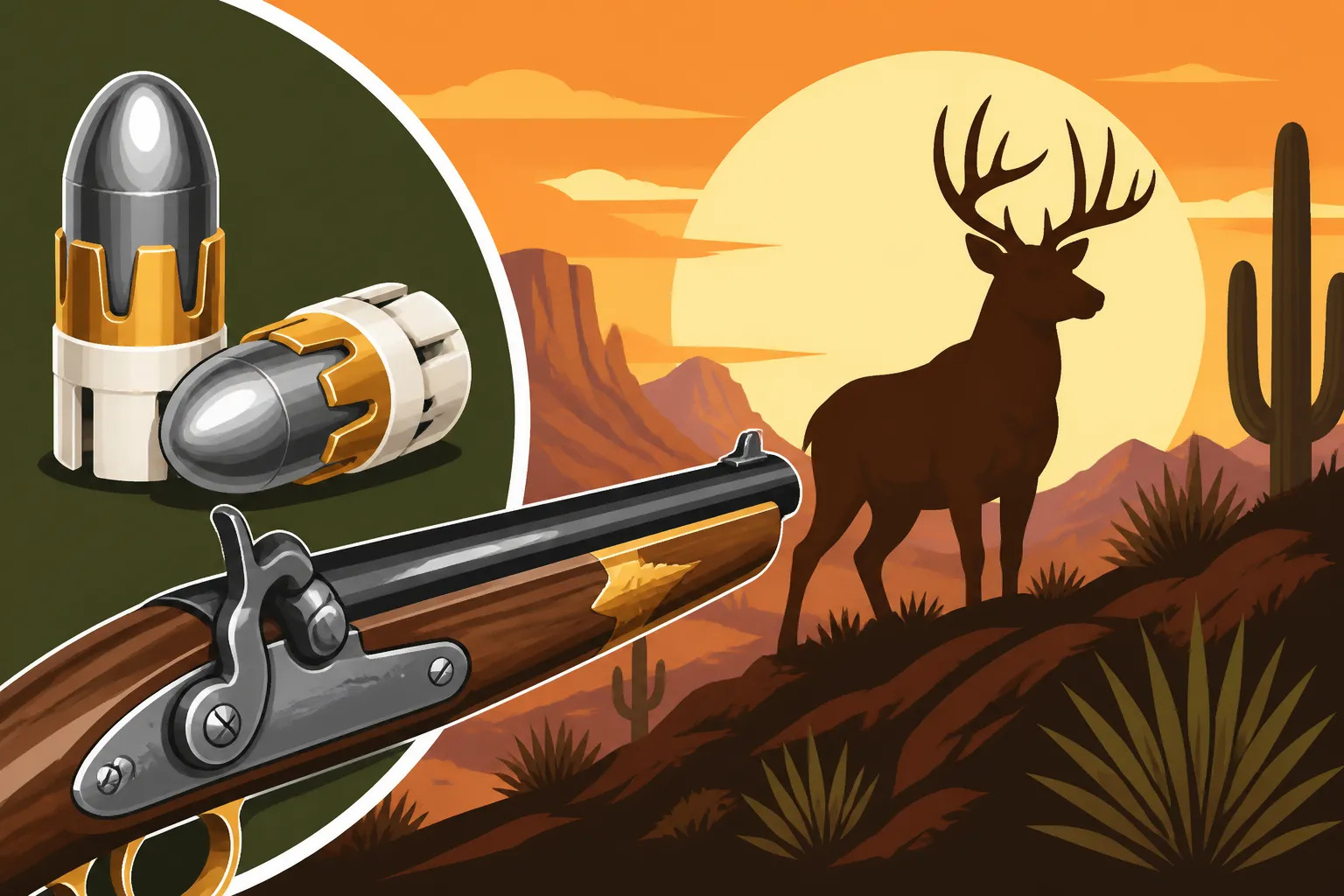
Sabot bullets have revolutionized muzzleloader hunting for many, offering a level of accuracy and terminal performance that traditional projectiles often struggle to match. A sabot, in simple terms, is a plastic sleeve that holds a smaller-diameter bullet centered in the bore of your muzzleloader. When fired, the sabot creates a gas seal, allowing the bullet to achieve higher velocities and engage the rifling more effectively. Once the bullet leaves the barrel, the sabot peels away, leaving the bullet to fly true to the target. This ingenious design allows you to shoot modern, high-performance bullets – often the same jacketed bullets used in centerfire rifles – from your muzzleloader.
The primary advantage is undeniable: enhanced accuracy. Modern bullets, designed with ballistic coefficients in mind, fly flatter and are less susceptible to wind drift than bulky conicals or round balls. This translates directly to tighter groups at the range and, more critically, greater confidence in the field. When you're making a shot at a wary Coues deer or a distant bull elk across an open mesa, that improved accuracy isn't just a luxury; it's a necessity for an ethical harvest. Furthermore, the terminal performance of jacketed bullets typically results in better expansion and energy transfer, leading to quicker, cleaner kills, which is paramount for any responsible hunter.
Increased Accuracy and Extended Range
One of the most compelling reasons to choose sabot bullets for your Arizona muzzleloader hunt is the dramatic improvement in accuracy and effective range they provide. Traditional muzzleloader projectiles, while charming in their simplicity, are often limited by their design. Patched round balls lose velocity quickly and are highly susceptible to wind, while many conical bullets, while heavier, can still tumble or suffer from less-than-ideal ballistic properties.
Sabot bullets, on the other hand, allow muzzleloaders to harness the precision of modern rifle bullet designs. These bullets are engineered for consistent flight, often featuring boat-tails, polymer tips, and carefully calculated ballistic coefficients. This means they maintain their velocity better, drift less in crosswinds, and follow a flatter trajectory. For a state like Arizona, where shots can often be taken across open desert flats or deep canyons, this extended effective range is a game-changer. You might not be shooting 500 yards with a muzzleloader, but extending your reliable ethical range from, say, 100 yards to 175 or even 200 yards with a sabot and proper practice can open up significant opportunities that wouldn't exist with traditional loads. This allows hunters to consider shots they might have previously deemed too risky, always within their practiced limits, of course.
Superior Terminal Performance on Big Game
Beyond accuracy, the terminal performance of sabot bullets is a critical factor for any big game hunter. When a bullet strikes an animal, you want it to expand reliably, transfer maximum energy, and create a sufficient wound channel to ensure a quick and humane harvest. Many traditional muzzleloader projectiles, particularly soft lead round balls, can deform inconsistently or have limited penetration on larger, tougher animals.
Sabot bullets address this by allowing you to use bullets specifically designed for controlled expansion and deep penetration, such as those made by Hornady, Barnes, or Federal. These are often the same bullets you'd trust in your centerfire rifle. For example, a Hornady SST sabot or a Barnes XPB bullet delivered from a muzzleloader will typically perform much like its centerfire counterpart, mushrooming perfectly and driving through bone and tissue. This is especially important when pursuing larger game like Arizona elk or sturdy mule deer. You need a bullet that can punch through a shoulder or break down an animal quickly. The reliable expansion and weight retention of quality sabot bullets significantly increase your chances of a clean pass-through and a short blood trail, leading to a more ethical and successful hunt.
Choosing the Right Sabot for Your Arizona Hunt
With the legality and benefits established, the next step is selecting the right sabot bullet for your specific hunting scenario in Arizona. This isn't a one-size-fits-all decision, as various factors will influence your choice, including the game you're pursuing, the typical terrain, and your personal muzzleloader's preferences. It's not just about picking the heaviest bullet; it's about matching the projectile to the task at hand to ensure optimal performance.
Consider what you're hunting: a Coues deer is a much smaller animal than a bull elk. A lighter, faster sabot might be ideal for deer, offering a flatter trajectory for potentially longer shots, while a heavier, more robust sabot might be necessary for the deeper penetration required on an elk. You also need to consider your muzzleloader's twist rate, as some barrels stabilize heavier or longer bullets better than others. It's always a good idea to consult your rifle's manual or manufacturer's recommendations.
Bullet Weight and Construction
When it comes to selecting sabot bullets, weight and construction are paramount. For deer, javelina, or smaller game, bullets in the 200-250 grain range are often excellent choices. They offer a good balance of velocity and energy, leading to flat trajectories and effective expansion on thinner-skinned animals. Brands like Thompson/Center's Shockwave or Hornady's SST in these weights are very popular and perform well.
However, if you're venturing out for Arizona elk, especially in challenging units like those on the Mogollon Rim as Arizona Elk Country, you'll likely want to step up to something heavier and more robust. Bullets in the 270-300 grain range or even heavier are often preferred for their increased momentum and ability to penetrate thick hide and bone. Look for bullets with bonded cores or monolithic construction (like Barnes Expander MZ) that are designed for high weight retention and controlled expansion. These bullets are built to drive deep, ensuring that if you hit a shoulder or a rib, you'll still get vital organ damage. It’s always best to experiment with several weights and designs at the range to see what your muzzleloader prefers and what groups best. Remember, consistency is key, and a bullet that shoots accurately is always superior, even if it's not the heaviest option available.
Ballistic Performance and Trajectory
Understanding the ballistic performance and trajectory of your chosen sabot bullet is crucial for ethical hunting, especially in Arizona's varied landscapes. Many hunters are tempted by high muzzle velocities, but a truly effective hunting bullet also needs to maintain that velocity downrange and offer a reasonably flat trajectory within your chosen ethical hunting distance.
Modern sabot bullets, with their superior ballistic coefficients, achieve this much better than traditional options. For example, a .45 caliber, 250-grain sabot might exit your muzzleloader at 1,800-2,000 feet per second (fps) and retain enough energy for a clean kill out to 150-200 yards. Comparing this to a round ball which drops like a stone beyond 75 yards, the difference is profound. Using tools like ballistic calculators or the detailed information provided by ammunition manufacturers can help you understand your bullet's drop and drift at various distances. Knowing your bullet's trajectory allows you to practice realistic scenarios and make accurate holdover adjustments in the field. This preparation is vital, whether you're taking a shot at a mule deer in open country or navigating the dense cover of the Glassing Arizona's Sky Islands for Coues Deer. Take the time to zero your muzzleloader carefully, perhaps at a Rifle Zero Distance for Open Desert that makes sense for your average shot opportunity, and then confirm drops at extended ranges. This knowledge will instill confidence and ensure ethical shots.
Dialing In Your Muzzleloader and Sabots
Once you've chosen your sabot bullets, the real work begins: dialing in your muzzleloader. This isn't just about sighting in at 100 yards; it's about understanding how your rifle performs with a specific load, in varying conditions, and across a range of distances. It takes time, patience, and a methodical approach, but the payoff is a hunting tool you can trust implicitly.
Remember that every muzzleloader is a unique beast. What works perfectly in your buddy's rifle might not be ideal for yours. This means thorough range testing with different powder charges, bullet types, and even primers. Consistency is paramount in muzzleloading; subtle changes can have significant impacts on accuracy.
Powder Charges and Primers
The interplay between your sabot bullet, powder charge, and primer is fundamental to achieving consistent accuracy. For powder, most modern muzzleloaders use either granular black powder substitutes like Pyrodex, Triple Seven, or Blackhorn 209, or pre-measured pellets. Arizona regulations on Powder Charges Allowed in Arizona Muzzleloaders are generally liberal, but always check your rifle's manual for maximum safe loads.
When starting your load development, begin with the manufacturer's recommended starting load and work your way up in small increments. Look for the "sweet spot" where your groups tighten up. For many sabots, charges between 90 and 120 grains (by volume) of a black powder substitute are common, but again, your rifle will tell you what it likes best. Primers also play a role; modern 209 shotgun primers are standard for most in-line muzzleloaders and provide reliable ignition. However, some primers are "hotter" than others and can subtly affect performance. Experimenting with different brands of 209 primers (e.g., CCI, Federal, Winchester) can sometimes yield surprising improvements in group size. Always ensure your powder is stored correctly and that your primers are fresh for consistent ignition.
Practice and Field Confidence
Even with the best sabot and carefully tuned load, your performance in the field hinges entirely on practice and building confidence. Shooting a muzzleloader accurately requires a different rhythm and technique than a centerfire rifle. The recoil can be stout, and the smoke often obscures your view immediately after the shot.
Spend ample time at the range, not just shooting from a bench, but practicing from various field positions: kneeling, sitting, and even standing. Simulate hunting scenarios. Practice loading quickly and efficiently, especially under pressure, as reloading in the field can be cumbersome. Get comfortable with the feel of the rifle and the cadence of the shot. Knowing your ballistic drops at different ranges is one thing, but practicing those shots regularly at 50, 100, 150, and 200 yards (if your rifle and skill allow for ethical shots at that distance) is what truly builds confidence. Resources like GoHunt can provide invaluable insights into unit terrain and potential shot distances, helping you tailor your practice. The more you practice, the more intuitive your movements become, and the more confident you'll be when that trophy animal steps out, ensuring you can make an ethical, clean shot when it matters most.
Using Modern Resources for Muzzleloader Hunting in Arizona
Even with traditional weapons like muzzleloaders, modern tools and resources can significantly enhance your hunting preparation and success in Arizona. The days of relying solely on paper maps and word-of-mouth are long gone, replaced by powerful digital platforms that offer unprecedented levels of information. Integrating these resources into your planning, especially when utilizing advanced projectiles like sabots, can give you a distinct edge.
Whether you're scouting a new unit, researching game movements, or simply staying on top of the latest regulations, these digital tools are invaluable. They help you make informed decisions, optimize your time in the field, and increase your chances of a successful hunt.
Digital Scouting and Regulation Research
Before you even step foot in the Arizona backcountry with your muzzleloader, leveraging digital scouting tools can give you a massive advantage. Platforms like GoHunt, OnX Hunt, or BaseMap allow you to analyze terrain, identify potential bedding areas, water sources, and travel corridors from the comfort of your home. You can study satellite imagery to find hidden canyons for Water Sources That Concentrate Arizona Desert Game or pinpoint subtle elevation changes that might hold deer. This kind of E-Scouting an Arizona Unit Before the Season is critical for maximizing your limited hunting time, particularly for challenging species like Coues deer or elusive elk.
Equally important is staying updated on the ever-evolving hunting regulations. The Arizona Game and Fish Department website is the official source, but understanding the nuances of the regulations booklet can sometimes be tricky. Always ensure you've reviewed Reading the Arizona Hunt Regulations Booklet for the current year, paying close attention to specific rules for muzzleloader seasons, permitted weapons during HAM hunts, and general hunting rules like legal shooting hours. Tools like GoHunt also often provide summarized, easy-to-digest regulatory information, helping you quickly confirm details about specific hunts or weapon requirements.
Community Insights and Data Analysis
Beyond mapping and regulations, the hunting community itself, often facilitated by online platforms, offers a wealth of shared knowledge. Forums, social media groups, and dedicated hunting sites can provide valuable insights into specific units, general game behavior, and even tips for muzzleloader loads that perform well in Arizona's diverse conditions.
Moreover, serious hunters often delve into data analysis, looking at draw odds, harvest statistics, and game population trends. While a muzzleloader tag might be easier to draw than a rifle tag for some premium units, understanding these numbers can still help you refine your application strategy. GoHunt, for instance, provides detailed draw odds and harvest success data by unit, which can be instrumental in choosing where to apply or which Units Around Flagstaff Worth Scouting might offer the best muzzleloader opportunities. Engaging with these communities and analyzing data allows you to learn from the experiences of others, ask questions, and contribute your own insights, making you a more informed and prepared hunter overall.
| Projectile Type | Key Characteristics | Pros | Cons | Ideal for Arizona Game |
|---|---|---|---|---|
| Sabot Bullets | Modern jacketed bullet in plastic sleeve; various designs | Excellent accuracy, flat trajectory, superior terminal performance | Can be finicky to load, higher cost per shot, requires bore-matching sabot | All big game (Elk, Mule Deer, Coues, Javelina) |
| Full Bore Conical | Solid lead projectile, fits bore snugly | Good energy transfer, simpler loading than sabots, more traditional | Lower ballistic coefficient, less accurate at longer ranges | Deer, Javelina, closer-range Elk |
| Patched Round Ball | Spherical lead ball, cloth patch for seal | Very traditional, low cost, light recoil, simple construction | Very limited range, poor ballistics, light for big game | Small game, very close-range deer, traditionalists |
Disclaimer
Please remember that hunting regulations can change. While I strive to provide the most current and accurate information, it is always your responsibility to consult the official Arizona Game and Fish Department regulations prior to any hunting activity. This guide is for informational purposes only and does not supersede state law.