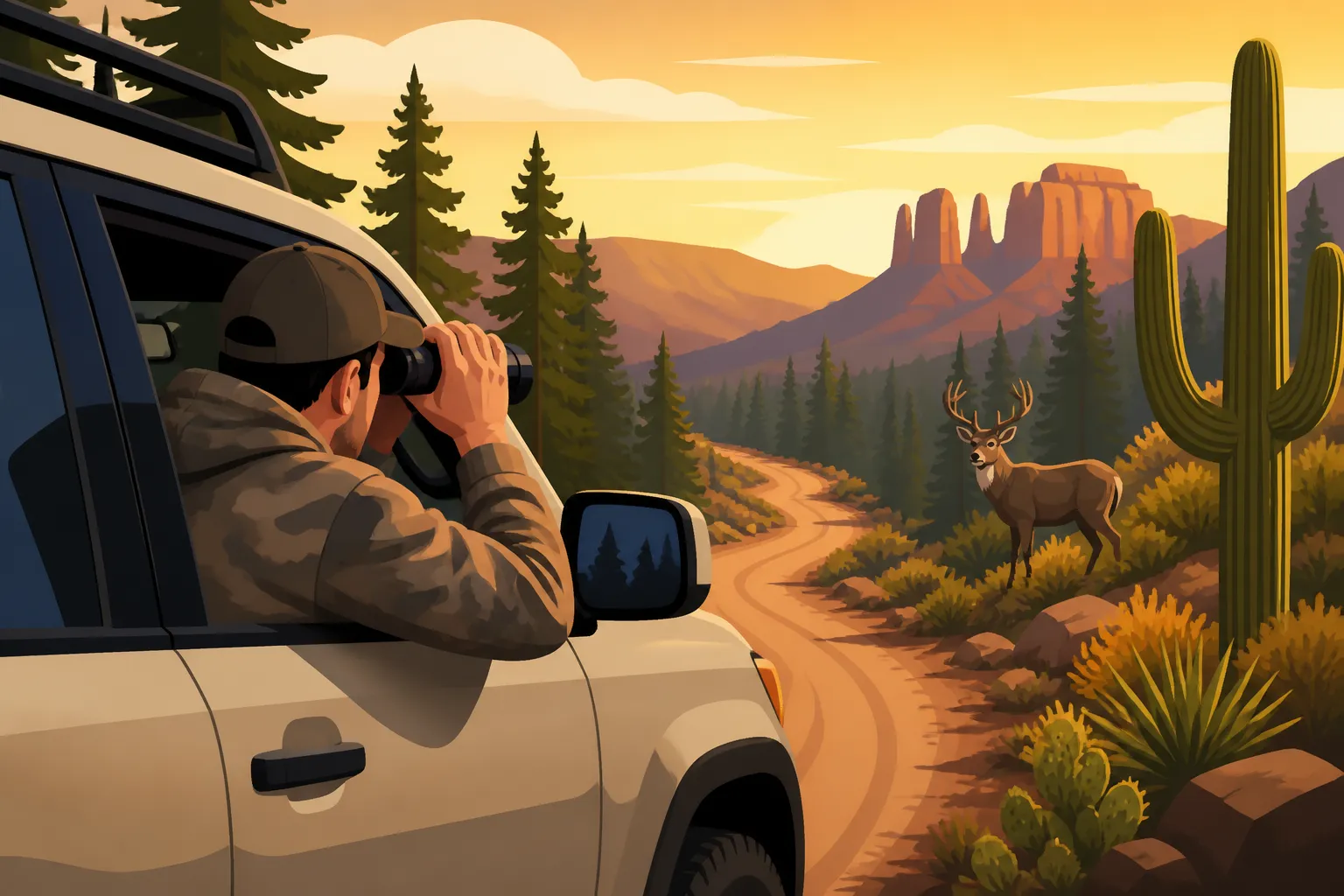
Glassing From a Vehicle Along a Forest Road
Arizona's vast and often rugged terrain makes covering ground on foot an incredible challenge, especially when you're short on time, scouting a new unit, or dealing with physical limitations. You can feel the pressure to find game, but the sheer scale of the landscape can be overwhelming. How do you efficiently locate deer, elk, or javelina without burning yourself out or missing key opportunities simply because you couldn't get eyes on enough country? This guide will dive deep into the art of glassing from a vehicle along forest roads, a highly effective, yet often misunderstood, method for hunters looking to maximize their time and expand their scouting and hunting reach in the Grand Canyon State.
The Strategic Advantage of Roadside Glassing in Arizona
Let's face it, Arizona is a massive state, and much of its prime hunting ground is public land crisscrossed by an extensive network of forest roads. While the romantic ideal of hunting often involves miles of hiking deep into the backcountry, the reality for many of us is limited time, aging knees, or simply the need to cover as much potential habitat as possible in a short window. This is where glassing from a vehicle becomes not just a convenience, but a strategic advantage that can dramatically increase your chances of finding game.
Why Forest Roads Are Prime Observation Points
Forest roads in Arizona are rarely just flat, straight lines. They often wind their way through diverse topography, hugging ridges, dipping into canyons, and traversing varying elevations. This natural undulation provides unique, elevated vantage points that can be impossible to access on foot without a significant time investment or extreme physical exertion. Think about it: a road might crest a ridge, opening up a panoramic view of several drainages, south-facing slopes, or distant mesquite flats – all potential game habitat. These roads act like natural "scouting highways," allowing you to drive past miles of country while constantly evaluating potential hot spots. Hunters who ignore the country visible from a road because it feels "too easy" are often missing out on opportunities. Game animals, especially deer and elk, frequently utilize areas relatively close to roads, especially if the pressure is low or cover is abundant.
Maximizing Limited Time and Energy
For the weekend warrior, the hunter with a family, or anyone who can't dedicate weeks to a backcountry pack trip, vehicle-based glassing is a game-changer. Imagine having only a day or two to scout a new unit before the season opens. Attempting to hike every drainage would be futile. By strategically driving forest roads and stopping at key overlooks, you can put eyes on an incredible amount of terrain. This method allows you to quickly eliminate unproductive areas and identify pockets that warrant a deeper, on-foot investigation later. It's about working smarter, not just harder. This approach frees up your precious physical energy for the actual stalk, rather than expending it all just to find an animal. It also makes hunting more accessible for those with physical constraints, ensuring that everyone can participate in the thrill of the chase.
Enhanced Safety and Predictable Accessibility
In Arizona's vast and sometimes unforgiving landscape, safety is always a concern. Remote backcountry can be days from help if something goes wrong. Forest roads, while sometimes rough, offer a more predictable path and a degree of safety. You're typically within reach of cell service more often, and if your vehicle breaks down, you're on a known route where other travelers might eventually pass by. This accessibility also means you can react quickly to changing weather conditions, such as sudden monsoon storms that can turn dirt roads into impassable mud pits, or rapidly cooling temperatures in the high country. Before you head out, make sure to check Motorized Travel Rules on Arizona Public Land and any current information on Seasonal Road Closures Across Arizona Forests to ensure your planned route is open and accessible.
Essential Gear and Setup for Effective Vehicle Glassing
You wouldn't head into the backcountry without the right pack and boots, and the same goes for effective vehicle glassing. This isn't just about pulling over and squinting; it's about having the right tools and knowing how to use them from the comfort of your truck or SUV.
Optics: The Cornerstone of Success
Without quality optics, you're just sightseeing. Your glass is your primary tool for separating deer from distant rocks or spotting the flick of an ear in dense brush.
- Binoculars: These are your first line of defense. A good pair of 10×42 or 12×50 binoculars are excellent for handheld scanning. While 10x is versatile, the extra magnification of 12x can really make a difference for picking apart distant hillsides. The key is handheld stability; practice holding them steady, bracing your elbows on your knees or the vehicle door frame. For extended glassing, even a simple window mount or a small tripod can make a 10x or 12x feel like a much more powerful tool, reducing fatigue and revealing more detail.
- Spotting Scopes: Once you've identified something interesting with your binoculars, a spotting scope is indispensable for making the call on whether it's a legal animal, a shooter, or just a doe. A 65mm or 85mm objective lens with 20-60x or 25-75x magnification will allow you to pick apart details that binoculars simply can't resolve. This is crucial for things like Judging an Arizona Coues Buck at Distance from a mile away or confirming points on a distant elk. You’ll need a sturdy tripod to go with it; a flimsy tripod will negate the benefits of even the best spotting scope.
- Tripods and Window Mounts: Never underestimate the power of stability. A dedicated tripod for your spotting scope is a must. For binoculars, a simple window mount that clamps to your vehicle door can provide rock-solid stability, turning your 10x binoculars into a fatigue-free long-range scanner. Some hunters even set up a small tabletop tripod on their dashboard if the angle is right. The more stable your optics, the more subtle details you'll pick up, and the longer you can comfortably glass.
Vehicle Configuration and Comfort
Your vehicle isn't just transportation; it's your mobile blind and observation platform. Optimize it for comfort and functionality.
- Clear Sightlines: Keep your windows spotless, both inside and out. Dust, mud, and smudges are your enemy. Consider using a good window cleaner regularly. Interior clutter on your dash or seats can reflect in the glass, obscuring your view. Keep it tidy.
- Comfort for Long Sessions: Glassing is a game of patience. Ensure your seat is comfortable and adjustable. Bring plenty of water, coffee, and snacks. Long hours behind the glass can be surprisingly draining, and staying hydrated and fueled is important.
- Quiet Operation: When you stop to glass, turn off the engine. Not only does it save fuel, but it eliminates vibration and engine noise that could spook nearby game or interfere with your concentration. Learn how to operate your windows quietly. Some vehicles have noisy power windows; if so, consider a manual crank window if you have the option, or just open them slowly.
Mapping Tools and Data Integration
In today's hunting world, digital maps are practically mandatory. They allow you to know exactly where you are, identify public vs. private land, and pinpoint advantageous glassing locations.
- Digital Mapping Apps: Apps like OnX Hunt, Gaia GPS, or BaseMaps are invaluable. They allow you to layer public land boundaries, private land ownership, topo lines, and even satellite imagery. This is critical for identifying potential glassing knobs and ensuring you're not inadvertently trespassing. They also help you visualize the terrain you're looking at, identifying saddles, drainages, and other features that might hold game. You can even use them for E-Scouting an Arizona Unit Before the Season, marking potential glassing points from home.
- Real-Time Data: Knowing the current weather, wind direction, and sunrise/sunset times is vital. Wind direction, in particular, will dictate how scent travels and how animals might be moving. Being able to read Reading Wind on a Sky Island Stalk is key, even when glassing from a road. Many mapping apps integrate weather data, and a good old-fashioned weather radio or even a reliable app on your phone can fill in the gaps.
- GoHunt: Tools like GoHunt's Insider platform offer incredible value by providing detailed mapping overlays, draw odds, and filtering options to help you identify units with high public land percentages and access routes. Using GoHunt, you can pinpoint specific forest roads that offer access to prime habitat and create waypoints for potential glassing spots long before you even leave your driveway. This saves immense time and helps prioritize your physical scouting efforts.
Techniques for Spotting Game from the Road
Glassing from a vehicle isn't just about aimlessly scanning the horizon. There's a method to the madness, a systematic approach that separates casual observers from successful hunters.
The Grid Glassing Method from a Stationary Position
This is arguably the most effective technique for picking apart vast landscapes. It requires patience and discipline.
- Set Your Anchors: When you pull over, first take a wide-angle look at the entire area you intend to glass. Identify the left, right, top, and bottom boundaries of your observation area. Mentally divide this area into smaller, manageable "grids."
- Start Wide, Then Narrow: With your binoculars (or spotting scope at its lowest power), start at one corner of your chosen grid – say, the top left. Methodically scan horizontally, moving your optics slowly, overlapping each scan by about 25-50%. Once you reach the right boundary, drop your optics down slightly and scan back to the left. Continue this pattern, working your way down the hillside, as if you're reading a book.
- Focus on Irregularities: Your brain is trained to recognize patterns. Animals break those patterns. Look for horizontal lines (like a deer's back) in a world of vertical trees, the glint of an antler, a patch of hide that doesn't quite match the surrounding vegetation, or any subtle movement. Pay extra attention to shade lines, the edges of thick cover, and areas where game might feel secure. The article, The Grid Glassing Method, Step by Step, offers an even deeper dive into this crucial technique.
- Patience is Paramount: It's easy to rush, especially when you're itching to find something. But game often reveals itself slowly. A deer might be bedded, only occasionally twitching an ear. An elk might be obscured by a tree, only to step out minutes later. Don't be afraid to spend 30 minutes or more meticulously picking apart a single hillside. Sometimes, the longer you sit, the more things appear.
Scanning While Slow Rolling (When Legal and Safe)
While stationary glassing is primary, there are times you can utilize very slow vehicle movement, where legal and safe, to cover ground. This isn't driving at 30 mph and hoping to see something; it's more like a crawl at 5-10 mph, typically on less traveled two-track roads.
- Focus on Movement and Edges: When moving slowly, your eyes should be constantly scanning for movement or stark irregularities. You won't be picking apart every bush, but you might catch a flash of white, a flick of a tail, or an animal moving through a clear cutting.
- Identify Stop Points: The goal of slow rolling is to identify promising areas where you can then stop and apply the grid glassing method. If you see something that catches your eye, pull over immediately, turn off the engine, and get out your heavier glass for a detailed inspection.
- Safety First: This method should only be employed on very remote, low-traffic roads where you won't endanger yourself or others. Always be aware of your surroundings, potential hazards on the road, and other vehicles. Never do this on paved roads or heavily used forest service roads.
Reading Terrain Features for Game Sign
Understanding where animals are likely to be found significantly increases your success. Arizona's diverse habitats mean different features hold different appeal.
- North-Facing Slopes and Shade: In Arizona's often scorching heat, especially during early seasons, north-facing slopes and shaded areas are sanctuaries. Animals will bed there during the day to escape the sun. Pay close attention to these areas, particularly beneath rimrock, in dense timber, or within thick canyons.
- Water Sources: This is non-negotiable in the desert. Water Sources That Concentrate Arizona Desert Game are magnets for all big game. Look for stock tanks, seeps, springs, and even recent rain puddles. Glassing around these areas, especially during dry spells or early morning/late evening, can be incredibly productive. You might even find opportunities for Hunting a Stock Tank During Early Archery.
- Feeding and Bedding Areas: Learn to recognize prime feeding areas (like oak brush for deer or grassy meadows for elk) and bedding areas (thick cover, often with good escape routes). Animals will transition between these areas throughout the day. Your goal is to intercept them or locate them in their midday beds.
- Understanding Animal Behavior: The time of day significantly impacts where you'll find animals. Early morning and late evening often find them actively feeding or moving. Midday, they're typically bedded. This also ties into Best Time of Day to Glass a Sky Island, where thermals and light play a huge role. Using GoHunt's mapping features, you can analyze historical harvest data and habitat overlays to predict these patterns more effectively.
Ethical Considerations and Legalities of Vehicle Glassing
While glassing from a vehicle can be highly effective, it's crucial to understand the ethical and legal boundaries. Misuse can lead to fines, loss of privileges, and damage to the reputation of hunters.
Respecting Private Property Boundaries
Arizona has a complex mosaic of public, private, and state trust lands. Knowing precisely where you are and where the animal you're glassing is located is paramount.
- Mapping Apps Are Your Shield: This is where digital mapping apps like OnX Hunt become non-negotiable. They clearly delineate public and private land boundaries, often down to individual parcels. Always double-check your location, and the location of the animal, before making a move.
- "Shoot, Shovel, and Shut Up" is Not a Strategy: You are absolutely forbidden to shoot across private property or retrieve an animal from private land without explicit permission from the landowner. If you glass a monster buck bedded just inside a private fence, you either need permission, or you pass. There are serious penalties for violating Trespass Law on Posted Arizona Property. It's your responsibility to know whose land you're on, and ignorance is no excuse. This is another area where GoHunt’s mapping system, with its detailed land ownership layers, proves invaluable.
Vehicle Use and Road Closures
Adhering to vehicle regulations on public lands is not just about avoiding a ticket; it's about respecting the resource and preventing unnecessary damage to fragile ecosystems.
- Stay on Designated Routes: Public land agencies, like the U.S. Forest Service and BLM, have specific regulations regarding motorized travel. These rules are put in place to protect wildlife, habitat, and watershed health. Never drive off-road to pursue game, scout, or set up a glassing position unless it's an explicitly designated route or a rare exception like retrieving a downed animal with permission and specific regulations. Consult Motorized Travel Rules on Arizona Public Land and motor vehicle use maps (MVUMs) for the specific area you're hunting.
- Observe Seasonal Closures: Many forest roads, especially in higher elevations, are subject to Seasonal Road Closures Across Arizona Forests during winter or spring to prevent damage from mud and snowmelt. Always check current conditions and closure notices before heading out. Driving on a closed road can result in hefty fines and resource damage.
Fair Chase and Sportsmanship
The concept of fair chase is at the heart of ethical hunting. Glassing from a vehicle should be seen as a tool for scouting and accessing hunting areas, not as a means to unfairly gain an advantage over game.
- The Vehicle as an Observation Platform, Not a Shooting Platform: In Arizona, it is generally illegal to shoot at game from a vehicle, across a public road, or within a specified distance of a road (often a public right-of-way). The vehicle is there to help you find and assess game, and to get you to a spot where you can then exit, stalk, and take an ethical shot on foot.
- Minimizing Disturbance: Be mindful of your presence. Keep noise down, avoid sudden movements, and don't block roads, especially in areas where other hunters or recreationists might be present. Respect other users of public land. If you're constantly blowing your horn, playing loud music, or driving erratically, you're not only disturbing game but creating a negative impression of hunters.
Table: Pros and Cons of Vehicle Glassing
| Aspect | Pros of Vehicle Glassing | Cons of Vehicle Glassing |
|---|---|---|
| Effort | Low physical exertion, ideal for limited mobility | Less immersive than deep backcountry hunting |
| Coverage | Covers vast distances quickly, puts eyes on more country | Limited to areas with road access; misses deep pockets |
| Observation | Stable platform for optics, often offers elevated views | Road noise can disturb close game; potential for distractions |
| Safety | Quicker access to help, more predictable routes | Can foster reliance on roads, less self-sufficient |
| Legality | Excellent for legal scouting and access | High risk of accidental road hunting or trespassing violations |
| Flexibility | Adaptable to weather conditions, easy to reposition quickly | Can encourage lazy scouting habits; less 'bush time' |
Disclaimer
Please remember that hunting regulations, seasons, and access rules in Arizona can change. It is always your responsibility to consult the most current Arizona Game and Fish Department regulations before planning any hunt. This article is for informational purposes only and should not be considered legal advice.