Reading Wind on a Sky Island Stalk
You've spent countless hours glassing, painstakingly picked apart distant hillsides, and finally, there it is: that elusive Coues deer, bedded in a steep, shadow-draped canyon of an Arizona Sky Island. The hard part, you think, is over. But then you start your approach, and the mountain itself seems to breathe, sending a phantom breeze swirling up from below, then down from above, threatening to betray your every move. Mastering the art of reading and playing the wind on these challenging stalks isn't just an advantage; it's often the difference between a successful close encounter and a deer blowing out of the country before you even get within range.
Understanding Arizona's Sky Island Microclimates
The Sky Islands of Arizona are a truly unique environment, a series of isolated mountain ranges rising dramatically from the desert floor. These ecological islands create their own weather systems, and understanding these localized conditions is paramount for any hunter venturing into their rugged embrace. It's not enough to know the general wind direction; you need to grasp the nuances of the terrain's influence.
Unique Geographic Influences on Wind
Imagine standing at the base of the Santa Catalina Mountains, looking up at groves of pine and fir. The air here feels different from the scorching desert below. As elevation changes, so does the atmospheric pressure and temperature, creating complex air currents. Deep canyons act like funnels, compressing and accelerating wind, or creating dead air pockets and swirling eddies where the wind changes direction unpredictably. Ridges, especially exposed ones, become highways for stronger, more consistent winds, while the leeward side of a ridge might offer a temporary reprieve.
Vegetation also plays a huge role. Dense stands of oak brush or manzanita can block and redirect ground-level winds, making the air feel calm even when a brisk breeze is moving just above the canopy. Conversely, a sparse, rocky slope offers little resistance, allowing wind to sweep freely. When you're trying to get close to a wary Coues deer, often referred to as the "gray ghost" for good reason, these microclimates mean your scent can be carried in a dozen different directions within a few hundred yards. This is why thorough preparation, including understanding these dynamics, is as important as your shot accuracy. It's a key part of what makes "Coues Deer in the Southeastern Sky Islands" such a unique experience.
Diurnal Wind Shifts and Thermals
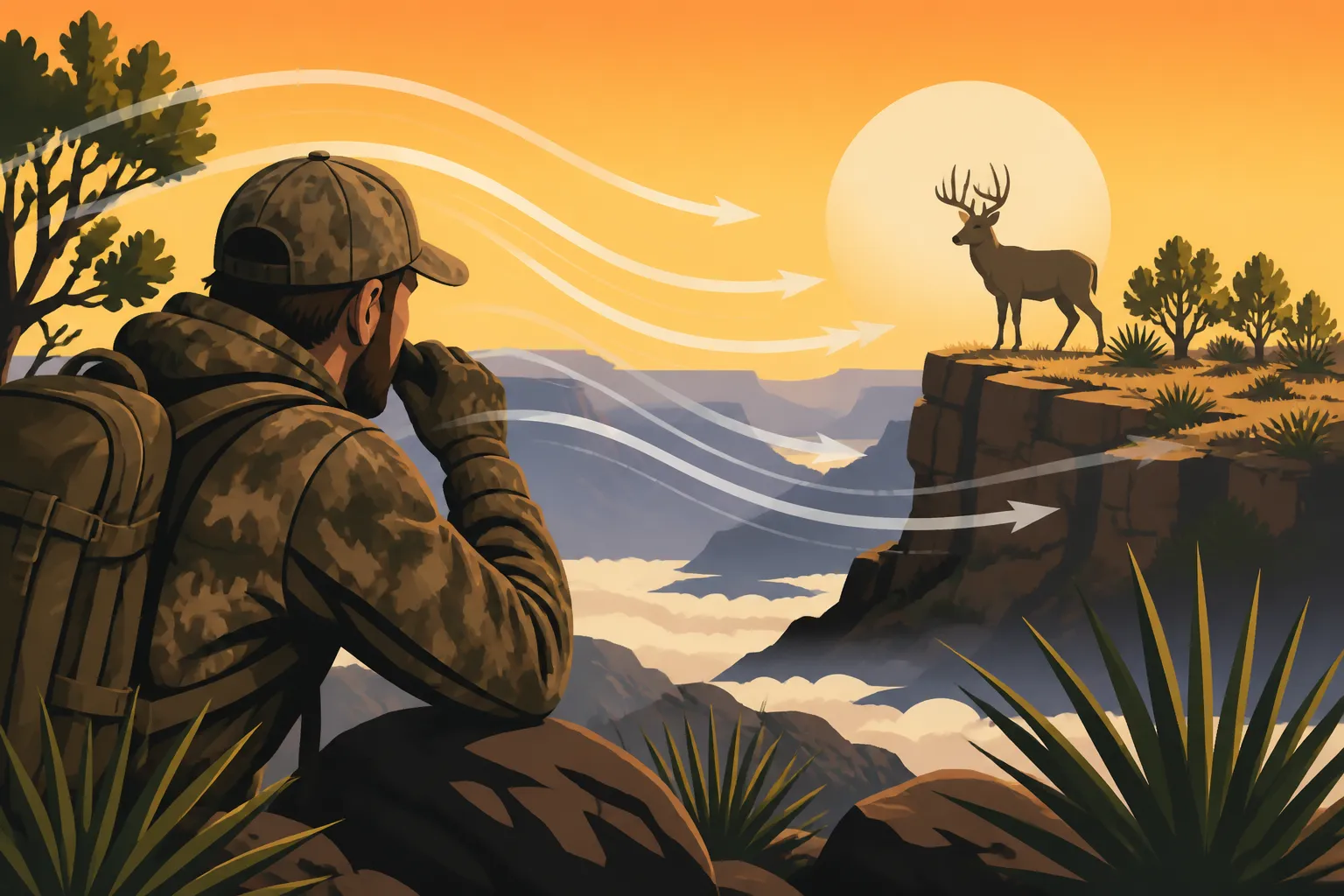
The most critical wind phenomenon in Sky Islands is the daily thermal cycle. As the sun rises, it heats the earth, and warm air begins to rise. This creates an upward draft, or "thermal," that pulls air from the lower elevations up the mountainsides. This effect is strongest in the late morning and early afternoon. If you're stalking a deer uphill during this time, the rising thermal will carry your scent directly to them.
As the sun sets and the landscape begins to cool, the opposite occurs. Cold air, being denser, sinks down the mountain. This creates a "down-thermal" or katabatic wind, pushing air from the higher elevations down into the canyons and across the desert floor. This downdraft typically becomes noticeable in the late afternoon and intensifies into the evening. Understanding these shifts is vital. If you're making an evening stalk, approaching from above a bedded animal can be disastrous, as your scent will be carried directly to them by the sinking air. Many hunters find that the "Best Time of Day to Glass a Sky Island" often corresponds with these thermal shifts, as animals may move more predictably when winds are more stable.
The Basics of Reading Wind for Hunters
Before diving into the specifics of Sky Island winds, it's essential to have a solid grasp of general wind reading principles. This foundation will help you adapt to the more complex scenarios you'll face in Arizona's rugged terrain.
Visual Cues and Sensory Input
Your eyes and ears are your primary wind tools. Start by looking for anything that moves:
- Trees and Shrubs: The direction and intensity of their sway can give you a broad overview of the wind. Pay attention to the top branches for overall direction and lower branches for ground-level movement.
- Grass and Leaves: Even a slight rustle or shimmer can indicate subtle air currents that might be enough to carry your scent.
- Dust and Dirt: If the ground is dry, a sudden puff of dust, even a small one, clearly shows wind direction.
- Spiderwebs: These delicate strands are incredibly sensitive to air movement and can reveal the faintest of breezes.
- Clouds and Vapor: While higher up, the movement of clouds can sometimes indicate the prevailing wind direction, though localized winds might be very different.
Beyond sight, don't underestimate your other senses. Feel the air on your face and ears; a subtle coolness on one side can indicate wind. Listen for the rustle of leaves or the whistling of wind through rocks. Even a slight sound difference can tell you which way the wind is moving. This constant sensory input is critical, especially when trying to pinpoint exactly "How Far to Stalk a Bedded Coues Buck" and how to get there undetected.
The Importance of Constant Awareness
The wind in a Sky Island environment is rarely constant. It's a living, breathing entity that changes with the terrain, time of day, and even minute shifts in temperature. This means continuous awareness is non-negotiable. Don't check the wind once at the start of your stalk and assume it will hold. Every few steps, especially as you navigate new terrain features like crossing a saddle, dropping into a wash, or rounding a ridge, you need to re-evaluate.
Use a wind checker constantly. A small bottle of unscented powder or even a piece of milkweed fluff can be your best friend. Release a puff of powder every 20-30 yards, or more frequently if the terrain is particularly broken. Watch how it drifts, not just immediately, but as far as you can follow it. Does it lift? Does it drop? Does it swirl back on itself? This real-time feedback loop is crucial. Failing to maintain this vigilance can lead to a busted hunt, as a sudden change in wind can carry your scent right to a deer you’ve spent hours trying to approach.
Specific Wind Behaviors in Sky Island Terrain
Now, let's get into the nitty-gritty of how wind interacts with the distinctive features of Arizona's Sky Islands. These are the nuances that will truly make or break your stalk.
Canyon and Draw Dynamics
Canyons and draws are natural funnels for air movement, but they are also notorious for creating unpredictable eddies and swirls. During the day, particularly mid-morning to late afternoon, canyons act like chimneys, drawing air uphill. This is your classic up-thermal. If you’re at the bottom of a canyon and a deer is above you, your scent is likely going right to them. Therefore, you should strive to be above the animal, letting your scent rise over them.
However, it's not always that simple. The shape of the canyon, its width, depth, and the presence of side draws can create swirling air currents. Wind can come down one side of a canyon, hit the bottom, and swirl back up the other side, or even eddy back upstream. This is where "Playing Thermals on a Canyon Stalk" becomes an art form. You might release your wind checker powder and see it go straight up, then watch it swirl sideways into a smaller draw. When moving through a canyon, stay as close to the leeward wall as possible, or hug the terrain features that might offer momentary dead air. The goal is to always assume the worst-case scenario and plan your route accordingly.
Ridge Line and Saddle Effects
Ridges are fantastic for travel and glassing, but they expose you to the full force of the wind. As air flows over a ridge, it often accelerates, creating a strong, consistent current. This can be a good thing if it's blowing directly away from your target. However, the downside is that crossing over a ridge can expose you to a strong crosswind or suddenly shift the wind direction entirely as you drop into the next drainage.
Saddles, the low points between two peaks or ridges, are absolute wind traps. They are notorious for turbulence and swirling winds because air is compressed and forced through a narrow opening. If you release your wind checker in a saddle, you might see it scatter in multiple directions. It's often best to avoid traveling through saddles directly if a deer is nearby. Instead, consider skirting around them, staying below the crest of the ridge, or utilizing features like rock outcroppings to break up the wind and mask your approach. When planning your route on a platform like GoHunt, pay close attention to the topographical lines around saddles and ridges, as they are crucial indicators of potential wind issues.
Aspect and Sun Exposure
The direction a slope faces, known as its aspect, heavily influences its heating and cooling, which in turn affects wind. South-facing slopes receive more direct sunlight and heat up faster than north-facing slopes. This means that an up-thermal will establish itself earlier and be stronger on a south-facing slope. If you're hunting a south-facing slope in the morning, the rising thermals will likely be carrying your scent uphill. Conversely, a north-facing slope, often shadier and cooler, might experience weaker or delayed thermals.
Understanding this allows you to strategize your approach. If you're stalking a deer on a south-facing slope in the morning, you'll want to stay above it or approach from a flank, using the rising air to your advantage by having it carry your scent over the deer. In the evening, as the air cools, the downdrafts will be strongest on these same slopes. A classic scenario involves a Coues buck feeding on an east-facing slope in the morning, with the sun hitting it directly, creating an updraft. By midday, it might bed down on a cooler, north-facing slope where the thermals are less intense or even non-existent.
Tactics for Stalking with Tricky Winds
Navigating the unpredictable winds of the Sky Islands requires a strategic mindset and a willingness to adapt. Sometimes, the most direct route is the most foolish.
The Wind Cone and Your Approach Angle
Every hunter knows the basic principle: stay downwind of your quarry. But in Sky Islands, this "downwind" area isn't a simple straight line. Imagine your scent as a cone spreading out from you. The goal is to keep that cone from intersecting your target. This means often taking a much longer, circuitous route. If the wind is swirling, you might have to backtrack, traverse, or even sit tight and wait for a more favorable shift.
When you spot a deer, immediately assess the wind in relation to its position. Where is your scent going? Where will it go if you move? This might mean approaching from the side, effectively using a crosswind that pushes your scent parallel to the deer's location, rather than directly at it. Remember that Coues deer have an incredible sense of smell, so "How Close a Bowhunter Needs to Get on Coues" requires absolute precision, making wind direction even more critical. If you have to choose between exposing yourself visually for a short period or taking a longer, safer route that keeps you downwind, always choose the latter. Patience is a virtue, and often, the most indirect route is the fastest to success.
Pausing and Re-evaluating Your Stalk
The temptation to keep pushing forward once you have a target in sight is strong. But in the Sky Islands, haste often leads to failure. Instead, build tactical pauses into your stalk. Every 50-100 yards, or whenever you enter a new micro-terrain feature (a small rise, a new wash, a cluster of trees), stop. Get low, take a few deep breaths, and re-check the wind. Don't just release one puff of powder; release several, watching their full trajectory.
During these pauses, also reassess the deer. Has it moved? Is it still bedded? Are other animals in the area that you hadn't spotted? These moments of quiet observation and wind checking are crucial for fine-tuning your approach. If the wind has shifted unfavorably, you might have to wait it out, or even pull back and try a different route. Sometimes, this patience leads to an animal moving into a better position for you, or the wind settling into a more predictable pattern. This methodical approach is also key when considering strategies like "Still Hunting Oak Brush for Coues", where slow, deliberate movement is fundamental.
Using Topography to Your Advantage
The broken, rugged terrain of the Sky Islands, while challenging, can also be your greatest ally in managing wind. Look for features that can create "dead air" pockets or shield your scent.
- Lee Sides: The side of a ridge or hill sheltered from the prevailing wind can offer a calmer approach.
- Deep Washes and Gulches: While some washes can funnel wind, others, especially deeper, narrower ones with dense vegetation, can momentarily trap still air or create a localized calm zone. "Using Washes and Draws to Close Distance" effectively involves understanding these nuances.
- Dense Vegetation: Thickets of manzanita, oak brush, or junipers can act as physical barriers, deflecting or buffering the wind at ground level. Move through these cautiously, but recognize their potential for concealment.
- Large Boulders and Rock Formations: These can create small pockets of still air directly behind them, offering momentary refuge from swirling winds.
When planning your route, use your maps (digital or paper) to identify these features. A ridge line that gives you a leeward approach, a deep wash that shields you, or a thick patch of timber that breaks the wind. Each of these can be a stepping stone in your silent, scent-free journey toward your target. This strategic use of the landscape requires not just mental preparation but also significant physical endurance, highlighting why "Preparing Physically for a Desert Hunt" is so important.
Tools and Techniques for Wind Assessment
Beyond your natural senses, modern hunting offers several effective tools and techniques to help you master wind detection. Integrating these into your routine will significantly boost your chances of success.
Physical Wind Indicators
There's a reason experienced hunters always carry a wind checker – it's the simplest and most reliable way to confirm wind direction at ground level.
- Scent-Free Wind Checker Powder: These small bottles contain a very fine, unscented powder that, when squeezed, releases a puff that drifts visibly in the slightest breeze. Brands like Wind Checker are widely available and indispensable.
- Milkweed Fluff: If you can find milkweed in the area, the delicate fluff from its seeds is an excellent, natural alternative to powder. It's incredibly light and floats for a long time, giving you a good read on air currents.
- Thread/String: A very lightweight piece of thread (dental floss, fine sewing thread) tied to your bow string, backpack strap, or a small stick can give you a continuous, if subtle, indication of wind. The downside is it's harder to see than powder in low light or dense cover.
- Smoke: If you're building a small, controlled fire for warmth or cooking during a prolonged wait (and fire restrictions allow it), the smoke can provide a powerful visual indicator of air movement, especially thermals. However, this is not a practical tool for an active stalk.
It's a good practice to use your wind checker frequently, especially before making a significant move or rounding a corner where the wind might shift. The goal is to always know where your scent is going.
Digital Aids and Planning
In today's hunting world, technology can offer valuable assistance even before you set foot on the mountain.
- Weather Apps: Apps like AccuWeather, The Weather Channel, or dedicated hunting apps often provide wind speed and direction forecasts. While these are broad forecasts for a general area, they can give you a baseline understanding of the prevailing winds for your hunt unit. Remember, localized Sky Island conditions will always vary, so use these as a starting point.
- Topographical Maps and Satellite Imagery: Platforms like GoHunt, OnX Hunt, or Google Earth allow you to study the terrain in detail from home. You can identify potential wind funnels, leeward slopes, ridges, and draws. By understanding the lay of the land, you can anticipate where thermals will likely rise and fall, and where wind might swirl. Using a tool like GoHunt to e-scout an Arizona unit before the season is an incredibly powerful way to anticipate challenges. This advanced planning can inform your "Scouting an Arizona Unit Before the February Deadline" efforts significantly.
- Barometers: A simple handheld barometer can indicate pressure changes, which can sometimes precede wind shifts. A rapidly dropping barometer often signals an approaching front and potentially more unpredictable weather and wind.
While these digital tools are fantastic for planning, they are no substitute for real-time, on-the-ground wind checking. They provide the framework; your wind checker provides the critical real-time detail.
The Art of the Test Whiff
Beyond physical indicators, develop the subtle skill of using your own senses for a "test whiff." This involves carefully observing small, environmental clues.
- Moisture: Wet leaves or moist soil can sometimes indicate recent downdrafts or areas where cool air has settled.
- Temperature Changes: As you move through different areas of a Sky Island, pay attention to subtle temperature shifts. A sudden cooling sensation can indicate a downdraft or a shift into a shaded, cooler microclimate where air behavior differs.
- Humidity: In dry Arizona, any hint of humidity might suggest air movement or a change in atmospheric conditions.
- Smell the Air: While your own scent is the problem, you can sometimes detect the faint scent of pine, juniper, or even damp earth carried on the wind, giving you a very subtle clue to its direction. This is a very advanced skill, honed through years of experience, but it’s part of becoming truly in tune with the environment.
The table below summarizes common wind patterns and tactical responses in Arizona's Sky Island environment:
| Terrain Feature | Typical Wind Behavior (Daytime) | Tactical Response for Stalking |
|---|---|---|
| Canyons/Draws | Up-thermals (air rises), funnels wind, creates eddies/swirls | Stay above the deer if possible; approach from the side with crosswind; use terrain for cover; frequent wind checks. |
| Ridgelines | Wind accelerates over crests, consistent but strong | Stay below the crest on the leeward side; cross quickly and get low; use strong, consistent wind to cover sound if truly downwind. |
| Saddles | Turbulent, swirling, unpredictable due to compression | Avoid direct travel through saddles if deer are close; skirt them or use extreme caution and constant wind checks. |
| South-facing Slopes | Strong, early up-thermals due to direct sun | Approach from above in the morning; use terrain for cover; be aware of stronger downdrafts in the evening. |
| North-facing Slopes | Weaker, delayed up-thermals; cooler, more stable air | Can offer more stable wind conditions, but still requires vigilance; good for midday bedding areas. |
| Dense Vegetation | Buffers ground-level wind, creates pockets of still air | Move slowly and quietly through; use as scent break, but be aware of wind above canopy; avoid getting entangled. |
| Large Boulders/Cliffs | Creates small "dead air" zones behind them; deflects wind | Use as temporary cover for scent; allows for quick wind re-checks before moving into open. |
Ultimately, mastering wind on a Sky Island stalk is a lifelong endeavor. It requires meticulous planning, constant vigilance, and a willingness to be patient and adapt. But when it all comes together – when you slip silently into range, perfectly playing the unpredictable mountain air – there's no more rewarding feeling in Arizona hunting.
Disclaimer
Please remember that hunting regulations and conditions in Arizona can change. Always consult the latest Arizona Game and Fish Department regulations before planning any hunt. This guide is for informational purposes only and does not replace official guidelines or common-sense safety practices.