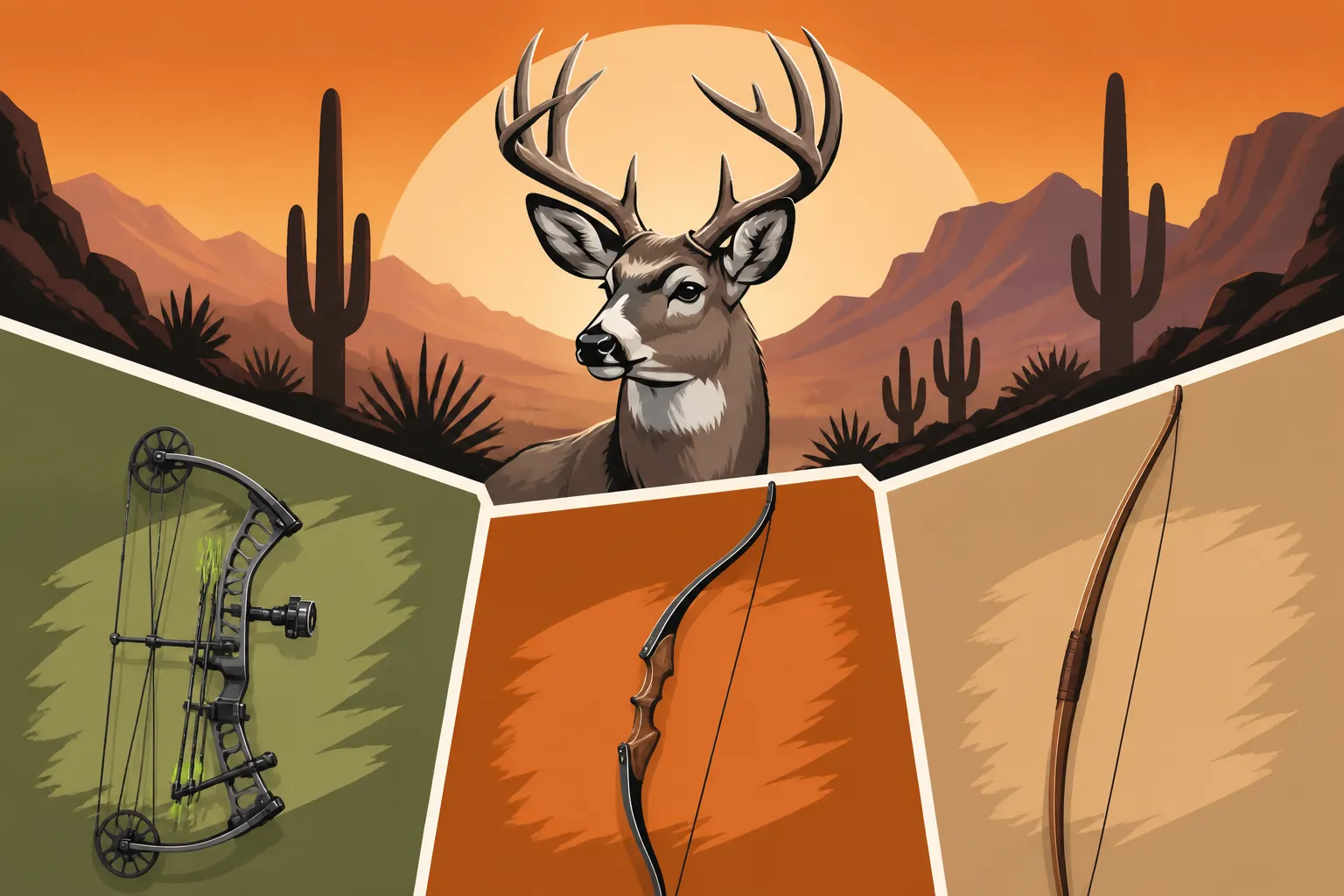
Compound, Recurve or Longbow for Coues Deer
Hunting Coues deer in Arizona can be one of the most rewarding, yet incredibly frustrating, experiences an archer can undertake. These diminutive deer, often dubbed "gray ghosts," are masters of their rugged, brushy domain, making shot opportunities fleeting and often at significant distances. Deciding whether to pursue them with a compound, recurve, or longbow isn't just a matter of preference; it's a strategic choice that directly impacts your chances of success, demanding a deep understanding of each weapon's strengths and limitations in the unforgiving Arizona landscape.
The Unique Challenges of Hunting Coues Deer
Before we dive into the nuances of bow types, it's crucial to acknowledge what makes Coues deer hunting in Arizona so singularly challenging. We're not talking about whitetails in a treestand over a food plot; this is a completely different ballgame, demanding specific skills and gear from the bowhunter.
Speed and Elusiveness of the "Gray Ghost"
The moniker "gray ghost" isn't just catchy; it perfectly describes the Coues deer. They're small, typically weighing between 80-120 pounds, and their grayish-brown coats blend seamlessly with the rocky, oak-studded hillsides and desert washes they inhabit. One moment they're there, the next they've vanished into thin air, leaving you wondering if you ever saw them at all. This incredible camouflage and ability to seemingly disappear requires immense patience and sharp eyesight from the hunter, particularly when trying to discern antler size or even just a flicker of movement. The challenge is magnified by the fact that they often move quickly through thick cover, offering only brief windows for a shot.
Their wary nature means getting close is paramount, yet incredibly difficult. A Coues deer often detects a hunter's presence long before the hunter sees them, using their exceptional hearing and keen sense of smell to their advantage. This makes every step of an approach a delicate dance, where one misplaced footfall or an unexpected gust of wind can send them bounding away, sometimes covering hundreds of yards in a matter of seconds. Bowhunters often spend countless hours glassing, only to get a single, fleeting chance for a shot, which frequently occurs at the edge of their comfortable range.
Terrain and Shot Opportunities in Sky Islands
Arizona's Coues deer primarily inhabit the "sky islands" of the southeastern part of the state – isolated mountain ranges rising dramatically from the desert floor. Think rugged, steep, rocky slopes covered in oak brush, juniper, and sparse pines, interspersed with deep canyons and open grasslands. This isn't flat ground, and it's certainly not easy walking. A typical day of Coues hunting involves significant elevation changes, scrambling over loose rock, and pushing through dense vegetation, all while trying to remain quiet and undetected.
The terrain directly dictates shot opportunities. While longer shots are common due to the open country, you'll also encounter situations where a deer pops up just beyond a ridge, offering a close but short-window shot before it dips back into cover. Most shots will be on deer that are either moving or about to move, often uphill or downhill, and rarely on perfectly flat ground. This means practicing shooting from awkward positions and at varying elevations is critical. The unforgiving nature of the landscape also means that a precise shot is absolutely essential, as a wounded animal can quickly find refuge in the dense thickets or rugged canyon bottoms, making recovery incredibly difficult. For more on navigating this unique environment, check out our guide on how to hunt Arizona's five-month OTC archery deer season.
Understanding Compound Bow Advantages for Coues
For many bowhunters venturing into the Coues deer world, the compound bow is often the first choice. And for good reason – modern compounds offer a suite of advantages that can significantly increase your effective range and shot accuracy, especially in the demanding Arizona environment.
Accuracy and Precision at Longer Ranges
The primary benefit of a compound bow for Coues deer is its inherent accuracy and ability to consistently place arrows at longer distances. With cams that provide a substantial let-off (often 70-90%), a compound bow allows a hunter to hold at full draw with much less strain compared to a traditional bow. This reduced holding weight translates directly to a steadier aim, minimizing muscle fatigue and allowing for more precise shot execution, especially when adrenaline is pumping or when a deer pauses for only a second.
Furthermore, compounds are designed to shoot with sights, peep sights, and releases, which all contribute to a more repeatable and precise shot. Modern sights with multiple pins can be accurately dialed in for specific distances, giving the hunter a clear aiming point out to 60, 70, or even 80 yards for highly skilled archers. While an ethical bowhunter would strive for much closer shots, having the capability to confidently make a longer shot when presented with no other option is a significant advantage in vast, open Coues country. The ability to fine-tune arrow flight and broadhead performance with a compound further enhances this precision, making every arrow count. You also want to ensure your broadheads meet the legal requirements; read more about why Arizona requires broadheads wider than 7/8 inch.
Holding at Full Draw for Extended Periods
Coues deer are notoriously cagey. They rarely stand still for long, and often, when they do, it's in a position that requires the hunter to wait for a better angle, a clear shooting lane, or for the animal to take another step. This is where the compound's high let-off truly shines. A hunter can draw their bow, find their anchor point, and hold it for an extended period – sometimes minutes – without undue muscle fatigue or shakiness. This capacity to wait for the perfect moment is critical when a Coues buck is walking through brush, feeding, or standing quartering-to, and you need him to turn broadside or clear a branch.
Imagine a scenario where you've stalked within range, drawn your bow, but the buck is partially obscured by an agave plant. With a compound, you can comfortably hold, breathing slowly, waiting for him to step into the clear. With a traditional bow, every second at full draw is an intense physical battle, making such waiting periods nearly impossible without compromising form and accuracy. This ability to maintain full readiness without sacrificing precision is a game-changer for bowhunters who understand the patience required to harvest a wary Coues deer.
Equipment Considerations for Compound Bow Hunters
Choosing a compound for Coues hunting involves more than just picking a brand. You need a setup that's robust, reliable, and appropriate for the challenges ahead. Look for a bow with a moderate axle-to-axle length (around 30-34 inches) for maneuverability in brush, but still stable enough for accuracy. A draw weight that you can comfortably manage and hold steady is far more important than maxing out your poundage; Arizona's minimum bow draw weight is 30 pounds, so focus on smooth shooting over sheer power. Many hunters prefer a hunting sight with a movable pin or a custom-dial setup to quickly adjust for those longer, unexpected shots.
Durability is also key. Your bow will likely take a few bumps and scrapes while you're navigating the rugged canyons and rocky slopes. Ensure your accessories – arrow rest, sight, quiver – are securely mounted and can withstand the rigors of the field. And don't forget broadheads; while mechanical broadheads are legal in Arizona, fixed-blade broadheads are often favored by some for their reliability and penetration on tougher game, especially with slightly lighter Coues deer. It’s always a good idea to perform a rigorous sight-in and practice routine before you ever step foot into the hunting unit, ensuring your setup is perfectly tuned for accuracy under pressure.
Recurve Bows: Blending Tradition with Practicality for Coues
Stepping into the world of recurve bows for Coues deer is a commitment to a more fundamental style of hunting. It's about shedding some of the modern conveniences for a deeper connection to the hunt, but it also comes with its own set of demands and rewards in the Arizona desert.
The Intimate Challenge of Traditional Archery
Hunting Coues deer with a recurve bow is an experience that resonates deeply with those who appreciate traditional archery. It forces you to become an even more skilled hunter, emphasizing tracking, stalking, and getting significantly closer to your quarry. Without the aid of sights or mechanical releases, the recurve demands an intuitive understanding of trajectory, range estimation, and consistent form. This "instinctive" shooting style is built on countless hours of practice, training your body and mind to work in harmony to deliver the arrow precisely where you're looking.
The beauty of the recurve lies in its simplicity and the intimate challenge it presents. There's a profound satisfaction in harvesting an animal with a bow that relies solely on your physical prowess and accumulated skill. This isn't to say it's easy; in fact, it's often more difficult. But for many, that increased challenge is precisely the draw. It refines your hunting skills beyond just shooting, pushing you to master the art of concealment, reading terrain, and anticipating animal movement in a way that modern equipment sometimes allows you to circumvent.
Quick Shot Acquisition in Close Quarters
One often-overlooked advantage of a recurve bow for Coues deer, particularly in brushy or broken terrain, is its rapid shot acquisition. Without sights to align, a skilled traditional archer can draw, aim, and shoot in a fluid motion that can be surprisingly fast. In situations where a Coues deer bursts from cover at close range, or pauses only for a second, this quickness can be the difference between a missed opportunity and a successful shot. The compact nature of many recurves also makes them more maneuverable in dense scrub, allowing for easier movement and quicker adjustment in tight quarters.
Imagine a Coues buck suddenly appearing at 25 yards in a small clearing. A recurve hunter can often be drawn and aiming almost instantaneously, relying on muscle memory and instinct to get the arrow on its way. While a compound hunter might be fumbling with a rangefinder or adjusting their sight pin, the recurve shooter has already committed to the shot. This isn't to say it's always faster, but in scenarios demanding quick, reactive shooting at closer ranges, the recurve offers a compelling edge for the practiced traditionalist. However, it means your personal limit for shot distance will likely be much shorter than with a compound. Knowing how close a bowhunter needs to get on Coues is vital for recurve success.
Training and Skill Development for Recurve Hunting
Committing to a recurve for Coues deer means committing to extensive training. This isn't a weapon you pick up a few weeks before the season and expect consistent success with. It requires year-round practice, focusing on form, release, and aiming without mechanical aids. Many traditional archers shoot hundreds of arrows each week to build the necessary muscle memory and consistency. Field archery courses, where you shoot at unmarked distances in varied terrain, are invaluable for developing the instinctive range estimation and shooting skills needed for hunting.
Beyond shooting, skill development for recurve hunting Coues also heavily involves improving your woodsmanship. Since your effective range will be shorter, your ability to stalk quietly, read wind on a sky island stalk, and utilize terrain that hides an approach in desert country becomes absolutely critical. You’ll need to master the art of being invisible, melting into the landscape, and exploiting every scrap of cover to get within that crucial 20-30 yard range. This holistic approach to hunting is what makes traditional archery such a rewarding, albeit challenging, endeavor. Utilizing resources like GoHunt can help you scout units effectively, improving your ability to pinpoint areas where closer encounters are more likely.
Longbows: The Ultimate Traditional Test for Coues Deer
For the purists among us, the longbow represents the pinnacle of traditional archery. Hunting Coues deer with a longbow takes the challenges of a recurve and amplifies them, demanding an even deeper level of skill, patience, and dedication.
The Purest Form of Archery Hunting
A longbow is, by design, the most basic form of hunting bow. Typically a single piece of wood (or laminated wood), it relies solely on the natural flex and recoil of the limbs to propel an arrow. There are no recurved tips for extra power, no sight windows for easier aiming, and certainly no let-off. It’s a direct connection between the archer, the bow, and the arrow, demanding exquisite form and absolute consistency to achieve accuracy. For many, this raw simplicity is the ultimate appeal – a return to the roots of hunting, an embrace of ancestral methods in pursuit of one of the continent's most challenging big game animals.
Choosing a longbow for Coues deer is a statement. It declares a commitment to the art of archery and the craft of hunting that few other weapons can match. Every draw is a full commitment, every release a precise act of will. The hunter becomes acutely aware of their body mechanics, breathing, and mental focus, as even the slightest imperfection in form can send an arrow off course. This pursuit is not for the faint of heart, but for those who embrace it, the satisfaction of a successful hunt is unparalleled, a testament to mastery over oneself and the environment.
Ethical Shot Distances and Limitations
With a longbow, ethical shot distances for Coues deer typically shrink even further compared to a recurve. While a highly skilled longbow archer might be effective out to 25-30 yards on a large target, the small vitals of a Coues deer and the often-unpredictable field conditions in Arizona mean that most longbow hunters will aim to get within 15-20 yards, if not closer. This significantly compresses your effective range, making every aspect of the stalk and approach critically important.
The trajectory of a longbow arrow is also more pronounced than that of a compound or even a recurve. This means that range estimation becomes even more vital, as a few yards difference can result in a significant change in arrow impact point. Consequently, longbow hunters spend countless hours practicing judging distance in varied terrain, knowing their specific bow and arrow setup's flight characteristics intimately. They learn to compensate for uphill and downhill shots instinctually, understanding that precision is paramount on such a small, agile animal in rugged country. The margin for error is razor-thin, and respecting those limitations is a hallmark of ethical longbow hunting.
The Commitment to Mastering the Longbow
Mastering the longbow is a lifelong pursuit, and hunting Coues deer with one is a profound expression of that journey. It requires not just physical strength and precision, but also a mental toughness to overcome the inherent difficulties. Hunters committed to the longbow often view it as a continuous process of self-improvement, where every practice session and every hunt contributes to a deeper understanding of their craft. This commitment often extends beyond just shooting, encompassing traditional arrow building, string making, and a comprehensive knowledge of equipment tuning without the aid of modern tools.
For a longbow hunter, success with Coues deer isn't just about punching a tag; it's about the process, the connection to the land, and the relentless pursuit of perfection in their archery. It demands an unparalleled level of patience, perseverance, and woodsmanship. It means accepting that shot opportunities will be rarer, and successful harvests even more so, but that the reward of achieving one under such challenging conditions is among the most fulfilling experiences in hunting.
Comparing Bow Types for Arizona Coues Deer Hunting
When it comes to making the final decision, it really boils down to balancing performance capabilities with your personal hunting philosophy and skill level. There’s no single "best" bow for everyone when pursuing Coues deer, but understanding their comparative strengths and weaknesses can help you choose the right tool for your adventure.
A Side-by-Side Look at Performance and Learning Curve
Let's lay out a quick comparison to highlight the key differences you'll experience in the field:
| Feature | Compound Bow | Recurve Bow | Longbow |
|---|---|---|---|
| Effective Range | Longest (40-80+ yards for skilled archers) | Medium (20-40 yards for skilled archers) | Shortest (15-30 yards for skilled archers) |
| Accuracy | Highest (Sights, release aid, high let-off) | Medium (Instinctive, string walking, or barebow aiming) | Lowest (Pure instinctive, requires extreme consistency) |
| Learning Curve | Moderate (Easier to pick up, harder to master) | High (Requires significant practice and dedication) | Very High (Demands years of consistent practice) |
| Holding at Draw | Easiest (High let-off allows long holds) | Difficult (Full draw weight, challenging for long holds) | Most Difficult (Full draw weight, no let-off) |
| Maneuverability | Moderate (Longer axle-to-axle, more accessories) | High (Generally shorter, fewer accessories) | Highest (Often very slender, simple design) |
| Steep Terrain | Good (But accessories can snag) | Excellent (Less to snag, more compact) | Excellent (Minimal profile) |
| Shot Speed | Fast (With mechanical advantage) | Moderate (Depends on archer's fluidity) | Moderate (Depends on archer's fluidity) |
| Hunting Style | Spot & stalk, long-range opportunities | Aggressive spot & stalk, close quarters | Stealthy spot & stalk, extreme close quarters |
This table clearly illustrates the trade-offs. If your goal is to maximize your chances of a successful harvest through extended effective range and precision, the compound bow offers undeniable advantages. This can be particularly helpful when glassing Arizona's sky islands for Coues deer, as it allows you to capitalize on those hard-earned stalk opportunities that might still be at the outer limits of traditional range. However, if you're drawn to the challenge and intimate nature of traditional archery, a recurve or longbow will force you to become a superior hunter in other ways, compensating for shorter range with superior woodsmanship and stalking prowess.
Personal Preference and Hunting Style Integration
Ultimately, the choice of bow for Coues deer is deeply personal and should align with your preferred hunting style and what you seek to gain from the experience. Are you a hunter who thrives on precision, technology, and extending your ethical range? Then a compound bow is likely your best bet, allowing you to leverage modern advancements to conquer the distances often encountered in Coues country. It also gives you more flexibility if you're trying to integrate your E-Scouting an Arizona unit before the season with real-time field data.
Perhaps you find joy in the simplicity and challenge of traditional methods, valuing the heightened senses and closer encounters that a recurve or longbow demands. These bows force you to slow down, become intimately familiar with your terrain, and master the art of the stalk. You'll spend more time meticulously planning your approach, utilizing every fold in the ground and every piece of cover, just as you would when practicing the grid glassing method, step by step, to locate deer. The satisfaction of a successful traditional hunt for such an elusive animal is profound. No matter your choice, consistent practice, physical preparation, and a deep respect for the animal are the constants that will define your success and enjoyment.
Essential Gear and Preparation Beyond the Bow
While your choice of bow is crucial, success on a Coues deer hunt in Arizona extends far beyond the string and limbs. The right supporting gear and proper physical conditioning are just as important, if not more so, for navigating the rugged desert mountains and capitalizing on those hard-earned opportunities.
Optics: The True MVPs of Coues Deer Hunting
Let's be blunt: if you're hunting Coues deer in Arizona, your optics are probably more important than your bow. These animals are small, often blend perfectly, and frequently hold in steep, brushy terrain. You will spend 90% of your time glassing, not stalking or shooting. A top-tier binocular (10x-15x is common, but some prefer 18x) and a high-quality spotting scope (20-60x or even 20-70x) are absolutely non-negotiable. Look for optics with excellent light transmission, crisp edge-to-edge clarity, and rugged construction to withstand the dust and abuse of the desert. A sturdy tripod is equally essential, as you'll be spending hours behind the glass, meticulously picking apart distant hillsides.
Learning to effectively use your optics is a skill in itself. It’s not just about looking; it’s about seeing. This involves setting up in good glassing positions, systematically breaking down terrain into grids, and developing the patience to scrutinize every rock, shadow, and patch of brush for a flicker of movement or the tell-tale horizontal line of a deer's back. Many experienced Coues hunters use a technique called "grid glassing," systematically covering every square inch of a hillside. Investing in the best optics you can afford and dedicating significant time to practice glassing techniques will yield far greater returns than agonizing over a few FPS difference in your bow's arrow speed. For deeper insights, consult our guide on optics power for Arizona's long desert sightlines.
Physical Conditioning for Mountainous Terrain
Coues deer hunting is a physically demanding endeavor. The "sky island" habitats are characterized by steep, often rocky slopes, loose scree, and dense vegetation. You'll be hiking miles each day, often gaining and losing hundreds or even thousands of feet in elevation, sometimes in scorching heat during early seasons or cold, windy conditions later in the year. Your fitness level directly impacts your ability to cover ground effectively, remain quiet on a stalk, and maintain concentration during long hours of glassing.
Start your physical conditioning program well in advance of your hunt. Focus on cardiovascular endurance (hiking with a weighted pack, stair climbing), leg strength (squats, lunges), and core stability. Practice hiking in the boots you plan to hunt in over varied terrain to break them in and identify any potential hot spots. The better shape you're in, the more ground you can cover, the more comfortably you can stalk, and the steadier your aim will be when that hard-earned shot opportunity finally arises. Don't underestimate the mental toughness that comes with physical preparedness; it allows you to push through fatigue and maintain focus when the "gray ghost" finally appears. Proper preparation, including how to prepare physically for a desert hunt, ensures you're ready for everything Arizona throws at you.
Disclaimer
Hunting is an inherently dangerous activity. Always prioritize safety, understand and follow all Arizona Game and Fish Department regulations, and respect private land boundaries. The information provided here is for educational and entertainment purposes only and should not be considered legal advice. Always verify current regulations and requirements before heading afield.