Choosing a Muzzleloader Sight Without Restrictions
It's incredibly frustrating, isn't it? You spend hours researching muzzleloaders, only to find a bewildering array of state-specific restrictions on sights, propellants, and even bullet types. Many states seem intent on making traditional muzzleloader hunting as challenging as possible with their rules. But here in Arizona, things are wonderfully different, offering a refreshing freedom that often surprises hunters used to stricter regulations elsewhere. This guide is going to walk you through exactly what makes Arizona's approach to muzzleloader sights so unique and how you can leverage this flexibility to choose the perfect setup for your next big game hunt.
The Refreshing Freedom of Arizona Muzzleloader Sights
If you've ever felt like you needed a law degree just to understand what kind of sight you could put on your muzzleloader for a hunt, you're not alone. Many states impose strict limitations, often requiring open sights, no scopes, or fiber optics only. This can be a real headache, especially if you're traveling or just want to use modern optics to extend your effective range. But Arizona stands out as a beacon of common sense in this regard, offering hunters an unparalleled degree of freedom when it comes to equipping their smoke poles. The rules here are refreshingly simple: if it's legal on a modern firearm, it's generally legal on your muzzleloader.
Historical Context and Modern Adaptations
Historically, muzzleloader seasons were often set aside to provide a more "primitive" hunting experience, leading to the strict sight restrictions we see in many places today. The idea was to level the playing field, making shots more challenging and keeping harvest numbers in check by limiting technological advantages. However, Arizona's approach has always leaned more towards hunter opportunity and safety rather than arbitrary restrictions. The Arizona Game and Fish Department recognized that modern optics could enhance a hunter's ability to make clean, ethical shots, particularly in the diverse and often challenging terrain found across the state, from the thick timber of the Mogollon Rim to the expansive deserts. This forward-thinking perspective has allowed Arizona hunters to adapt and utilize the best sighting technology available, ensuring more humane harvests and a better overall hunting experience. This is a stark contrast to some states where you're practically squinting down a rudimentary iron sight, hoping your eyes are good enough for that 100-yard shot.
What Isn't Allowed? (Mostly Nothing)
When we talk about what isn't allowed with muzzleloader sights in Arizona, the answer is delightfully brief: virtually nothing. Unlike states that prohibit scopes, illuminated reticles, or even fiber optic pins, Arizona places no such specific limitations on your muzzleloader sighting system. This means you can mount a powerful variable scope, a red dot sight, or even stick with traditional open sights if that's your preference. The main legal constraints in Arizona for hunting apply to all firearms and are more about ethical hunting practices, like not hunting with night vision or thermal optics. For the muzzleloader itself, if it’s capable of firing a legal bullet and uses an approved propellant (and yes, that includes modern powders like Hodgdon Triple Seven or even Blackhorn 209), your choice of sight is entirely up to you. This flexibility is a game-changer, allowing you to truly optimize your setup for your specific hunt and personal abilities, rather than being confined by outdated regulations. It’s definitely worth understanding that Arizona Puts No Limits on Muzzleloader Sights or Powder, a fact that might make hunters from other states do a double-take.
The Practical Benefits of Unrestricted Sights
The practical benefits of Arizona's unrestricted muzzleloader sight rules are immense. For starters, it greatly expands your effective range. With a quality scope, many hunters can confidently take shots out to 200 yards or even further, which might be impossible or at least highly unethical with open sights, especially as our eyesight naturally degrades with age. This is particularly crucial when hunting in wide-open country for species like pronghorn or mule deer where long shots are often the norm. Imagine trying to identify a trophy buck at 250 yards with open sights versus a 3-9×40 scope. The difference is night and day.
Secondly, it improves accuracy and shot placement. A clearer sight picture and magnification reduce the chance of a marginal hit, leading to cleaner kills and less wounded game. This aligns perfectly with ethical hunting principles. Additionally, the freedom to choose means you can tailor your sight to your specific needs. If you're hunting in dense timber for elk, a low-power variable scope or a red dot might be ideal for quick target acquisition. If you're glassing vast desert landscapes for Coues deer, a higher magnification scope could be your best friend. This adaptability also makes muzzleloaders more appealing to a broader range of hunters, encouraging participation and providing more opportunities. For a deep dive into the underlying reasoning, you might want to read Why Arizona Muzzleloader Rules Are So Open.
Exploring the Diverse Types of Muzzleloader Sights
Because Arizona offers such incredible freedom, you're not just limited to iron sights anymore. The world of optics is your oyster, allowing you to choose the system that best suits your hunting style, the conditions you'll face, and your personal vision. This is where you can truly customize your muzzleloader to become a highly effective hunting tool.
Traditional Open Sights (Iron Sights)
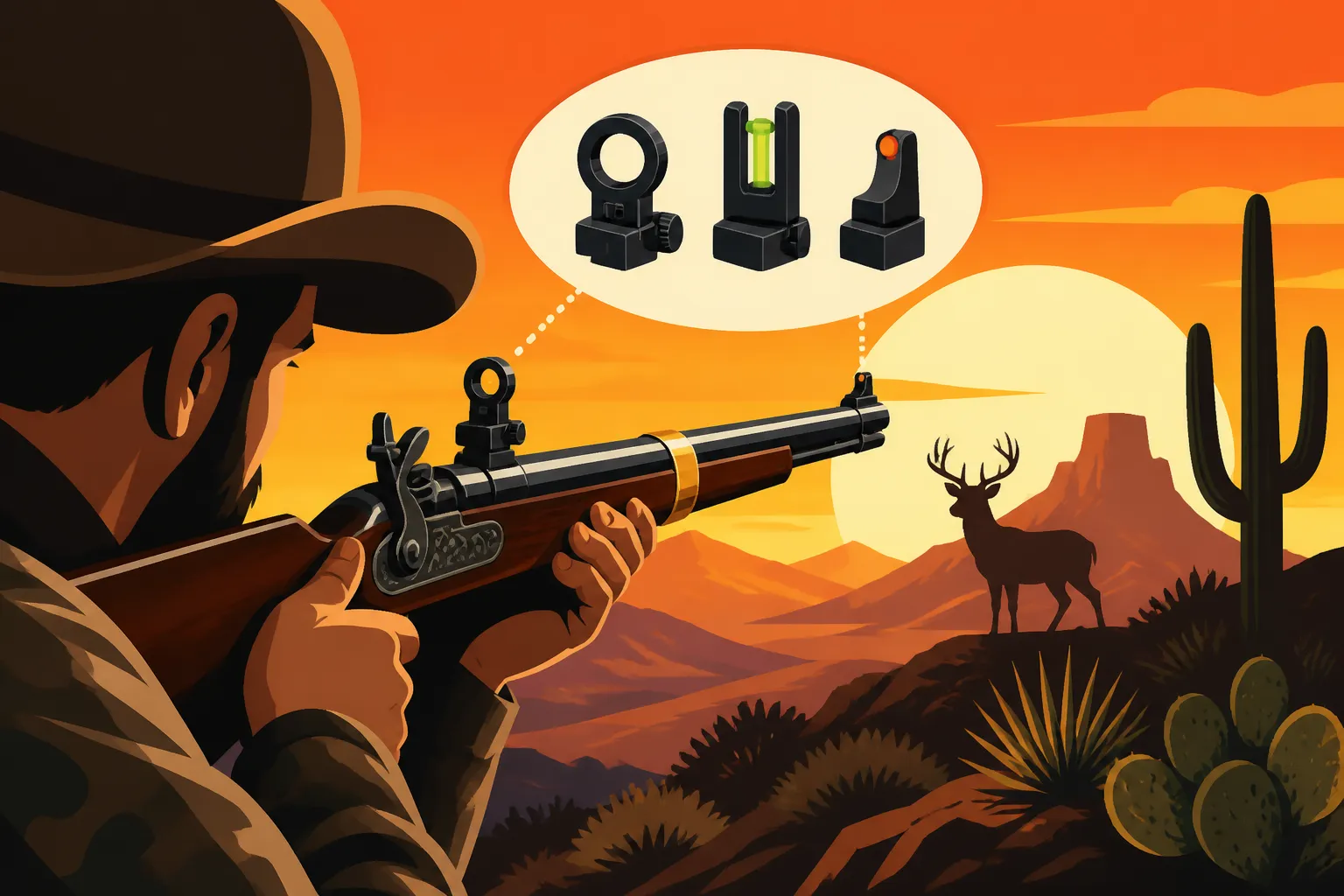
Open sights are the classic choice, and for good reason. They are rugged, reliable, and don't rely on batteries. They consist of a front sight (usually a post or bead) and a rear sight (often a notch or aperture). They are excellent for close-range shooting, typically within 75-100 yards, and are incredibly fast for target acquisition in dense cover. If you're still-hunting in thick mesquite for javelina or pushing through heavy ponderosa pines for elk, an open sight can be remarkably effective.
However, they have significant drawbacks. They offer no magnification, making long-range precision difficult, and they can be challenging to use in low light conditions or for hunters with vision impairments. It requires your eye to simultaneously focus on three planes: the rear sight, the front sight, and the target. For many, especially as we get older, this becomes increasingly difficult. While they might evoke a sense of tradition, relying solely on them for all Arizona hunting scenarios, given the vast open spaces, might put you at a disadvantage. They're simple, yes, but simplicity doesn't always equate to efficacy for every situation you'll encounter in Arizona's diverse units.
Peep Sights and Ghost Rings
Peep sights are a step up from traditional open sights, offering a slightly improved sight picture and often better accuracy, especially at slightly longer ranges. A peep sight replaces the rear open notch with a small aperture (a "peep hole") closer to your eye. Your eye naturally centers the front sight in the peep hole, making aiming more intuitive and faster than aligning three points. Ghost ring sights are a type of peep sight with a larger aperture, allowing for extremely fast target acquisition, almost like a red dot, but without electronics.
These sights are fantastic for bridging the gap between open sights and optics. They are still incredibly durable and weatherproof, don't require batteries, and offer a much clearer sight picture in varying light conditions than a traditional open notch. For hunters who want more accuracy than open sights provide but aren't ready to jump to a full scope, or for those who appreciate the aesthetic and ruggedness of iron sights, a quality peep or ghost ring sight can be an excellent compromise. Brands like Williams Gun Sight Company and Lyman offer fantastic options that can significantly improve your precision with a muzzleloader.
Scopes: Magnification for Precision
This is where Arizona's rules truly shine. The ability to mount a magnified scope on your muzzleloader opens up a world of possibilities for precision and extended range. Scopes come in various forms, from fixed power (e.g., 4x) to variable power (e.g., 3-9x, 4-12x, or even higher magnification). They gather light, offer a clear sight picture, and allow for precise aiming points, crucial for making ethical shots on game out to 200 yards and beyond.
Choosing a scope involves considering factors like magnification range, objective lens size (for light gathering), reticle type (duplex, BDC, illuminated), and durability. A common choice for muzzleloaders in Arizona is a 3-9×40 or 4-12×40 scope. This provides enough magnification for longer shots on mule deer in the high country or pronghorn on the grasslands, while still offering a wide field of view at lower powers for closer encounters. For hunters specifically wondering about this, yes, you absolutely Can You Use a Scope on an Arizona Muzzleloader?, and it's a huge advantage. Remember that high-quality glass, like what you find from optics manufacturers like Leupold, Vortex, or Zeiss, can make all the difference in low light conditions, which are often prime hunting hours.
Red Dot Sights
Red dot sights are becoming increasingly popular across all firearm platforms, and muzzleloaders are no exception, especially with Arizona's open regulations. These non-magnifying electronic sights project an illuminated red (or sometimes green) dot onto a glass lens. The beauty of a red dot is its speed and ease of use. You simply put the dot on the target and squeeze the trigger. There's no front sight, rear sight, or parallax to worry about.
Red dots excel in fast-paced hunting scenarios, like stalking javelina in dense prickly pear or navigating thick oak brush for Coues deer where shots are often under 100 yards and happen quickly. They are also excellent in low light, as the illuminated dot stands out against a dim background. Most red dots are also incredibly durable, waterproof, and have long battery lives. While they don't offer magnification for long-range precision, their speed and simplicity make them a formidable option for close to medium range hunting, giving you an edge when a quick, accurate shot is paramount. Brands like Aimpoint and Holosun are popular choices known for their robustness.
Factors to Consider When Choosing Your Muzzleloader Sight
With so many options open to you in Arizona, deciding on the "best" muzzleloader sight isn't a one-size-fits-all answer. It truly depends on how and where you plan to hunt. Thinking through these factors will help you make an informed decision that maximizes your effectiveness in the field.
Hunt Type and Terrain
The type of hunt you're planning and the specific terrain you'll be navigating are huge determinants for your sight choice. Are you drawing a coveted elk tag for a unit on the Mogollon Rim, where shots could be across a canyon or through thick timber? If you're expecting longer shots over open terrain, especially during an archery-only season that allows muzzleloaders, a magnified scope is likely your best friend. This lets you properly identify your target and make precise holdovers for distance. On the other hand, if your tag is for javelina in the rolling hills of Southern Arizona, where encounters are often close and fast, a red dot or a peep sight might give you quicker target acquisition without the bulk and complexity of a scope.
Consider the landscape: will you be still-hunting dense thickets, or sitting over a water source hoping for a mule deer? For wide-open desert hunting, where you might be glassing from afar and needing to identify antler points, a high-quality scope is invaluable. If you're navigating steep, rugged canyon country, the added weight and potential snag points of a large scope might be a consideration, making a more compact red dot or even a durable peep sight more practical. Tools like GoHunt can be invaluable here, helping you scout units and understand the typical terrain and shot distances you might encounter before you even apply for a tag.
Lighting Conditions and Time of Day
Arizona's hunting seasons can span from the scorching, bright days of early archery to the dim, cold mornings of late fall. The ambient light during your hunt will significantly impact sight visibility and your ability to make an ethical shot. Traditional open sights can be very difficult to use effectively at dawn, dusk, or under heavy tree canopy where light is minimal. The black front sight often disappears against a dark animal or background.
Fiber optic open sights improve this somewhat, gathering ambient light to create bright, visible pins. However, they still lack magnification. Red dot sights truly shine in low light, offering a crisp, illuminated aiming point that's easy to see against any background. Scopes, particularly those with larger objective lenses (e.g., 40mm or 50mm) and high-quality glass, gather more light than the naked eye, extending your effective shooting hours into the critical periods of dawn and dusk. Some scopes even offer illuminated reticles, which provide the best of both worlds: magnification and a highly visible aiming point in poor light. Understanding when legal shooting hours begin and end, and matching your sight to those conditions, is paramount for success and ethical hunting.
Personal Preference and Vision
Ultimately, your choice in muzzleloader sight will also come down to what feels most natural and effective for you. What works for one hunter might not work for another. If you have perfect 20/20 vision and grew up shooting open sights, you might feel perfectly confident with a good peep sight. However, if your vision isn't what it used to be, or you struggle with astigmatism, a magnified scope or a red dot might be a necessity rather than a luxury.
Consider your comfort level with technology. Some hunters prefer the simplicity and ruggedness of mechanical sights, while others embrace the precision and features offered by modern optics. Spend time at the range with different setups if possible. Ask friends if you can try their scoped muzzleloader or one with a red dot. What feels intuitive? What allows you to get on target quickly and consistently? Don't be swayed entirely by tradition or what "everyone else" uses. Your personal vision and preference should weigh heavily in this decision, as it directly impacts your confidence and ability to make that critical shot when the moment arrives.
Installation and Zeroing Your Muzzleloader Sight
Once you've chosen your ideal sight, the next crucial steps are proper installation and precise zeroing. Even the most expensive, highest-quality optic is useless if it's not mounted correctly and dialed in for your specific load.
DIY vs. Professional Gunsmith Installation
For many muzzleloaders, installing a scope or red dot sight can be a straightforward DIY project. Most come with pre-drilled and tapped holes, ready for a Weaver or Picatinny style base. If you're comfortable working with tools, have the right screwdriver bits (often Torx or hex), and can follow instructions, mounting a base and rings and then attaching the optic yourself is entirely feasible. Crucial steps include using a thread locker (like blue Loctite) on base screws and ensuring scope rings are tightened evenly to avoid pinching the scope tube.
However, if your muzzleloader requires drilling and tapping, or if you simply lack confidence in your mechanical skills, taking it to a professional gunsmith is always a wise investment. A gunsmith has the specialized tools, knowledge, and experience to ensure everything is perfectly aligned and torqued to specification, preventing costly damage to your firearm or optic. Improper installation can lead to frustrating accuracy issues, scopes coming loose, or even structural damage to the rifle. It's often worth the small fee for peace of mind, especially when you consider the cost of your tag and the hunt itself.
Mounting Considerations and Ring Selection
The quality of your scope rings and base is just as important as the scope itself. Don't skimp here! Cheap rings can flex, slip, or fail under recoil, leading to zero shifts and endless frustration. Always opt for sturdy, reputable brands like Leupold, Vortex, Warne, or Talley. When choosing rings, consider the height. You want the scope mounted as low as possible without the objective lens touching the barrel or the eyepiece interfering with the hammer or breech opening. Higher rings might be necessary if your scope has a very large objective lens or if you need to clear a hammer.
Ensure your scope is mounted level. Many tools exist, from bubble levels to specialized scope leveling kits, that help you achieve perfect alignment. A canted scope will cause your point of impact to shift horizontally at longer distances, even if it's zeroed perfectly at 100 yards. Pay attention to eye relief as well – position the scope so you have a full, clear sight picture when you bring the rifle to your shoulder, without having to move your head forward or backward excessively. This is critical for preventing "scope bite" from recoil and for fast, comfortable target acquisition.
Initial Boresighting and Range Zeroing
Once installed, the first step before hitting the range is boresighting. This essentially aligns your scope's reticle with the barrel's bore, getting you "on paper" at the range and saving you precious time and ammunition. You can do this with a laser boresighter that inserts into the muzzle, or if your rifle has a removable bolt, by visually boresighting down the barrel at a target while looking through the scope.
After boresighting, it's time to head to the range for actual zeroing. Start at a close distance, like 25 yards, to ensure you're hitting the target. Once you're consistently hitting the bullseye at 25 yards, move to your desired zero distance – often 100 yards for muzzleloaders, but some might prefer 150 yards for flatter trajectory with modern propellants and sabot bullets. Fire groups of three shots, adjust your scope's windage and elevation turrets based on where your bullets are hitting, and repeat until your groups are centered. Don't forget to account for temperature and altitude if you're zeroing in a different environment than where you'll be hunting. For open desert hunting, understanding your Rifle Zero Distance for Open Desert is a critical step in ethical hunting.
Maintenance and Troubleshooting Your Muzzleloader Sight System
A hunting trip can quickly go south if your optics aren't performing as they should. Proper care and knowing how to troubleshoot common issues can save your hunt and ensure your gear is always ready for action.
Regular Cleaning Regimen
Your muzzleloader's sight, whether it's a scope, red dot, or iron sight, is exposed to the elements: dust, rain, snow, and even the corrosive byproducts of black powder combustion. A regular cleaning regimen is essential. For optics, use a dedicated lens pen or a soft brush to remove loose dust, followed by a microfiber cloth and lens cleaning solution. Never use your shirt or harsh chemicals, as these can scratch or damage lens coatings.
For iron sights, a simple wipe-down with a damp cloth and then drying is usually sufficient. Pay attention to areas where powder residue can build up, especially around peep sights or if you have fiber optic elements. A small amount of gun oil on metal parts can prevent rust, but avoid getting it on optical surfaces. Consistent cleaning not only preserves the clarity and functionality of your sight but also extends its lifespan. Remember, a clear sight picture is vital for accurate shot placement.
Checking for Looseness and Zero Shifts
One of the most common issues with any mounted optic is screws coming loose due to recoil or vibration during transport. Before and after every hunt, and certainly before each range session, physically check all mounting screws: base screws, ring screws, and even the screws holding your optic to the rings (if applicable). A simple twist test with your fingers can reveal if anything is loose. If you find anything wobbly, gently re-torque it to the manufacturer's specifications, perhaps adding a drop of blue Loctite if it's a recurring issue.
A loose sight system is a guaranteed way to lose your zero. If your groups suddenly start wandering, or your point of impact shifts dramatically, a loose mount is often the culprit. Other causes of zero shift can include extreme temperature changes, dropping the rifle, or even rough handling. It's always a good idea to confirm your zero before a big hunt, especially if you've traveled a long distance or subjected your rifle to any jostling. A quick check at the range can prevent heartbreak in the field. This constant vigilance is part of being a responsible hunter.
Proper Storage and Transport Tips
How you store and transport your muzzleloader and its sight system plays a big role in its longevity and accuracy. When storing, always keep your rifle in a clean, dry environment, preferably in a padded gun case. Avoid storing it in areas with extreme temperature fluctuations or high humidity, which can lead to rust or fogging issues with optics. If you're putting it away for an extended period, remove batteries from red dots or illuminated scopes to prevent corrosion.
During transport, ensure your rifle is secured to prevent it from bouncing around, which can loosen screws or even damage the optic. A quality hard case with custom-cut foam inserts offers the best protection, especially for scoped rifles. If using a soft case, make sure it's well-padded. On those long drives to remote units like those accessible via Access Along the Mogollon Rim, your gear will take a beating if not properly secured. Treating your rifle and optic with care during travel is just as important as proper shooting technique in maintaining accuracy.
Maximizing Your Accuracy with Any Sight System
Having the best sight system in the world won't do you much good if you haven't put in the practice to use it effectively. Precision shooting with a muzzleloader requires a combination of good gear, consistent practice, and an understanding of external factors.
Consistent Practice Drills
The key to maximizing accuracy with any sight system is consistent practice. Don't just zero your rifle once and call it good for the season. Regular range time helps you become familiar with your rifle's nuances, how it performs with your chosen load, and how to effectively use your sight under various conditions. Practice shooting from different positions you might encounter in the field – prone, kneeling, sitting, and off shooting sticks or a bipod. This is especially true for muzzleloaders, where the recoil impulse and the unique loading process can affect your follow-through.
Focus on fundamental shooting techniques: proper breathing, trigger control, and consistent cheek weld. If using a scope, practice finding your target quickly and acquiring a clear sight picture. For red dots, focus on presenting the rifle smoothly and placing the dot precisely. Practice at varying distances, not just your zero, so you understand your bullet's trajectory. Understanding how your chosen bullet and powder combination performs at different ranges, and how to compensate for bullet drop, is vital. You can research various bullet weights and ballistic coefficients on platforms like GoHunt to inform your practice.
Understanding Ballistics and Rangefinder Integration
Modern muzzleloaders, especially when paired with saboted bullets and smokeless-equivalent powders, can achieve surprisingly flat trajectories. However, they are still not quite as flat-shooting as high-velocity centerfire rifles. Understanding the ballistics of your specific load is crucial for making accurate shots beyond your zero distance. Know your bullet's drop at 150, 200, and 250 yards. Many scope reticles offer bullet drop compensation (BDC) points, or you can create a custom drop chart for your specific setup.
This is where a good quality rangefinder becomes an indispensable tool. Estimating distances in the field is incredibly difficult, especially in wide-open country or across canyons. A rangefinder removes the guesswork, giving you a precise distance to your target. Once you have that distance, you can then apply your ballistic knowledge – whether that's holding over, using a BDC reticle, or dialing turrets – to make an accurate shot. Integrating a rangefinder into your hunting process is a non-negotiable step for ethical long-range muzzleloader hunting in Arizona. For those long shots over vast distances, understanding concepts like Holding for Wind Across a Wide Canyon becomes equally as critical as knowing your ballistics.
Choosing the Right Accessories
Beyond the sight itself, a few key accessories can significantly boost your accuracy. Good quality shooting sticks or a bipod provide a stable shooting platform, especially crucial for muzzleloaders which tend to be a bit heavier and have a more pronounced recoil than some centerfire rifles. This stability allows for better accuracy, particularly when shooting from unsupported positions in the field.
A quality sling is also essential for comfortable carrying, but it can also be used as a shooting aid to stabilize your rifle. Knowing how to quickly deploy shooting sticks or use your sling for support can shave valuable seconds off your setup time and significantly improve your steadiness. Don't overlook the importance of good eye and ear protection at the range, and comfortable, stable footwear in the field. Every element that contributes to your comfort and stability ultimately contributes to your accuracy.
| Sight Type | Pros | Cons | Best Use Cases |
|---|---|---|---|
| Open Sights | Durable, reliable, no batteries, fast at close range. | Poor in low light, limited range, difficult for vision-impaired. | Dense timber, close-quarters brush, backup sight. |
| Peep Sights | More accurate than open sights, durable, no batteries, faster acquisition. | No magnification, still challenging in very low light. | Medium range (75-125 yards), faster target acquisition than open sights. |
| Magnified Scope | Excellent precision, extended range, good in low light, clear sight picture. | Can be bulky, requires zeroing, batteries for illuminated reticles. | Long-range shots (100-250+ yards), open country, identifying game. |
| Red Dot Sight | Extremely fast target acquisition, excellent in low light, simple. | No magnification, limited to close-medium range, requires batteries. | Fast-paced hunts, dense cover, close ranges (under 100-125 yards). |
Disclaimer
Please remember that hunting regulations can change. Always consult the most current Arizona Game and Fish Department regulations before heading afield. This guide is for informational purposes only and does not constitute legal advice.