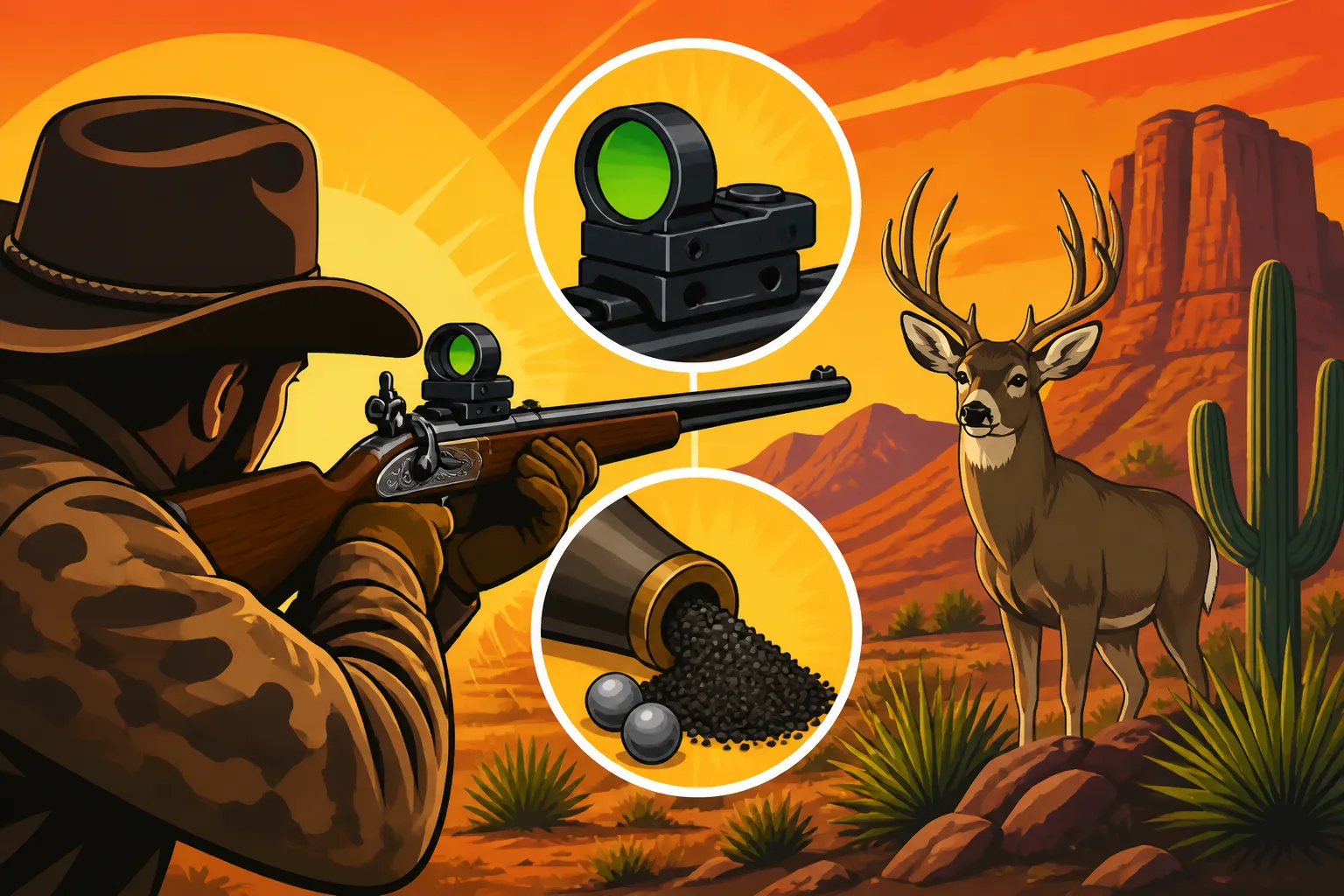
Arizona Puts No Limits on Muzzleloader Sights or Powder
Hunting in Arizona can sometimes feel like navigating a maze of regulations, especially if you're coming from a state with super strict rules on muzzleloaders. The frustration of trying to figure out what sight you can use or what type of powder is legal is real, and it can deter even seasoned hunters. This guide is here to cut through all that confusion and clearly explain why Arizona stands out with its incredibly open approach to muzzleloader sights and powder, giving you the freedom to optimize your setup for success.
Understanding Arizona's Unique Stance on Muzzleloaders
When you're preparing for a muzzleloader hunt, the equipment restrictions in many states can be a real headache. You often hear about "period-correct" weapons, limitations on optics, or specific powder types you must use. It’s enough to make you wonder if you’re reenacting a historical battle rather than enjoying a modern hunting pursuit. This isn't the case in Arizona, and understanding this fundamental difference is crucial for any hunter looking to capitalize on the opportunities here. The Grand Canyon State has a refreshingly different philosophy when it comes to these traditional firearms, offering a level of flexibility that often surprises newcomers and delights long-time residents alike.
The Freedom Hunters Don't Expect
Let's be honest, how many times have you read through hunt regulations only to find a long list of prohibitions? For muzzleloader hunters, this usually means no scopes, no sabots, sometimes even no pelletized powder. It forces you to make compromises, often feeling like you're hunting with one hand tied behind your back, especially when chasing wary game at longer distances or in challenging light. But here in Arizona, the rulebook essentially says, "If it's safe and effective, go for it." This freedom means you can truly tailor your muzzleloader setup to the specific demands of your hunt, whether that's an open-country elk hunt in the White Mountains or a close-quarters javelina stalk in the Sonoran Desert. It allows for a more personalized and, frankly, more enjoyable hunting experience without the constant worry of violating an obscure rule.
Why Arizona Rules Differ from Other States
The primary reason Arizona's muzzleloader rules are so open compared to many other states often boils down to how the Arizona Game and Fish Department (AZGFD) approaches hunting seasons and equipment. While some states aim to create a more "primitive" hunting experience for muzzleloader seasons, Arizona tends to focus more on harvest management and providing diverse hunting opportunities. Instead of restricting equipment to ensure a "primitive" challenge, Arizona's regulations generally allow for a broader range of legal methods to maximize hunter success within the established tag quotas. This pragmatic approach is a big part of "Why Arizona Muzzleloader Rules Are So Open". They trust hunters to make responsible equipment choices that align with ethical hunting practices. This doesn't mean a lack of challenge; Arizona hunting, especially for big game like elk and Coues deer, is inherently challenging due to the terrain and the animals themselves. It simply means your equipment isn't an added obstacle by regulation.
Deciphering Muzzleloader Sight Systems With No Restrictions
One of the biggest head-scratchers for hunters coming to Arizona is the sheer lack of muzzleloader sight restrictions. In many states, the term "muzzleloader hunt" conjures images of open iron sights, sometimes peep sights if you're lucky. The idea of putting a modern scope, or even a red dot, on a muzzleloader for a dedicated "muzzleloader season" is often unheard of or strictly forbidden. But in Arizona, this isn't just allowed; it's a game-changer for many hunters who want to extend their effective range and increase their accuracy, without having to wait for a general rifle season.
Scopes on Arizona Muzzleloaders: A Game Changer
Imagine being able to take a precise, ethical shot at 200 yards with your muzzleloader – something that would be nearly impossible with open sights for most hunters. In Arizona, this isn't just a dream; it's a reality. The ability to mount a magnified optic, just like you would on a centerfire rifle, fundamentally transforms the muzzleloader hunting experience. A good scope, with its light-gathering capabilities and ability to magnify your target, vastly improves shot placement, especially in low light conditions or when targeting smaller vitals on animals like Coues deer. This freedom allows hunters to confidently engage targets at distances that would typically be reserved for modern rifles. You might choose a lower power variable scope, something like a 2-7x or 3-9x, for versatility in different terrains, or even a fixed power if you're confident in your typical shot range. This flexibility is a huge advantage, and understanding "Can You Use a Scope on an Arizona Muzzleloader?" is key to maximizing your hunt.
It's not just about distance, either. A scope dramatically helps with target identification and making sure you're taking the right animal, especially important when hunting in areas with varied age classes or species. It can mean the difference between confidently taking a legal buck or passing on a shot you're not entirely sure about. For hunters with aging eyes, a scope can literally extend their hunting careers, keeping them in the field with a firearm they enjoy. Many hunters prefer a traditional reticle, but some even experiment with custom ballistic reticles designed for muzzleloader trajectories, further enhancing their long-range capabilities.
Traditional Open Sights and Peep Sights
Now, just because you can use a scope doesn't mean you have to. Many traditionalists still prefer the challenge and aesthetic of open sights or peep sights, and they are absolutely legal and widely used in Arizona. Open sights, typically a front blade and a rear notch, offer a classic hunting experience, requiring a higher degree of skill and practice to achieve accuracy, especially beyond 75-100 yards. They are rugged, simple, and won't fog up or get knocked out of alignment easily. However, they can be challenging in dim light or against dark backgrounds, and precise aiming can be difficult on small targets.
Peep sights offer a slight upgrade from open sights, providing a larger rear aperture that helps centralize the front sight more quickly and accurately. This can improve both speed and precision compared to a traditional notch and blade. They still maintain a traditional feel but can extend your effective range a bit further, perhaps out to 125-150 yards for a skilled shooter. While not offering the magnification of a scope, peep sights provide a cleaner sight picture and are excellent for fast target acquisition in heavy cover, like some of the dense oak brush you might encounter when "Still Hunting Oak Brush for Coues". The choice between open and peep sights often comes down to personal preference, the type of hunting you're doing, and how much you've practiced with your specific setup. Both are perfectly viable options in Arizona's unrestricted muzzleloader seasons.
Red Dot and Holographic Sights: Modern Optics for Traditional Arms
In between the simplicity of iron sights and the magnification of traditional scopes, you'll find modern red dot and holographic sights. These electronic sights project an illuminated aiming point onto a lens, allowing for extremely fast target acquisition and an unmagnified, wide field of view. While they don't offer magnification, their parallax-free nature and bright reticles make them incredibly effective in challenging light conditions and for quick, close-range shots. They're particularly popular for hunting in thick cover or when expecting quick encounters with fast-moving animals.
Many hunters find red dot sights to be an excellent compromise, offering significant accuracy improvements over open sights without the bulk or complexity of a magnified scope. They are especially useful for hunters who want the benefits of a modern aiming system but prefer to keep their muzzleloader's "primitive" aesthetic intact, or for those who find scopes cumbersome in dense vegetation. They excel in situations where speed is paramount, like jump-shooting javelina or navigating tight timber for elk. Their battery life is typically excellent, and many are designed to withstand harsh weather conditions, making them a robust option for the rugged Arizona backcountry. This wide array of options falls under "Muzzleloader Sight Systems With No Restrictions", truly empowering hunters to customize their setup.
Powder Charges Allowed in Arizona Muzzleloaders
Beyond sights, the freedom to choose your propellant is another aspect that sets Arizona apart. In some states, "muzzleloader" strictly means black powder only, perhaps with some allowance for Pyrodex. The idea of using smokeless powder in a muzzleloader during a primitive weapons season is often met with stern looks and outright bans. However, Arizona's regulations don't specify propellant type, opening up possibilities for enhanced performance and convenience, though with important safety caveats.
Smokeless Powder: The Debate and Reality
The discussion around smokeless powder in muzzleloaders is often a heated one in the hunting community. Historically, muzzleloaders were designed for black powder, which burns differently and creates lower pressures than modern smokeless propellants. Using smokeless powder in a muzzleloader not specifically designed for it is incredibly dangerous and can lead to catastrophic failure of the firearm. However, certain manufacturers, like CVA and Savage, have produced specific muzzleloader models (e.g., the CVA Paramount and Savage 10ML-II, though the Savage is no longer produced) that are engineered and proofed to safely handle specific smokeless powders within prescribed limits.
For these specialized rifles, using smokeless powder offers several advantages: significantly higher velocities, flatter trajectories, increased energy, and far less corrosive residue than black powder. This translates to extended effective range and easier cleanup. For hunters who own these specific firearms, Arizona's regulations mean they can legally and safely utilize their rifle's full potential during muzzleloader seasons. However, it is absolutely critical that you only use smokeless powder in a muzzleloader explicitly rated and designed for it by the manufacturer, and always follow the manufacturer's load data meticulously. Never guess, and never use smokeless powder in a traditional black powder muzzleloader. This is a matter of safety, not just legality.
Black Powder and Pyrodex: The Classics
For most muzzleloader enthusiasts, black powder and its modern synthetic equivalents like Pyrodex, Triple Seven, and Blackhorn 209 remain the go-to choices, and they are, of course, completely legal in Arizona. Black powder is the original propellant, offering that satisfying cloud of smoke and pungent aroma that is part of the traditional muzzleloading experience. It's effective and reliable, though it requires diligent cleaning due to its corrosive nature. Load data for black powder is generally simpler, often measured by volume, and specific to the caliber and projectile.
Pyrodex and other synthetic black powder substitutes like Triple Seven are less corrosive and produce less fouling than traditional black powder, making cleanup a bit easier. They are designed to burn similarly to black powder, making them safe for use in any muzzleloader designed for black powder. Blackhorn 209, a newer generation of black powder substitute, is particularly popular for its extremely clean burn, consistency, and non-corrosive properties, making it almost as user-friendly as smokeless powder without the high pressures. It cleans up with standard solvents, a huge bonus after a long day in the field. All these options fall under the umbrella of "Powder Charges Allowed in Arizona Muzzleloaders", giving you a wide berth to choose what suits your style and rifle.
Granulated vs. Pelletized Powder: What to Consider
Within the realm of black powder and its substitutes, you also have the choice between granulated (loose) powder and pelletized forms. Both are legal in Arizona, and each has its pros and cons. Granulated powder, measured by volume, offers the ultimate in customization. You can fine-tune your load precisely, incrementally adjusting the charge to find the most accurate combination for your specific rifle, bullet, and primer. This level of precision is often favored by accuracy fanatics and those who enjoy the tinkering aspect of muzzleloading. It's also typically more cost-effective per shot.
Pelletized powder, on the other hand, offers unparalleled convenience. Pre-measured charges in tablet form (e.g., 50-grain equivalents) mean you simply drop the desired number of pellets down the barrel. This speeds up loading in the field, which can be a significant advantage when a quick follow-up shot is needed. It also eliminates the need for a powder measure, reducing the amount of gear you need to carry. While pellets offer less flexibility for fine-tuning loads, modern manufacturing has made them incredibly consistent, often yielding excellent accuracy straight out of the box. For a hunter seeking simplicity and speed, especially when dealing with the kind of physical exertion involved in "Packing an Elk Out of Rim Country Alone", pellets can be a real blessing.
Bullets and Projectiles: Sabots and More
The choice of projectile is just as critical as your powder charge and sight system for muzzleloader performance. Arizona's open regulations extend to bullets as well, meaning you're not shackled by "patched round ball only" rules or other limitations common elsewhere. This freedom allows you to select modern, high-performance bullets that maximize accuracy, energy transfer, and ethical harvesting, giving you a distinct advantage in the field.
Sabot Bullets in an Arizona Muzzleloader: Maximizing Accuracy
Sabots are arguably one of the most significant advancements in modern muzzleloading. A sabot is a plastic sleeve that allows you to shoot a smaller, aerodynamically superior bullet (often a jacketed pistol bullet) through a larger bore muzzleloader. For example, a .50 caliber muzzleloader can shoot a .452" or .40 caliber bullet encased in a sabot. This design allows for higher velocities, flatter trajectories, and vastly improved accuracy compared to traditional full-bore conical bullets or round balls, especially at longer ranges. The plastic sabot grips the rifling, imparting spin to the projectile, then separates from the bullet shortly after it leaves the barrel.
The ability to use "Sabot Bullets in an Arizona Muzzleloader" means you can essentially shoot a modern, high-performance bullet from your muzzleloader, mimicking the ballistic performance of some centerfire cartridges. This dramatically increases your effective ethical hunting range. Hunters often combine sabots with scopes and clean-burning powders to create a very potent and accurate hunting package. Popular sabot bullet options include Hornady SSTs, Barnes Expander MZ, and various Nosler Partition and AccuBond pistol bullets. For hunters chasing trophy animals where every inch of accuracy counts, sabots are often the first choice.
Conical Bullets for Maximum Impact
While sabots offer superior aerodynamics, full-bore conical bullets also have a dedicated following, and for good reason. These heavy, lead-based projectiles are designed to be slightly undersized for the bore, then engraved by the rifling as they are forced down the barrel. They are typically heavier than sabot-encased bullets of similar caliber, meaning they carry more kinetic energy for deep penetration and bone-crushing impact, especially at closer ranges. Many traditionalists prefer conicals because they maintain the spirit of a "full bore" projectile, but modern designs are far from primitive.
Examples include PowerBelt bullets, Hornady FPB (Flex Tip Pointed Bullet), and various other pure lead or copper-alloy designs. These bullets expand reliably and often retain a high percentage of their weight, leading to excellent terminal performance on game. While their ballistic coefficient usually isn't as high as a slender sabot bullet, they can be exceptionally accurate at moderate ranges (out to 150 yards or so) and deliver devastating knock-down power. They are often simpler to load in the field as there's no plastic sabot to worry about, and for hunters prioritizing raw impact and simplicity, they are an excellent choice in Arizona.
Round Balls and Traditional Loads
For those who truly embrace the historical aspect of muzzleloading, patched round balls are also a legal option in Arizona. This is the oldest form of muzzleloader projectile, consisting of a spherical lead ball wrapped in a lubricated cloth patch. The patch seals the bore, grips the rifling, and then falls away after leaving the barrel. While offering relatively low velocity and a rainbow-like trajectory compared to modern projectiles, round balls can be surprisingly accurate at very close ranges, typically within 75-100 yards, especially with a well-matched patch and powder load.
Hunting with patched round balls is a challenging and deeply satisfying experience, connecting the hunter to centuries of tradition. It demands a high level of skill in stalking and shot placement, reinforcing the idea of getting "as close as you can" to your quarry. While not the choice for every Arizona hunter, particularly in open country, for those pursuing game in thick cover or simply wanting to experience muzzleloading in its most traditional form, the round ball remains a viable and legal option thanks to Arizona's broad regulations. It's a testament to the state's flexibility that it accommodates both the most modern and most traditional muzzleloader setups.
| Feature | Open Sights | Peep Sights | Red Dot Sights | Magnified Scopes |
|---|---|---|---|---|
| Pros | Simple, rugged, traditional, no batteries, legal everywhere. | Faster acquisition than open, better sight picture than open, rugged. | Fast acquisition, good in low light, parallax-free, wide FOV. | Magnification for precision, excellent low light, extends range, aids ID. |
| Cons | Difficult in low light, limited range/precision, slower acquisition. | Still no magnification, limited range compared to scopes. | No magnification, battery dependent, can be pricey. | Can fog up, heavy/bulky, slower acquisition at close range, expensive. |
| Ideal Use | Close range, thick cover, traditional hunts. | Moderate range, faster shots, slight traditional feel. | Fast, close-to-moderate range, thick cover, low light. | Long range, open country, precision shots, target identification. |
| AZ Legality | Legal | Legal | Legal | Legal |
Leveraging Arizona's Muzzleloader Freedom for Success
The lack of restrictions on muzzleloader sights and powder in Arizona isn't just about what's legal; it's about what's possible. This freedom allows you to approach your muzzleloader hunt with a strategic mindset, optimizing your setup to maximize your chances of success. It means you can realistically pursue big game in varied terrains and conditions, knowing your equipment won't be the limiting factor.
Matching Your Muzzleloader Setup to Arizona Terrain
Arizona's landscapes are incredibly diverse, from the high ponderosa pine forests of the Mogollon Rim to the rugged, sprawling deserts of the south. Your muzzleloader setup should ideally reflect the environment you'll be hunting in. For instance, if you're drawn for an elk hunt in Unit 9 on the Kaibab Plateau, which features more open country and potential for longer shots, equipping your muzzleloader with a high-quality magnified scope and flat-shooting sabot bullets powered by a consistent propellant like Blackhorn 209 or even smokeless powder (if your rifle is rated for it) makes perfect sense. This combination gives you the reach and precision needed for a 200-yard shot if the opportunity arises.
Conversely, if your tag is for a Coues deer hunt in the dense oak brush of the Coronado National Forest, where shots are often under 100 yards and quick target acquisition is critical, a lighter, more compact setup might be preferred. A red dot sight or a low-power variable scope could be ideal, paired with a reliable conical bullet for powerful impact. Even peep sights could be highly effective in such an environment. The key is to think about the typical shot distance, visibility, and terrain challenges of your specific hunting unit and tailor your muzzleloader accordingly. This thoughtful approach ensures your equipment is an asset, not a hindrance, in the diverse hunting grounds of Arizona. Many hunters use resources like GoHunt to scout unit terrain and anticipate shot distances, which then informs their gear choices.
Practice Makes Perfect: Dialing in Your Unrestricted Rig
Having the freedom to use advanced sights and powders means absolutely nothing if you haven't put in the time at the range. In fact, with a scoped muzzleloader capable of 200-yard shots, practicing at those distances becomes even more critical. Unlike modern centerfire rifles, muzzleloaders typically have a more pronounced bullet drop, and understanding your specific rifle's trajectory with your chosen load is paramount. This isn't just about getting on paper; it's about consistently grouping shots, understanding your holdovers, and mastering the process of reloading in the field.
You'll want to experiment with different powder charges, bullet types, and even primers to find the most accurate combination for your rifle. Take detailed notes, recording group sizes, velocities, and environmental conditions. Once you've found your "sweet spot," practice shooting from various field positions – prone, kneeling, sitting, and off shooting sticks. Simulate hunting scenarios: rapid reloading, shooting in different light conditions, and practicing under a time constraint. Remember, a muzzleloader isn't a bolt-action rifle; the reload process is slower, and you might only get one or two shots at an animal. Mastering your specific setup through extensive practice will build the confidence you need when that big bull or buck steps out. Don't forget to practice in the same clothing and gear you'll be hunting in, especially if you plan to wear a pack or different layers.
Muzzleloader Specific Hunt Strategies
While the equipment is more flexible, the fundamental strategies for hunting with a muzzleloader in Arizona still lean into specific tactics. Muzzleloader seasons often fall during periods of unique animal behavior or before general rifle seasons, presenting opportunities that require particular approaches. For example, early season muzzleloader elk hunts might coincide with "Bugle Timing Across the Mogollon Rim", meaning calling strategies become highly effective. You might be able to get close enough for a muzzleloader shot by setting up on a screaming bull.
Similarly, late-season muzzleloader deer hunts might find animals in their winter range or preparing for the rut, where patience and glassing prowess are key. Utilizing the freedom of a magnified scope means you can potentially glass from further distances and then plan a more precise stalk. Scouting your unit thoroughly, understanding animal movements, and identifying key bedding and feeding areas are always crucial. However, with a muzzleloader, especially one with a longer effective range, you might be able to extend your glassing efforts or hold off on a stalk for a slightly better angle, knowing your weapon can handle the shot. Using tools like GoHunt's mapping features to mark potential shot opportunities and ranges on satellite imagery can significantly improve your in-field decision-making.
The Muzzleloader Experience in Arizona: Opportunities and Challenges
Arizona's approach to muzzleloader hunting creates a unique set of opportunities and challenges. It's a chance to engage in a rewarding hunt that bridges the gap between traditional archery and modern rifle seasons, often with less pressure and at unique times of the year. Understanding these aspects helps you set realistic expectations and prepare thoroughly.
Muzzleloader Season Timing and Opportunities
Muzzleloader seasons in Arizona are strategically placed throughout the year, often providing unique hunting windows for various species. For elk, muzzleloader hunts are typically held in September, overlapping with the peak of the rut, offering exciting bugling action. Imagine calling in a bull to 150 yards and knowing your scoped muzzleloader is up to the task. This timing often allows access to bulls that are less pressured than during the general rifle seasons that follow.
For deer, muzzleloader tags can be found in both early fall and late winter. The fall hunts can be warmer, requiring careful meat care, but offer opportunities before general rifle pressure. Late winter hunts, particularly for mule deer, might coincide with the beginning of the rut, when bucks are more active. Javelina also have muzzleloader seasons, providing a chance to chase these unique desert dwellers with a powerful single-shot weapon. These dedicated muzzleloader seasons are often draw-only, emphasizing the importance of understanding the Arizona draw cycles and application deadlines. For example, the deadline for Arizona elk and antelope is typically in February, while deer, sheep, and bison deadlines usually fall in June. Checking "The Arizona Elk and Antelope Application Deadline" is a vital first step.
Comparing Muzzleloader Hunts to Archery and Rifle
Muzzleloader hunting in Arizona truly offers a distinct middle ground between archery and rifle hunting. Archery hunting requires extreme proximity, often within 60 yards, demanding intense stalking skills and an intimate knowledge of animal behavior. It's incredibly challenging and rewarding, but not every hunter can consistently get that close. Rifle hunting, on the other hand, often allows for much longer shots, but these seasons are typically shorter and can be more crowded.
Muzzleloader seasons, with their flexible equipment rules, blend aspects of both. You still face the challenge of a single-shot weapon and a slower reload, encouraging thoughtful shot placement and careful stalking. However, the ability to use magnified optics and more potent projectiles extends your effective range significantly beyond traditional archery, often to 150-250 yards, depending on your setup and proficiency. This means you don't necessarily need to get within bow range, but you still need to be a more accomplished stalker than many rifle hunters. It provides a unique blend of challenge and opportunity, making it a favorite for many Arizona hunters looking for a longer, more skill-intensive season than general rifle hunts.
Packing and Preparing for an Arizona Muzzleloader Hunt
Preparing for an Arizona muzzleloader hunt involves some specific considerations, especially given the state's diverse and often rugged environment. Beyond your unrestricted muzzleloader, you'll need all the standard hunting gear, but with a few muzzleloader-specific additions. Firstly, meticulous cleaning supplies are essential, particularly if you're using black powder or Pyrodex. A full cleaning kit including bore solvent, patches, a jag, and a bore brush should always be in your pack. Even with cleaner-burning powders, a quick wipe down in the field can prevent accuracy issues.
Secondly, you'll need your loading components: powder, primers, and bullets. It's wise to pre-package charges for quick reloading in the field. Many hunters use speedloaders or small vials to hold a pre-measured powder charge, a projectile, and a primer. Carrying extra primers is always a good idea, protected from moisture. A sturdy ramrod with an appropriate bullet starter is also critical, as the factory rod is often insufficient. Given Arizona's often dry and dusty conditions, keeping your muzzleloader's bore and components clean and dry is paramount. And, as always, having plenty of water, especially for "Heat Management on an Arizona Early Season Hunt", is non-negotiable, as is a reliable first-aid kit.
Ethical Considerations and Responsible Hunting with Modern Muzzleloaders
While Arizona grants hunters significant freedom with muzzleloader equipment, this freedom comes with a heightened responsibility. The ability to use scopes and advanced projectiles doesn't diminish the ethical obligations of a hunter; it amplifies them. It's crucial to ensure that while leveraging modern technology, we uphold the highest standards of ethical hunting and respect for the game we pursue.
Ensuring Clean Kills with Advanced Setups
The primary ethical responsibility of any hunter is to make a clean, humane kill. With a scoped muzzleloader and high-performance bullets, the potential for longer-range shots exists, but this doesn't mean every hunter should attempt them. A clean kill is not solely about the weapon's capability, but the hunter's proficiency. Just because your rifle can shoot 200 yards doesn't mean you can shoot 200 yards consistently under field conditions. Wind, animal movement, and adrenaline all play a significant role.
It is absolutely vital to know your personal maximum effective range – the distance at which you can consistently place shots into a vital zone under hunting pressure. This range is determined by extensive practice, not just theoretical ballistics. For many, even with a scoped muzzleloader, this might still be 150 yards or less. Pushing beyond your comfort zone and skill level, simply because your equipment allows it, is unethical. Always aim for precise shot placement, and if there's any doubt about your ability to make a clean kill, pass on the shot. This discipline is a cornerstone of responsible hunting, regardless of your weapon choice.
Respecting the Spirit of Muzzleloader Hunting
Even with modern amenities like scopes and clean-burning powders, many hunters cherish the "spirit" of muzzleloader hunting. This often involves a commitment to a slower, more deliberate pace, a focus on stalking and getting close, and an appreciation for the historical connection to these firearms. While Arizona's regulations don't mandate a "primitive" experience, it's a personal choice many hunters make to deepen their connection to the sport.
This might mean voluntarily limiting your shots to closer ranges, opting for peep sights over a scope, or even using traditional black powder. It's about finding your personal balance between leveraging modern advancements for ethical efficiency and embracing the unique challenges and traditions of muzzleloading. It's a way to demonstrate respect for the animal and the hunting tradition itself, even when the rules are open-ended. The flexibility in Arizona allows you to define your own muzzleloader hunting experience, whether that's a cutting-edge setup or a more historically inspired one.
Staying Informed on Potential Rule Changes
While Arizona's muzzleloader regulations have been remarkably consistent in their openness, it's always prudent for hunters to stay informed about potential rule changes. Hunting regulations are dynamic and can be influenced by wildlife management goals, public feedback, and legislative action. The Arizona Game and Fish Department periodically reviews and updates its hunting rules, and while drastic changes to muzzleloader equipment are not currently anticipated, it's good practice to check the current year's hunting regulations before each season.
You can typically find the most up-to-date information on the AZGFD website, where they publish the official hunt regulations booklet. Additionally, participating in public comment periods or following hunting conservation organizations can keep you aware of any proposed changes. Websites like GoHunt also provide excellent summaries and updates on regulation changes. Being an informed hunter means not just knowing the rules, but also understanding the process by which they are made, ensuring you're always hunting legally and responsibly.
Disclaimer
The information provided in this guide is for general informational purposes only and is not legal advice. Hunting regulations can change, and it is the responsibility of every hunter to consult the most current Arizona Game and Fish Department regulations before hunting. Always ensure you are in compliance with all state and federal laws.