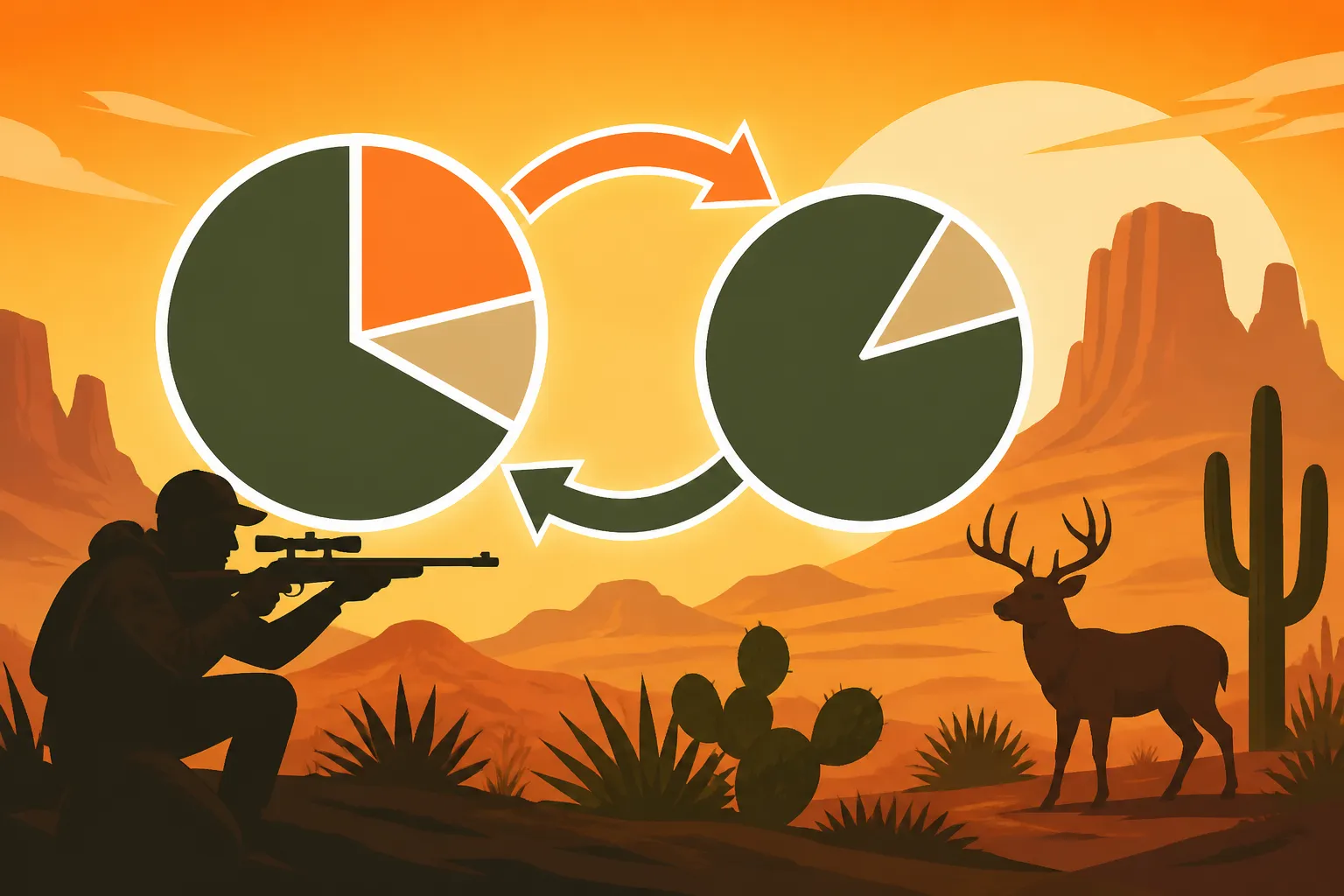
Why Twenty Percent and Ten Percent Interact
Navigating the Arizona big game draw can feel like trying to solve a Rubik's Cube blindfolded, especially when you're a nonresident. Many hunters get understandably frustrated trying to decipher the complex tag allocation system, wondering why their carefully accumulated bonus points don't always translate to better odds. This guide will pull back the curtain on one of the most confusing aspects: the crucial, and often misunderstood, interaction between Arizona's 20% bonus point pass and the strict 10% nonresident cap.
Understanding Arizona's Draw System Basics
Arizona's draw system is famously intricate, and it’s no secret that many hunters find themselves scratching their heads, particularly when comparing their results to those of residents or even other nonresidents. At its core, the system aims to distribute a limited number of coveted big game tags fairly, but "fairly" means different things to different groups. For nonresidents, it introduces additional layers of consideration that can make or break an application strategy.
The Two Passes: Bonus Point and Random
When you apply for a big game tag in Arizona, your application goes through two distinct "passes" – think of them as two separate rounds of drawings. This dual-pass system is designed to reward loyalty and experience while still offering a chance for newer applicants or those with fewer points.
First up is the Bonus Point Pass. This is where your hard-earned points really shine. In this initial pass, a certain percentage of tags for each hunt are set aside specifically for applicants with the highest bonus point totals. The idea here is that if you've been applying for years, diligently building points, you get a significant leg up. It’s a reward for persistence, essentially. If you've been putting in for elk in Unit 9 for a decade, this is your best shot. Hunters often pore over data, sometimes with tools like GoHunt, to see how many points it really takes to draw in this first pass. This system ensures that those who have been playing the long game have a distinct advantage in securing some of the most sought-after tags. For more on this, you might want to read our article on How Arizona's Bonus Point Pass Awards the First Twenty Percent.
After the Bonus Point Pass concludes, any remaining tags are then moved into the Random Pass. As the name suggests, this is a pure lottery. Every application that didn't draw in the bonus point round (and that is still eligible) gets an equal chance, regardless of how many points they have. This is where a hunter with zero points can theoretically draw the same tag as someone with 15 points, provided those points weren't enough to secure a tag in the first pass. It’s a bit like a second-chance drawing, ensuring that everyone maintains a sliver of hope, even if their point totals aren't through the roof. This aspect is vital, as it prevents the system from becoming entirely point-driven and inaccessible to new hunters. For a deeper dive into this, check out The Random Pass That Follows in Arizona.
The Overall Nonresident Cap
Now, here’s where things get even more specific for our out-of-state friends. Arizona has a fundamental rule: a hard cap of ten percent on the total number of big game tags that can be issued to nonresidents for any given hunt. This isn't just for elk or deer; it applies across the board, from pronghorn to bighorn sheep. This cap is a significant factor, as it means that even if a nonresident has a massive pile of points, they can never receive more than a tenth of the available tags for that specific hunt.
This cap is in place to ensure that the majority of Arizona's big game opportunities remain available to its residents, who fund much of the wildlife management efforts through their license and tag purchases. It's a common practice in western states, and while it's completely understandable from a state management perspective, it adds a layer of complexity and often frustration for nonresidents. It means the nonresident pool isn't just competing among themselves; they're effectively competing for a much smaller slice of the overall pie from the outset. This cap fundamentally reshapes how nonresidents approach the draw compared to residents.
The 20 Percent Bonus Point Pass Explained
Let's zero in on the Bonus Point Pass, because this is often where the initial hopes (and subsequent heartbreaks) of many nonresident applicants lie. Understanding its mechanics is crucial for building any kind of effective long-term strategy in Arizona.
How the Point Pass Works
In Arizona's bonus point pass, up to twenty percent of the tags available for each specific hunt code are allocated based on bonus points. "Up to" is an important distinction here; it's not always exactly 20%, but it gives you a good ballpark. Within this 20% pool, tags are awarded to applicants with the most bonus points first, working their way down until that 20% quota is met. If multiple applicants have the same high number of points, a random drawing occurs among them. This means your application goes into a pool with others who have similar point totals, and the computer selects winners until that initial percentage of tags is filled.
For example, if a hunt has 100 tags available, up to 20 of those tags will be distributed in the Bonus Point Pass. The system will look for the highest point holders, say those with 20 points, then 19, then 18, and so on, until 20 tags are gone. It’s a system designed to heavily favor those who have consistently applied over many years. This is why you hear stories of people waiting a decade or more for a premium elk or mule deer tag. Your success in this pass is directly proportional to your point accumulation, making it a critical consideration for those with long-term hunting goals. Remember, you can earn a point just by applying, which helps build that critical mass over time, as detailed in Earning an Arizona Point by Applying.
Who Benefits Most from the Point Pass
The Bonus Point Pass is an absolute game-changer for those who have patiently accumulated a significant number of points. It is unequivocally designed to benefit the most persistent applicants.
For nonresidents, this means that if you're aiming for a premium tag in a high-demand unit – think the legendary Kaibab mule deer or a top-tier Mogollon Rim elk hunt – having a high point total is almost a prerequisite to drawing in this initial pass. Without those points, your chances in the Bonus Point Pass are slim to none. It rewards foresight and a long-term commitment to applying in Arizona, even in years when you might not realistically expect to draw.
This system essentially filters out the casual applicants for the most competitive hunts, creating a more predictable path for those with a serious investment in the state's draws. It’s a powerful incentive to keep applying and building points, year after year, if those dream tags are on your bucket list. Nonresidents, in particular, need to understand that this pass is their best (and often only) chance for certain hunts, given the overall scarcity of tags they can draw.
Species Where the Point Pass is Crucial
While the Bonus Point Pass affects all big game species, its importance is amplified for specific animals, particularly those with very limited tags or extremely high demand. Prime examples include:
- Elk: Especially the trophy units like Unit 9, 10, or 23. The number of points required to draw an early archery or rifle elk tag in these units through the Bonus Point Pass can be astronomical, often requiring double-digit points. If you don't have the points, your odds are almost entirely relegated to the Random Pass, which for these hunts, can be dishearteningly low. Our article on Arizona Elk Season Structure by Hunt Code provides more context on these coveted hunts.
- Mule Deer: Particularly for the Arizona Strip or Kaibab units, which are renowned for producing world-class bucks. These hunts are also extremely point-heavy in the first pass.
- Pronghorn: Known for their elusive nature and limited tags, especially for rifle hunts. Drawing a quality pronghorn tag almost invariably requires significant points in the Bonus Point Pass.
- Desert Bighorn Sheep: These tags are incredibly rare, with very few allocated each year. Drawing one is often a once-in-a-lifetime opportunity, and it nearly always happens through the Bonus Point Pass for those with decades of point accumulation.
For these species, simply applying for a point each year, even without expecting to draw, is a strategic move for nonresidents. It's an investment in future opportunities.
The 10 Percent Nonresident Cap Explained
Now, let's turn our attention to the hard ceiling that nonresidents face, because this is where the plot thickens and often causes the most confusion and frustration.
Arizona's Ten Percent Nonresident Cap
As mentioned, Arizona enforces a strict rule: no more than ten percent of the total available tags for any specific big game hunt can be issued to nonresident hunters. This isn't "up to" ten percent; it's a firm maximum. If a hunt code has 100 tags, only 10 can go to nonresidents, regardless of how many points they have or how many apply. If there are 30 tags, only 3 can go to nonresidents. If there are only 5 tags, technically only 0.5 tags can go to nonresidents, meaning it rounds down, and zero tags would be available to nonresidents in that particular hunt.
This cap applies to the total allocation, meaning it's the absolute ceiling after both the Bonus Point Pass and the Random Pass have run their course. It's a cumulative limit, not just applied to one segment of the draw. This specific rule is a foundational element of Arizona's draw philosophy, prioritizing resident access above all else. Understanding The Nonresident Tag Cap in Arizona is essential for any out-of-state hunter.
The Impact on Nonresident Odds
The most direct impact of the 10% cap is a drastic reduction in the overall number of tags available to nonresidents. While residents are competing for 90% (or more) of the tags, nonresidents are vying for a mere 10% or less. This immediately makes the odds significantly tougher for nonresidents, even for hunts that might seem relatively accessible to residents.
Consider a hunt with 100 tags. Residents have 90 tags to compete for, while nonresidents have only 10. If the number of nonresident applicants is disproportionately high for those 10 tags, the individual odds plummet. This is particularly noticeable in high-demand hunts where nonresident interest is strong. For example, if 1,000 residents apply for their 90 tags, and 500 nonresidents apply for their 10 tags, the nonresident competition per tag is far more intense. It's a stark reality that shapes every application decision.
This cap often means that even with a good number of points, a nonresident might still have significantly lower odds than a resident with fewer points, simply because the pool of available tags for nonresidents is so much smaller. This is a common point of contention and a source of frustration, but it's a fixed rule in Arizona.
Why the Cap Exists
The 10% nonresident cap is a policy decision driven by several key factors, common to many western states. Primarily, it's about resident opportunity and funding.
- Funding: Resident hunters and anglers contribute significantly to the Arizona Game and Fish Department's (AZGFD) budget through license sales, tag fees, and excise taxes on hunting equipment (Pittman-Robertson Act funds). These funds are crucial for wildlife management, habitat restoration, and enforcement. By prioritizing residents, the state ensures that those who contribute most directly to the system receive the bulk of the hunting opportunities.
- Conservation and Management: Local residents often have a more direct stake in the long-term health of local wildlife populations and habitats. The cap helps maintain a balance, allowing AZGFD to manage game populations effectively while catering to its primary constituents.
- Public Land Access: Arizona has vast tracts of public land, but managing access and hunting pressure is a continuous challenge. Limiting nonresident tags helps distribute pressure and ensures that prime hunting areas aren't overwhelmed by out-of-state hunters. It's a way of protecting the local hunting culture and experience.
While it might feel restrictive to nonresidents, the cap is a strategic move by the state to balance wildlife management goals with the expectations and contributions of its resident hunting community.
How the Two Allocation Rules Intertwine
This is where the real magic (or misery, depending on your perspective) happens. The 20% Bonus Point Pass and the 10% Nonresident Cap don't operate in isolation; they interact in a specific sequence that profoundly impacts nonresident draw odds.
The Sequential Application of Rules
Arizona applies its draw rules in a very particular order, which is critical to understand.
- Initial Tag Allocation: First, the total number of tags for a given hunt code is determined.
- Bonus Point Pass (Up to 20%): The system then runs the Bonus Point Pass, awarding tags to the highest point holders. Crucially, at this stage, the nonresident cap is NOT yet applied. This means both residents and nonresidents are competing in this initial pass for up to 20% of the tags, based purely on points. A nonresident with 25 points has the same chance as a resident with 25 points in this initial allocation, assuming they are among the top point holders.
- Random Pass (Remaining Tags): Any tags not drawn in the Bonus Point Pass then move to the Random Pass, where all remaining eligible applicants have a chance. Again, the nonresident cap is still not explicitly applied to this specific pass.
- The 10% Cap Check (After all tags are provisionally drawn): After all tags have been provisionally awarded through both the Bonus Point and Random passes, the system then checks if the total number of tags issued to nonresidents for that specific hunt exceeds 10%. If it does, tags are taken away from the lowest point-holding nonresidents (those drawn in the Random Pass first, then those in the Bonus Point Pass with fewer points) until the 10% cap is met. These reclaimed tags are then reallocated to residents.
This sequence is the absolute key to understanding the Arizona draw for nonresidents. It means that while you can draw a tag in the Bonus Point Pass as a nonresident, your ability to hold onto it, or even to draw one in the Random Pass, is ultimately constrained by that 10% ceiling. This process can be quite frustrating for nonresidents who see high draw odds for residents with fewer points, only to realize their own "successful" draw gets revoked due to the cap.
Real-World Scenarios and Outcomes
Let's walk through a hypothetical to really drive this home. Imagine a high-demand elk hunt with 100 tags.
-
Scenario 1: Nonresident Draws in the Bonus Point Pass
- The Bonus Point Pass awards 20 tags. Let's say among the top point holders, 5 nonresidents and 15 residents draw tags. So far, so good. Nonresidents have 5 tags.
- The remaining 80 tags go to the Random Pass. After the random draw, another 10 nonresidents and 70 residents provisionally draw tags.
- Now, the total nonresident tags are 5 (BP Pass) + 10 (Random Pass) = 15.
- The 10% cap check: The total tags are 100, so only 10 nonresidents can ultimately receive tags. Since 15 were provisionally drawn, 5 nonresidents will have their tags rescinded. These will typically be the nonresidents who drew in the Random Pass with lower (or zero) points. The tags are then re-issued to residents who were unsuccessful.
- Outcome: Even though 15 nonresidents drew, only 10 ultimately receive tags. The nonresidents with the highest points (those who drew in the BP Pass) are usually safe, but those in the random pass are at high risk.
-
Scenario 2: Nonresident Fails to Draw in the Bonus Point Pass, Draws in Random
- A nonresident has some points but not enough for the Bonus Point Pass. They apply and are lucky enough to draw in the Random Pass.
- However, if the total number of nonresidents drawn (BP Pass + Random Pass) exceeds the 10% cap, that randomly drawn tag will likely be taken away and given to a resident.
- Outcome: The hunter's draw success is short-lived, replaced by disappointment due to the cap.
This interaction is why just looking at "points needed to draw" in the Bonus Point Pass for a given unit can be misleading for nonresidents. You also need to consider how many other nonresidents are likely to draw and if that will push the nonresident allocation over 10%. This is where analyzing application data with tools like GoHunt becomes incredibly valuable. They help you gauge not just points needed, but also the overall nonresident competition.
When the Cap Becomes a Bottleneck
The 10% nonresident cap primarily acts as a bottleneck in hunts that are:
- Extremely popular with nonresidents: Hunts for trophy elk, big mule deer, or early season archery opportunities tend to attract a disproportionate number of nonresident applicants. Even if only a few tags are available, the competition for those limited 10% becomes fierce.
- Low Tag Count Hunts: If a hunt only has a very small number of total tags, the 10% cap can mean that only 1 or 2 (or even zero) tags are truly available to nonresidents. For instance, a hunt with 15 tags means only 1 nonresident tag (10% of 15 is 1.5, rounded down). A hunt with 8 tags means 0 nonresident tags (10% of 8 is 0.8, rounded down). This drastically reduces, or even eliminates, nonresident opportunity.
- Hunts with a Strong Bonus Point Pool: If a hunt has a deep pool of nonresidents with high points, they will fill up the 10% cap quickly in the Bonus Point Pass, leaving almost no tags for nonresidents in the Random Pass, regardless of their luck.
Understanding these scenarios helps nonresidents strategize where their points might be best spent and where the odds are simply too stacked due to the cap.
Strategies for Nonresidents in the Arizona Draw
Given this complex interplay of the 20% bonus point pass and the 10% nonresident cap, simply applying haphazardly isn't a viable strategy for out-of-state hunters hoping to draw a quality tag. A thoughtful, long-term approach is essential.
Building Bonus Points Strategically
For many of the state's most coveted tags, especially for species like elk and trophy mule deer, accruing a substantial number of bonus points is the most reliable path to drawing. Since the Bonus Point Pass doesn't initially consider the nonresident cap, having enough points to draw in this first pass effectively puts you ahead of many other nonresidents.
- Apply Annually: The most fundamental strategy is to apply every year, even if you don't plan to hunt or don't expect to draw a premium tag. This consistency builds your point total, and every point increases your odds in the Bonus Point Pass. Don't let a year slip by! You can even apply for a point-only option if you prefer not to actually enter the draw for a tag, but still want to increase your points. This point-only strategy is a great way to ensure you're always gaining, which is covered in Buying an Arizona Point Without Applying to Hunt.
- Target Point-Only for Certain Species: If a specific hunt is so competitive that drawing it feels like a pipe dream, or if your current point total is far from competitive, applying for "point only" can be a smart move. This guarantees you accrue a point without risking drawing a tag you can't use or don't want.
- Consider Loyalty Points: Arizona also offers a "Loyalty Point" for applying for five consecutive years. While not directly tied to the point pass, it's another testament to how the state rewards consistent participation. Our article The Arizona Loyalty Point Explained details how this can further enhance your application.
Building points is a marathon, not a sprint. It requires patience and a commitment to the process, but it's the bedrock of any successful long-term nonresident draw strategy in Arizona.
Using Data to Inform Applications
In a system this complex, guessing isn't a strategy. Smart nonresidents rely heavily on data and analysis to make informed application choices.
- Analyze Draw Odds: Don't just look at the overall draw odds for a unit; delve into the nonresident-specific odds. Many resources provide data broken down by resident/nonresident and by point tier. This will give you a realistic picture of your chances. Websites like GoHunt offer detailed analytics tools that are invaluable for this purpose, allowing you to filter by species, unit, and your specific point total. They can help you identify units where the 10% cap might not be hit by high point holders, potentially leaving some tags for lower point applicants in the Bonus Point Pass, or even in the Random Pass if nonresident interest isn't as high.
- Understand Tag Numbers: Pay close attention to the total number of tags available for each hunt code. As discussed, a low tag count severely restricts nonresident opportunity due to the 10% cap. If a hunt has 20 tags, only 2 can go to nonresidents. If it has 5 tags, zero tags will go to nonresidents. This factor alone can eliminate many hunts from a nonresident's viable options, regardless of points.
- Monitor Nonresident Application Trends: While harder to track precisely, understanding general nonresident interest in certain units or hunt types can be helpful. High demand from other nonresidents directly impacts your chances within that 10% cap. GoHunt's Insider tool, for example, often provides analysis of these trends, helping you anticipate where competition might be fiercest. Their platform is excellent for Checking Arizona Draw Odds Before You Apply.
By meticulously studying the data, you can move beyond hope and begin to make strategic, data-driven decisions that maximize your chances within the constraints of the system.
Considering Group Applications
For nonresidents, group applications offer a unique way to pool points and increase collective odds, but they come with their own set of considerations, especially with the 10% cap in play.
- Point Averaging: In Arizona, when applying as a group, the points of all applicants are averaged. This can be beneficial if a lower-point nonresident applies with a higher-point nonresident, boosting their collective odds. However, if a high-point hunter applies with a zero-point hunter, it will lower the high-point hunter's effective draw odds in the Bonus Point Pass.
- All or Nothing: If a group draws, all members of the group draw a tag. If they don't, none do. This means choosing your group wisely is paramount.
- Nonresident Cap Implications: The 10% cap still applies to the total number of nonresident tags issued, regardless of group applications. So, even if a group of nonresidents successfully draws, if their combined draw, plus other individual nonresident draws, pushes the overall allocation over 10%, some of those tags will be rescinded, starting with the lowest point holders. This makes group applications for nonresidents a bit of a double-edged sword; they can help you draw, but the cap can still snatch it away.
Before forming a group, carefully consider the point totals of all members and the likely competition within the 10% nonresident quota. For more on group applications, you can explore topics like Maximum Group Size in an Arizona Application and How Arizona Averages Points Across a Group.
Case Studies and Practical Examples
To make the interaction between the 20% bonus point pass and the 10% nonresident cap truly concrete, let's look at a few common scenarios for different species.
High-Demand Elk Hunts
Arizona's trophy elk hunts are arguably the most competitive draws in the West. Units like 9, 10, or 23, especially for early archery or rifle seasons, are legendary for their bull quality and notorious for their draw difficulty.
- The Reality for Nonresidents: For a nonresident targeting one of these hunts, the interaction of the 20% and 10% rules is stark. To have any realistic chance, you must draw in the Bonus Point Pass. This means accumulating a very high number of points – often in the upper teens or even 20+.
- Example: Imagine Unit 9 has 150 early rifle elk tags.
- 20% Bonus Point Pass: Up to 30 tags (20% of 150) are allocated here. Let's say 25 residents and 5 nonresidents with the highest points draw.
- 10% Nonresident Cap: Only 15 total nonresident tags are allowed (10% of 150).
- Outcome: Those 5 nonresidents who drew in the Bonus Point Pass are likely safe. However, if more than 10 additional nonresidents were to draw in the Random Pass, those random draw tags would be rescinded until the 15-tag cap is met. This means if you don't draw in the Bonus Point Pass for these top units, your chances as a nonresident are exceedingly slim, as any random draw success is highly vulnerable to the 10% cap. Nonresidents often spend years just accumulating points for these specific tags, understanding that the only path to success is through the Bonus Point Pass. This situation is why many nonresidents will apply for a point only for these dream tags until their point total is truly competitive.
General Deer Hunts
Deer tags, particularly for mule deer and Coues deer, are often more numerous than elk tags, but still vary widely in demand. Arizona Deer Seasons Across the Calendar can show you the breadth of opportunities.
- Mule Deer on the Plateaus: Hunts for mule deer on the northern plateaus, such as Unit 1 or 3A, can be popular.
- Example: A general mule deer hunt with 300 tags.
- 20% Bonus Point Pass: Up to 60 tags. Perhaps 50 residents and 10 nonresidents with decent points draw.
- 10% Nonresident Cap: Only 30 total nonresident tags are allowed.
- Outcome: The 10 nonresidents who drew in the Bonus Point Pass are secured. This leaves 20 more nonresident tags available (30 cap – 10 already drawn). If more than 20 nonresidents draw in the Random Pass, some will lose their tags. This means even with a few points, drawing in the Random Pass as a nonresident is still a risk, but generally less so than for premium elk hunts due to higher overall tag numbers and potentially lower nonresident demand per tag.
- Example: A general mule deer hunt with 300 tags.
- Coues Deer in the Sky Islands: Coues deer hunts, especially those in the "sky islands" of southeastern Arizona, can be very unique and offer good opportunities.
- Example: A Coues deer hunt in Unit 22 with 200 tags.
- 20% Bonus Point Pass: Up to 40 tags. Perhaps 35 residents and 5 nonresidents with mid-level points draw.
- 10% Nonresident Cap: Only 20 total nonresident tags are allowed.
- Outcome: The 5 nonresidents who drew in the BP Pass are safe. This leaves 15 more nonresident tags available. If fewer than 15 nonresidents draw in the Random Pass, all who drew will keep their tags. If more than 15 draw, some will be rescinded. For these hunts, the Random Pass can be a more viable option for nonresidents with lower points, but the 10% cap still serves as a hard limit on total success. The sheer volume of tags can sometimes soften the impact of the cap slightly.
- Example: A Coues deer hunt in Unit 22 with 200 tags.
Less Sought-After Species
For species like javelina or even certain bear or mountain lion hunts, the dynamic shifts again, primarily because overall demand (resident and nonresident) is often lower, and tag numbers can be higher. Our article Arizona Javelina Tags Are Available All Year covers how accessible these can be.
- Example: General Javelina Hunt with 500 tags.
- 20% Bonus Point Pass: Up to 100 tags. With javelina often being drawn with few points, or even zero points, many residents and a handful of nonresidents might draw here.
- 10% Nonresident Cap: Only 50 total nonresident tags allowed.
- Outcome: It's highly likely that the 10% cap won't even be hit in many javelina hunts, especially for nonresidents. If fewer than 50 nonresidents apply and draw in total, then every nonresident who draws will keep their tag, regardless of points or which pass they drew in. The interaction is less of a bottleneck here because the demand simply isn't high enough to trigger the cap's full restrictive effect.
These examples illustrate that the "why" behind the 20% and 10% interaction isn't just theoretical; it translates directly into your chances of holding a tag in your hand. Understanding these nuances is paramount for any nonresident hoping to experience the incredible hunting Arizona has to offer.
Disclaimer
Please note that hunting regulations, seasons, and draw mechanics are subject to change. Always consult the most current Arizona Game and Fish Department regulations before applying or heading afield. This guide is for informational purposes only and does not constitute legal advice.