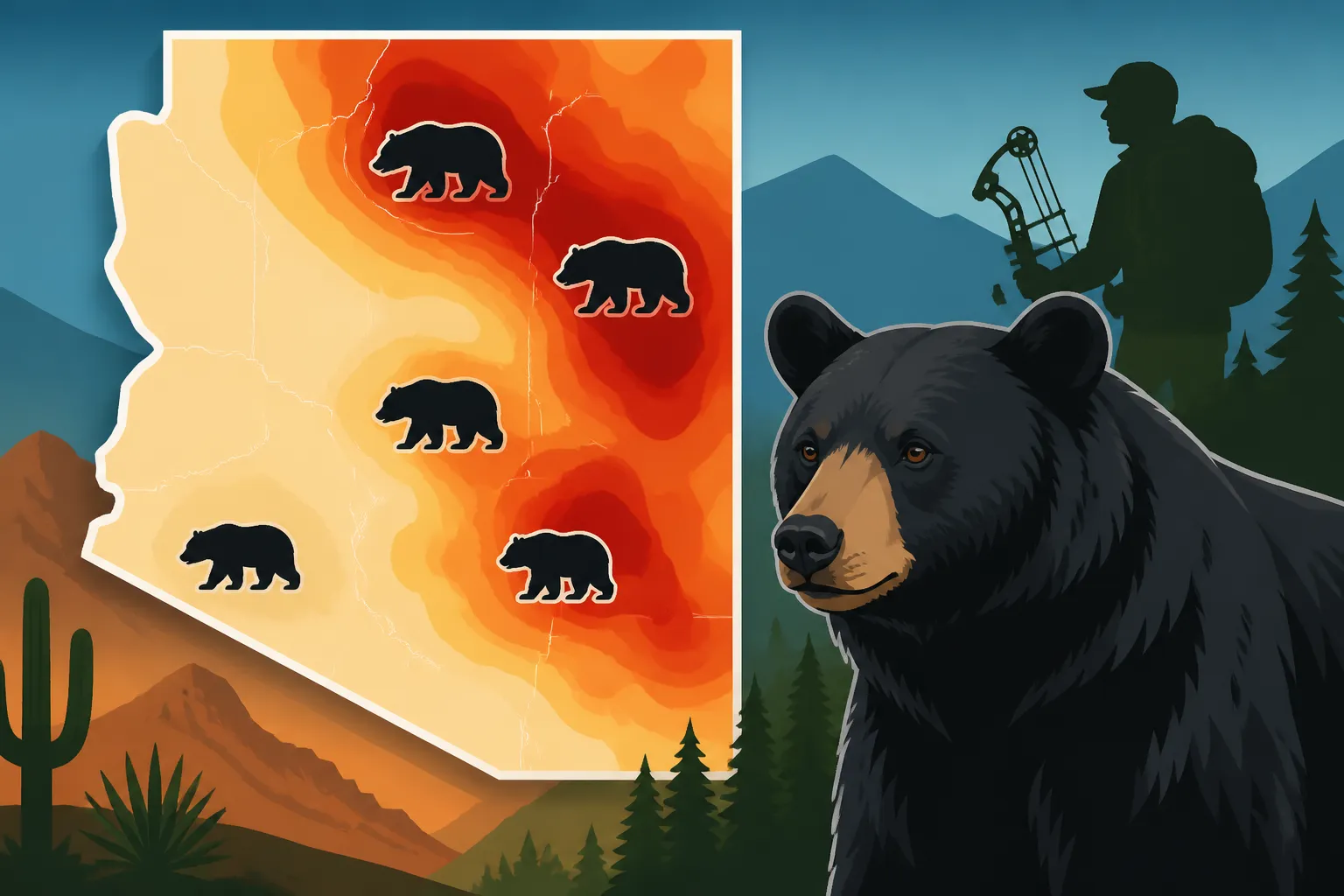
Black Bear Density Across Arizona
It’s a common misconception, especially for those new to Arizona, that our state is nothing but scorching desert devoid of large, charismatic mammals like black bears. Many envision endless saguaros and think bears are reserved for the pine-covered mountains of states further north. But if you’ve spent any time scouting the varied landscapes here, you know that couldn't be further from the truth. Black bears are not only present but thriving across a surprising array of Arizona’s diverse ecosystems, offering unique and challenging hunting opportunities. This guide will walk you through the real picture of black bear density across Arizona, dispelling myths and pinpointing where these elusive animals make their homes, and how that impacts your hunting strategy.
Understanding Arizona's Black Bear Habitats
Arizona's landscape is far more varied than many give it credit for. From high-elevation conifer forests to arid, brush-covered mountains, black bears have adapted to an impressive range of environments. Their presence is a testament to the state's incredible biodiversity, showcasing how these animals can carve out a living even in seemingly harsh conditions. For hunters, understanding these diverse habitats is the first step in unlocking successful bear encounters.
Beyond the Pines: Diverse Bear Country
While it's true that the classic image of a black bear often places them in dense pine and aspen forests, like those found on the Mogollon Rim or the White Mountains, Arizona's bears are far more versatile. You'll find them in oak woodlands, pinyon-juniper zones, and even the rugged, chaparral-covered slopes of the desert mountains. These aren't necessarily the picture-perfect forests of Colorado or Montana, but they provide the essential ingredients for bear survival: food, water, and cover. The bears here have simply learned to utilize what's available, often shifting their routines to be more active during cooler parts of the day or concentrating in areas with dense brush.
For instance, the higher elevations near Flagstaff and Payson certainly hold a strong bear presence, offering that familiar timbered hunting experience. But venture south into the more arid regions, and you'll discover bears inhabiting rocky canyons and steep, brushy hillsides where you might typically only expect to find javelina or Coues deer. This adaptability means hunters need to broaden their search image and understand that "bear country" in Arizona isn't a monolithic concept. It requires a nuanced approach, looking for sign in unexpected places and understanding how a bear's needs might differ depending on its specific locale.
Elevation and Vegetation: Key to Bear Presence
The primary drivers of black bear distribution in Arizona are elevation and the associated vegetation types. Generally, bears prefer elevations between 4,000 and 9,000 feet, which offer a cooler climate and more abundant forage than the scorching desert floor. However, they will certainly venture higher and lower depending on seasonal food availability and water. The vegetation zones directly correspond to these elevations, providing a roadmap for where to focus your efforts.
Think about the transition zones: from the saguaro-studded desert, you move into grasslands, then into scrub oak and chaparral, eventually reaching the ponderosa pines and mixed conifer forests. Bears tend to concentrate in the oak woodlands and chaparral areas because these habitats are rich in acorns, berries, and other mast crops—critical food sources, especially in the fall. These areas also provide excellent cover, allowing bears to move relatively undetected. The denser the cover, the more secure a bear feels, which is a major factor in their daily patterns. When you're scouting, pay close attention to the transitions between these vegetation types, as bears often travel and feed along these edges.
Water Sources and Food Availability
Just like all wildlife in Arizona, black bears are intrinsically tied to water. In this often-parched landscape, reliable water sources act as magnets, concentrating animals and making them more predictable. Bears need water not just for drinking, but also for cooling down during the warmer months. Identifying stock tanks, natural springs, seeps, and even temporary rain-filled depressions can be a game-changer for locating bears.
Beyond water, food availability is the ultimate determinant of bear density and movement. Arizona's bear populations fluctuate significantly based on mast crop production—especially acorns from various oak species, prickly pear fruit, and juniper berries. When a particular food source is abundant, bears will often congregate in those areas, sometimes moving many miles from their typical home ranges. Conversely, in drought years or when mast crops fail, bears may expand their search for food, venture into lower elevations, or even become more visible near human developments, leading to increased conflicts. A savvy hunter will stay informed about local conditions, paying attention to rainfall patterns and forage reports, which can significantly impact where bears are feeding.
Mapping Black Bear Density: General Distribution
While black bears can be found across a surprisingly broad swath of Arizona, certain regions are undeniably prime bear country, boasting higher densities and more consistent populations. Understanding these general distribution patterns is essential for anyone looking to hunt bears here, whether you're a resident or planning a trip from out of state. It helps narrow down the vastness of the Arizona landscape into more manageable hunting zones.
The Mogollon Rim and White Mountains: Prime Bear Territory
When most Arizonans think of black bears, their minds immediately go to the vast forested expanses of the Mogollon Rim and the White Mountains. This extensive uplift, stretching across the central and eastern parts of the state, offers everything a bear could want: dense ponderosa pine and mixed conifer forests, abundant oak thickets, consistent water sources, and plenty of rugged terrain for cover. Units like 27, 3C, and those along the Rim (e.g., portions of 4A, 4B, 5A, 5B) consistently support robust bear populations.
The sheer size and continuity of this habitat allow bears to thrive, leading to some of the highest densities in the state. Hunters in these areas can expect to find bears foraging for acorns in the fall, seeking out succulent plants in the spring, and utilizing the shade and water during the summer. While this is prime elk country—many hunters scouting for elk often encounter bears—it’s also a fantastic place to specifically target bears. Access is generally good via forest roads, but the terrain can be steep and heavily timbered, demanding good physical conditioning and diligent scouting. Learning about The Mogollon Rim as Arizona Elk Country can also give you insights into the broader ecosystem bears inhabit there.
Sky Islands: Southern Arizona's Hidden Bear Havens
Perhaps one of Arizona's most unique ecological phenomena is the "Sky Islands" of the southeastern region. These isolated mountain ranges, rising dramatically from the surrounding desert, are like biological arks, supporting ecosystems more akin to those found far to the north. Mountains such as the Chiricahuas, Santa Ritas, Huachucas, and Galiuros provide crucial habitat for black bears, often in surprisingly high densities given their isolated nature. While often associated with Arizona's Sky Islands and Where Coues Live, these ranges are equally important for bears.
The vegetation on these Sky Islands transitions from desert scrub at their base to oak woodlands, pine forests, and even small patches of mixed conifer at their peaks. Bears exploit these varied elevation bands, moving up and down the mountains in search of food and water throughout the year. The rugged, often impenetrable canyons and dense oak brush provide exceptional cover, making bears here notoriously difficult to spot. Hunting these areas often involves arduous climbing and patient glassing, as bears can seemingly vanish into the landscape. Despite the challenges, the Sky Islands offer a genuinely wild and rewarding bear hunting experience for those willing to put in the effort.
Western Arizona: Surprising Pockets of Bear Activity
While the Mogollon Rim and the Sky Islands are widely recognized as primary bear habitats, western Arizona also holds surprising pockets of black bear density. Many hunters might dismiss this region as too hot and dry for bears, but specific mountain ranges offer the necessary resources. The Bradshaw Mountains near Prescott, for instance, have a well-established bear population, benefiting from scattered Ponderosa pine, dense chaparral, and critical water sources. Similarly, ranges like the Hualapai Mountains near Kingman, and even portions of the Bill Williams Mountain area, provide sufficient habitat.
These western populations often rely more heavily on prickly pear fruit, agaves, and mesquite beans when available, supplementing their diet with grasses and forbs. Their densities might not be as high or continuous as those found in the central and eastern forests, but they are certainly present and offer unique hunting opportunities. Hunting in these areas often means adjusting your strategy to the more arid conditions: focusing heavily on water sources, identifying areas with recent prickly pear production, and adapting to the open, yet brushy, terrain. It's a different kind of bear hunt, but a valid one for the intrepid hunter.
Factors Influencing Bear Populations and Management
Understanding where bears live is one thing, but comprehending why their populations fluctuate and how the state manages them adds another crucial layer for the dedicated hunter. Arizona's black bear populations are dynamic, influenced by a complex interplay of natural cycles, human activities, and targeted conservation efforts. Knowing these factors can help you anticipate bear movements and understand the reasoning behind hunting regulations.
Food Cycles and Forage Fluctuation
Black bear populations, and their distribution within a unit, are heavily driven by food cycles. Unlike some other big game species, bears are opportunistic omnivores, meaning their diet can shift dramatically based on what's available. The success or failure of critical mast crops, particularly acorns and prickly pear fruit, directly impacts bear health, cub survival rates, and overall population density. Years of abundant food often lead to higher cub production and better survival through the winter, boosting population numbers.
Conversely, periods of drought or poor mast crop production can put significant stress on bear populations. During these times, bears may have to travel farther and wider to find sustenance, making them more visible in unusual areas, including residential zones. This can lead to increased human-wildlife conflicts, and the Arizona Game and Fish Department (AZGFD) often adjusts management strategies accordingly. For a hunter, staying informed about local forage conditions is paramount. Sites like GoHunt often compile information on forage reports or connect you with resources that help you gauge the health of the local food supply, which can be a key indicator of where bears will be concentrating their efforts for feeding.
Harvest Limits and Hunter Pressure
Arizona manages its black bear population through a combination of limited-entry draws and over-the-counter (OTC) tags, often with specific unit-by-unit harvest limits. These limits are carefully calculated by the AZGFD to ensure sustainable populations while providing hunting opportunities. Hunters need to be acutely aware of these regulations, as units can close mid-season once the harvest objective for female bears is met. This mechanism, known as a "female harvest limit," is critical for maintaining population health, as the number of breeding females directly impacts future generations. Learning Female Harvest Limits on Arizona Bears is non-negotiable for bear hunters here.
Hunter pressure can also influence bear distribution. In readily accessible units, bears may become more nocturnal or move into thicker, less accessible areas to avoid human contact. This is particularly true in areas with higher road densities or near popular camping spots. Experienced hunters often seek out less-traveled canyons or wilderness areas to find bears that are less disturbed. It's also worth noting that Arizona Bear Season and Harvest Limits vary by unit and season, so studying the regulations thoroughly is crucial before planning any hunt.
Conservation Efforts and Research
Arizona Game and Fish Department (AZGFD) conducts extensive research and conservation efforts to monitor and manage black bear populations. This includes bear trapping and collaring studies to track movements, estimate populations, and assess habitat use. Data gathered from these efforts directly informs management decisions, including setting harvest limits and identifying areas where conservation efforts are most needed. The goal is to maintain a healthy, viable bear population across the state while minimizing human-wildlife conflicts.
One important aspect of these efforts is public education, particularly regarding proper food storage in bear country and what to do if you encounter a bear. Reducing attractants in campgrounds and residential areas helps prevent bears from becoming habituated to human food, which is often a precursor to conflicts and, unfortunately, often leads to bears having to be removed. Hunters, through their license fees, directly contribute to these vital conservation programs. Staying informed about The Black Bear Population Estimate Explained and understanding the science behind bear management helps foster a responsible and ethical hunting community.
Best Units for Black Bear Hunting in Arizona
Choosing the right unit for black bear hunting in Arizona can feel overwhelming, given the state's vast and varied landscape. While bears are distributed widely, certain units consistently offer higher densities and better opportunities for success. The "best" unit often depends on your hunting style, preferred terrain, and how much effort you're willing to put in.
Northern Arizona Units: High Opportunity Zones
For many, the high country of Northern Arizona, encompassing the Mogollon Rim and the White Mountains, represents the pinnacle of bear hunting in the state. Units like 27, 3C, 1, and 4A are often cited for their strong bear populations. These units offer expansive forests, plentiful oak brush, and consistent water sources, making them ideal habitats. Bears here often grow to impressive sizes, benefiting from abundant food resources.
Hunting in these northern units typically involves a mix of glassing open hillsides, still-hunting through dense timber, and focusing on areas known for mast crop production in the fall. Access is generally good, with numerous forest roads crisscrossing the landscape, but the terrain can be rugged and physically demanding. These units often have both spring and fall seasons, with harvest limits that require careful monitoring; remember to check if How Arizona Closes a Bear Unit Mid-Season is applicable to your chosen unit. Utilizing mapping tools like those offered by GoHunt, or simply taking the time for E-Scouting an Arizona Unit Before the Season can give you a significant advantage in breaking down these large, complex units.
Southeastern Units: Challenging but Rewarding
The Sky Island units of southeastern Arizona, such as 29, 30A, 30B, 35A, and 35B, offer a completely different, yet equally rewarding, bear hunting experience. While the overall density might not be as high as in some northern units, the bears here are often spread out across incredibly steep, brushy, and remote country. These are not areas for the faint of heart; expect long, strenuous hikes, intense glassing sessions, and a true test of patience.
The reward, however, can be a solitary experience in a stunning landscape, with the chance to spot a bear that few others would ever encounter. Success in these units often hinges on finding isolated water sources and concentrating your efforts in oak thickets and chaparral pockets where bears seek cover and food. Scouting, often by simply driving and walking forest roads to Reading a Unit Before You Ever Walk It, and then using high-quality optics to dissect the rugged mountainsides, is crucial. For those who relish a physical and mentally demanding hunt, the Sky Islands provide an unforgettable adventure.
Utilizing Tools for Unit Selection
Navigating Arizona's vast hunting landscape and selecting the perfect unit for bear can be daunting. Thankfully, there are powerful tools and resources available to help you make informed decisions. Beyond just looking at draw odds or general population numbers, you need to dig into habitat types, access points, and historical success data.
One invaluable resource for this is a platform like GoHunt. Their "Insider" membership, for example, provides detailed information on units, including harvest success rates, public land percentages, and crucial land ownership maps. This allows you to overlay different data points, like historical bear harvest locations with known oak thickets or water sources, to pinpoint potential hotspots. You can even use their mapping features to identify areas with limited access, which often correlates with less hunter pressure and potentially more undisturbed bears. Combining digital scouting tools with real-world knowledge of an area’s vegetation and water availability is the modern hunter’s secret weapon. Remember to also cross-reference with the official AZGFD regulations, which provide the most up-to-date legal frameworks, including Baiting Rules That Apply to Arizona Bears and any unit-specific restrictions.
Seasonal Movements and Bear Behavior
Understanding black bear density across Arizona isn't just about knowing where they live, but also when and how they utilize those habitats throughout the year. Bears are highly seasonal animals, with their behavior and movements dictated largely by food availability, breeding cycles, and the need to prepare for winter dormancy. For hunters, this means adapting your strategies to align with these seasonal shifts.
Spring Bear Activity: Foraging After Denning
As the last snow melts and temperatures begin to rise in late spring, Arizona's black bears emerge from their dens, often lean and hungry. This is a critical time for them to replenish lost energy reserves. During the spring seasons, bears are primarily focused on finding the first available green vegetation, such as tender grasses, forbs, and emerging succulent plants. They often concentrate on south-facing slopes, which warm up faster and sprout new growth earlier in the season. These slopes also tend to have good visibility, making them excellent spots for glassing.
In years with a mild winter and early spring, bears might emerge earlier, and with good rainfall, the green-up can be extensive. This means bears might be more spread out. However, if conditions are dry or late, bears might concentrate more heavily on specific canyons or areas that hold moisture and thus produce more forage. Water sources also become increasingly important as the season progresses and temperatures climb. While spring hunts can be challenging due to unpredictable weather and often thick new vegetation, catching a bear actively foraging after months of dormancy can be incredibly rewarding.
Summer Patterns: Water and Shade Seekers
As Arizona plunges into the intense heat of summer, black bear behavior shifts dramatically. With temperatures soaring, bears prioritize finding shade and staying hydrated. Their activity often becomes more crepuscular or nocturnal, meaning they are most active during the cooler hours of dawn, dusk, and even throughout the night. During the day, they will seek out dense cover, north-facing slopes, and areas with thick canopy to escape the sun.
Water sources become absolute magnets during the summer. Stock tanks, perennial springs, and seeps will draw bears from considerable distances. Concentrating your scouting efforts around these water holes, while always being mindful of ethical considerations and regulations like Hunting a Stock Tank During Early Archery, is a smart strategy. The monsoon season, typically from July to September, brings vital rainfall that can temporarily change bear movements. New puddles and seeps can open up, allowing bears to disperse slightly, but established water sources remain key attractants. Also, consider how severe events like How Wildfire Changes Elk Habitat can temporarily alter bear movements by destroying cover or opening up new forage.
Fall Bear Behavior: Hyperphagia and Preparation
Fall is perhaps the most critical season for black bears in Arizona, as they enter a period of "hyperphagia"—an intense drive to eat and put on fat reserves in preparation for winter denning. This translates to significantly increased activity, often throughout the day, as bears voraciously consume acorns, berries, juniper cones, and other mast crops. For hunters, this is often the most productive time to pursue bears.
The key to fall bear hunting is finding the food source. Scout heavily for acorn crops; identifying oak trees that are dropping acorns will often lead you directly to bears. Pay attention to fresh scat, disturbed ground, and claw marks on trees. Bear sign will be abundant in areas with heavy mast production. Their movements will be centered around these feeding grounds, and they might travel considerable distances between different food patches. Understanding these patterns, combined with knowledge of bear density in your chosen unit, significantly increases your chances of a successful fall hunt.
| Region/General Area | Typical Bear Density | Primary Habitat Characteristics | Common Food Sources (Seasonal) | Hunting Challenge Level |
|---|---|---|---|---|
| Mogollon Rim/White Mtns. | High | Dense conifer/oak forests, rugged canyons, good water | Acorns, berries, forbs, pine nuts | Moderate-High |
| Sky Islands (SE AZ) | Medium-High | Steep, brushy mountains, oak woodlands, isolated springs | Acorns, prickly pear, agaves, juniper berries | High |
| Western AZ Mountains | Low-Medium | Chaparral, pinyon-juniper, rocky terrain, scattered water | Prickly pear, agaves, mesquite pods, grasses | Moderate-High |
| Central AZ Highlands | Medium | Mixed conifer, scrub oak, riparian corridors, various elevations | Acorns, berries, insects, cacti fruits | Moderate |
Disclaimer
Please remember that hunting regulations and wildlife populations are subject to change. Always consult the most current Arizona Game and Fish Department regulations before planning any hunting trip. This guide is for informational purposes only and does not replace official documentation.