Holding for Wind Across a Wide Canyon
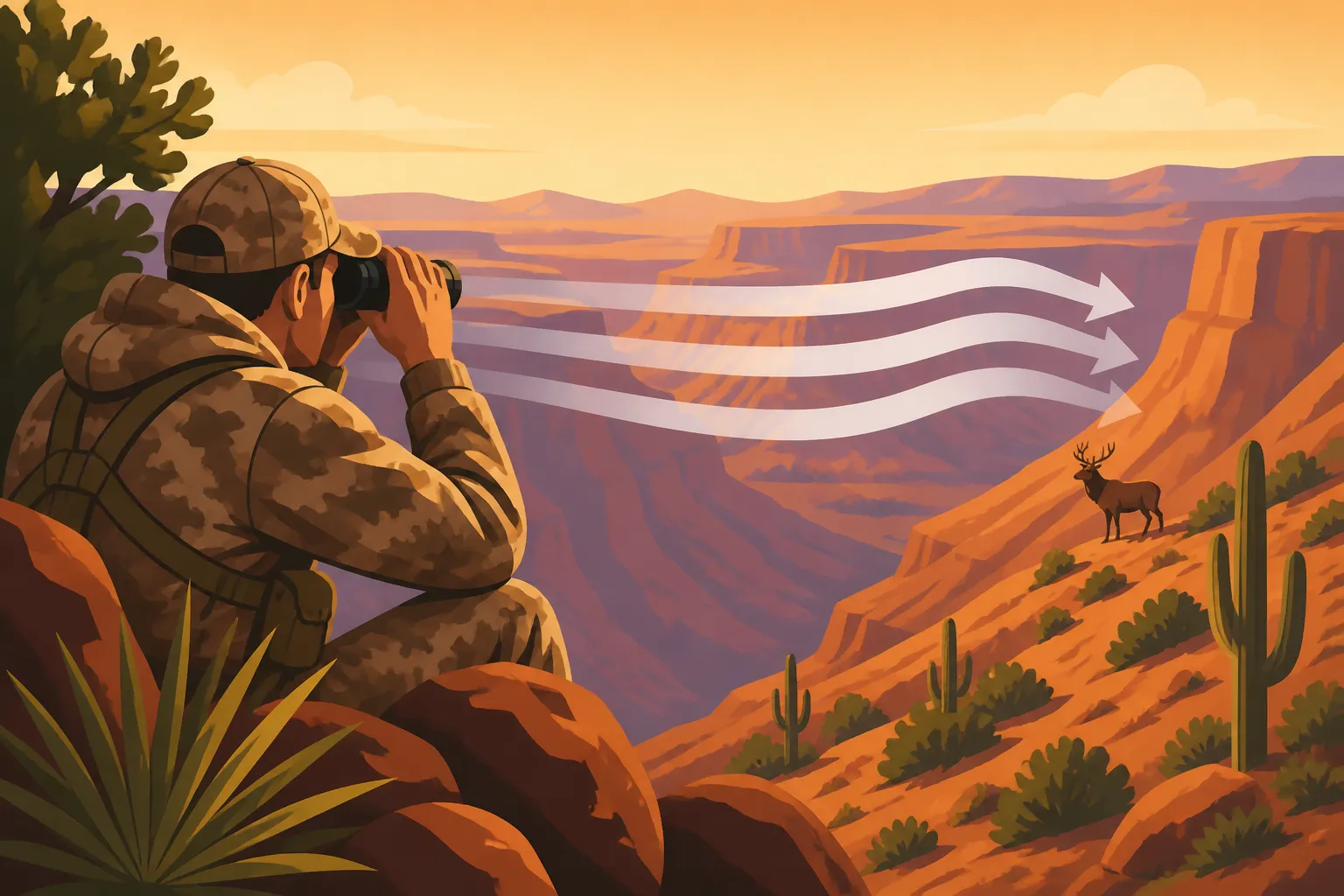
There’s almost nothing more frustrating in Arizona hunting than when you finally get set up on a deer or an elk across a wide canyon, your heart pounding, only for the wind to start swirling and messing with your shot. That feeling of anticipation turning to uncertainty as you watch thermals dance and flags whip around is enough to make anyone pull their hair out. This guide is all about helping you understand, predict, and ultimately compensate for those tricky cross-canyon winds, giving you a better chance at making an ethical shot when it counts.
The Unpredictable Nature of Canyon Winds
Hunting in Arizona's vast and rugged canyons, whether you're after a Coues deer in the Sky Islands or an elk on the Mogollon Rim, means you're going to encounter wind. And not just a gentle breeze, but often turbulent, multi-directional gusts that seem to defy logic. The biggest frustration isn't just the wind itself, but its uncanny ability to change direction and speed mid-shot, making even a perfect range obsolete.
The Frustration of Inconsistent Airflow
Imagine you're overlooking a deep canyon in Unit 21, watching a beautiful Coues buck feeding hundreds of yards away. You've ranged him, checked your dope, and just as you settle in, a gust hits you from the right, then immediately shifts to the left, then seemingly dies completely. This isn't just annoying; it's a legitimate challenge to ethical shot placement. Canyon walls act like giant funnels and deflectors, creating unpredictable micro-climates of air movement. What you feel on your cheek might be entirely different from what the bullet experiences 400 yards downrange and across a depression. It's this sheer inconsistency that separates canyon wind from open-country wind, demanding a much more nuanced approach. You can often see the grass moving in one direction on your side of the canyon, while the scrub oak on the far slope is swaying in a completely different direction, or even not moving at all. It's enough to make you second-guess every decision.
Elevation Changes and Wind Microclimates
Arizona's canyons aren't just wide; they often involve significant elevation changes. A deer might be 500 feet below you, or you might be looking up at an elk on a bench above. These elevation shifts create distinct wind microclimates. Air rising from the canyon floor as the sun warms it (thermals) can clash with prevailing winds coming over the top of the rim. What you might experience as a consistent breeze on your high perch could be a chaotic vortex of swirling air down in the shadows where your target stands. This is particularly true in the early morning or late evening when thermals are strongest. Understanding how these thermals behave, as explored in articles like Playing Thermals on a Canyon Stalk, is critical. The topography itself, with its ridges, draws, and saddles, funnels and diverts air currents in complex ways, making a direct, straight-line wind reading almost impossible.
Reading the Wind's Behavior in Arizona Canyons
Successfully holding for wind across a wide canyon starts with becoming a master wind reader. It's not about guessing; it's about observing, understanding the terrain's influence, and using every available indicator. Think of it as putting together a puzzle, piece by painful piece.
Thermals and Aspect in Desert Canyons
Thermals are the rising and falling air currents driven by temperature changes, and they are incredibly influential in Arizona's desert canyons. As the sun rises and warms the canyon walls, air begins to rise. This rising warm air creates an updraft, especially noticeable on south-facing slopes that catch the most sun. Conversely, shaded, north-facing slopes might still be experiencing a downdraft of cooler air. Later in the day, as the sun sets, the ground cools, and air begins to fall, creating downdrafts. This means the wind direction and intensity can completely reverse from morning to afternoon. For instance, an early morning stalk might involve dealing with a steady downdraft pushing your scent into the canyon, while an evening hunt might see a strong updraft carrying your scent up and out. Using a mapping tool like GoHunt can help you identify slopes and aspects, allowing you to anticipate thermal shifts before you even set foot in the field. Recognizing these patterns is paramount when you're trying to figure out How Far to Stalk a Bedded Coues Buck without busting them.
Wind Flags and Indicators
Since you can't always feel the wind where your bullet will be, you need to rely on visual cues. These "wind flags" are your best friends. Look for:
- Vegetation Movement: Pay close attention to trees, bushes, and even small blades of grass, particularly those near your target. Do they sway consistently in one direction, or are they twitching erratically? Is it different on the near side versus the far side?
- Dust and Particulates: If you can spot dust devils or even just airborne pollen or seeds, these are fantastic indicators of wind direction and speed at various points in the canyon.
- Mirage: On longer shots, mirage (the shimmering distortion you see through your optics) can tell you a lot about wind. If the mirage is leaning heavily to one side, it indicates a strong crosswind. If it's boiling straight up, the wind might be less of a factor, but thermals are strong.
- Synthetic Yarn or Powder: Many seasoned hunters carry a small bottle of unscented talcum powder or a piece of lightweight synthetic yarn on their rifle scope or binos. These provide immediate, localized wind direction, but remember, this is only telling you what the wind is doing right where you are, not necessarily across the canyon.
Impact of Terrain Features
Every ripple, ridge, and draw in a canyon plays a role in how the wind behaves. A steep, narrow section will often funnel wind, making it faster and more consistent. A wide, bowl-shaped amphitheater might create swirling, unpredictable gusts. A prominent ridge running perpendicular to the prevailing wind can create a calm "lee" side directly behind it, but turbulent eddies just beyond that. When you're using tools like GoHunt for your E-Scouting an Arizona Unit Before the Season, take the time to study these terrain features. Look at the elevation contours, the shape of the canyon, and potential pinch points or wide-open bowls. A deep understanding of these features, combined with on-the-ground observation, will help you predict where the wind is likely to be stable and where it will be chaotic. This also helps you decide if Using Washes and Draws to Close Distance is a viable option for your approach.
Practical Techniques for Compensating for Wind
Once you’ve done your best to read the wind, the next step is to apply that knowledge to your shot. This involves a blend of ballistic understanding, practical shooting skills, and smart positioning.
Calculating Windage Adjustments
For most rifle hunters, especially across wide canyons, simply "holding into the wind" isn't precise enough. You need to calculate. Modern ballistic calculators, often available on your phone or specialized devices like Kestrels, are invaluable. You input your bullet’s ballistic coefficient, muzzle velocity, range, and current environmental conditions (temperature, humidity, altitude), and then estimate the wind speed and direction. The calculator will then tell you how many clicks of windage to add to your scope or how far to hold off.
Here’s a simplified breakdown for estimating wind speed for your ballistic calculator:
| Wind Speed (MPH) | Visual Cues | Bullet Impact (Rough) at 400 Yards |
|---|---|---|
| 1-3 | Barely noticeable, smoke drifts slowly | 2-4 inches |
| 3-5 | Light breeze, leaves rustle, flags barely move | 4-8 inches |
| 5-8 | Small branches sway, flags extend | 8-15 inches |
| 8-12 | Trees sway, dust/paper lifted | 15-25 inches |
| 12-18 | Branches break, difficult to walk | 25-40 inches |
Note: These are approximations for a common hunting caliber like a .308 Winchester with a typical hunting bullet. Your actual bullet drift will vary significantly based on caliber, bullet weight, ballistic coefficient, and muzzle velocity.
When judging cross-canyon wind, remember that the wind affecting the bullet might be different from what you feel. Try to average the wind you observe across the bullet's path. If the wind is coming straight across (90 degrees), it has the maximum effect. If it's quartering, it has less. It's often a good idea to know your Rifle Zero Distance for Open Desert and understand how your chosen bullet, like one for the Best All-Around Caliber for Desert Elk, performs in varying wind conditions from that baseline.
Stance and Shooting Stability
Wind doesn't just push your bullet; it can push you. Even a relatively light crosswind can make a steady offhand shot impossible at longer ranges. When taking a shot across a canyon, stability is paramount.
- Prone Position: This is always your best bet for maximum stability. Get as low to the ground as possible.
- Rifle Rest/Bipod: A good bipod or a sturdy set of shooting sticks is non-negotiable in windy conditions. Ensure your bipod legs are spread wide for a stable platform. If you’re on rocky ground, consider how Shooting Sticks or Bipod on Rocky Ground can provide crucial support.
- Natural Rests: Use rocks, downed logs, or even your backpack to create a solid rest. The less movement from you, the better you can focus on the wind's effect on the projectile.
- Body Position: If shooting from a tripod with a spotting scope, make sure your body is braced and not presenting a large surface area to the wind. For standing shots, a wider, more athletic stance can help, but avoid anything that introduces tension.
Strategic Stalking and Positioning
Sometimes, the best way to compensate for wind is to avoid shooting in it altogether by getting closer or finding a better shooting position. This is where your fieldcraft truly shines.
- Close the Distance: If the wind is wildly unpredictable, your best bet is often to cut the distance. Even knocking off 50 or 100 yards can significantly reduce the wind's impact on your bullet. Patience is key here, as discussed in Why Coues Deer Reward Patience Over Movement.
- Find a Protected Niche: Can you move to a point where the canyon wall provides a wind break? Sometimes moving a short distance can put you in a small pocket of calm air or at least a more consistent wind pattern.
- Wait for a Lull: Wind often comes in gusts and lulls. If you have the time and the animal is calm, waiting for a momentary break in the wind can be a game-changer. This takes immense self-control and confidence in your ability to hold steady for extended periods.
- Angle of Shot: Consider if moving to a different position could give you a more favorable wind angle (e.g., shooting with the wind mostly at your back or face, rather than a direct crosswind). This requires careful planning and a good sense of the terrain, which you can often glean from a detailed mapping application like GoHunt, which shows terrain features and contours. When glassing from a ridge, consider how the wind interacts with the terrain you are observing. Using The Grid Glassing Method, Step by Step from a solid, wind-protected position will improve your chances of spotting game before you need to make an approach.
Gear and Preparation for Windy Conditions
Preparation for windy canyon hunts starts long before you even leave home. Having the right tools and practicing with them can make all the difference.
Ballistics Calculators and Kestrel Devices
We touched on ballistic calculators, but it's worth emphasizing their importance. A dedicated Kestrel device is an excellent investment. These handheld weather meters provide accurate real-time wind speed, direction, temperature, barometric pressure, and humidity. When paired with a built-in ballistic solver (like those found in models like the Kestrel 5700 Elite), they provide incredibly precise firing solutions for your specific rifle and ammunition combination. If a Kestrel is out of your budget, many excellent smartphone apps like Ballistic AE or Applied Ballistics Mobile offer robust calculations. Just remember to have your rifle's true muzzle velocity and bullet's ballistic coefficient dialed in for accuracy. Being able to quickly get an accurate wind hold is crucial when seconds count.
Practice with Wind Drifts
There’s no substitute for practice, especially in windy conditions. Head to the range on a blustery day, not just on calm ones.
- Shoot at Varying Distances: Practice shooting at different ranges (200, 300, 400+ yards) with known crosswinds. Observe how your bullet drifts.
- Use Wind Flags: Set up simple wind flags (strips of surveyor's tape, pieces of yarn) at intervals downrange to see how the wind changes.
- Simulate Field Positions: Don't just shoot from a bench. Practice prone, kneeling, and using shooting sticks or a bipod, as this is how you'll likely shoot in the field.
- Mental Drills: When you're not shooting, just sit and observe the wind. Try to estimate its speed and direction, then compare it to actual readings. This mental conditioning is a huge part of being a successful windy-day shooter. This kind of dedicated practice, combined with a strong understanding of your physical limits, as explored in Preparing Physically for a Desert Hunt, makes you a much more confident hunter.
Optics for Wind Reading
Your binoculars and spotting scope are not just for finding game; they are essential wind-reading tools.
- Spotting Scope Power: A good spotting scope, especially one with higher magnification as suggested in Spotting Scope Power for Coues Country, allows you to clearly see subtle vegetation movement, dust, or mirage patterns across the canyon. You can often see the grass twitch on a far ridge that's invisible to the naked eye.
- Reticles with Windage Markings: Many modern rifle scopes have reticles with hash marks or dots specifically designed for windage adjustments. Learn to use them instinctively. Practice holding off by a certain number of dots rather than clicking, which can be faster in a dynamic wind situation.
- Rangefinding Binoculars: Having a rangefinder integrated into your binoculars can save precious seconds. Being able to range and immediately look for wind indicators without changing optics helps streamline your shot process when an animal presents itself.
Ultimately, mastering wind across wide Arizona canyons is about combining meticulous observation, sound ballistic knowledge, and unwavering patience. It's a skill that's honed over countless hours in the field and on the range, but one that pays dividends when that trophy animal steps out into a swirling crosswind.
Disclaimer
Please remember that hunting regulations, seasons, and rules can change. Always consult the most current Arizona Game and Fish Department regulations before planning any hunt. This information is for educational and informational purposes only and should not be considered legal advice or a substitute for official sources.