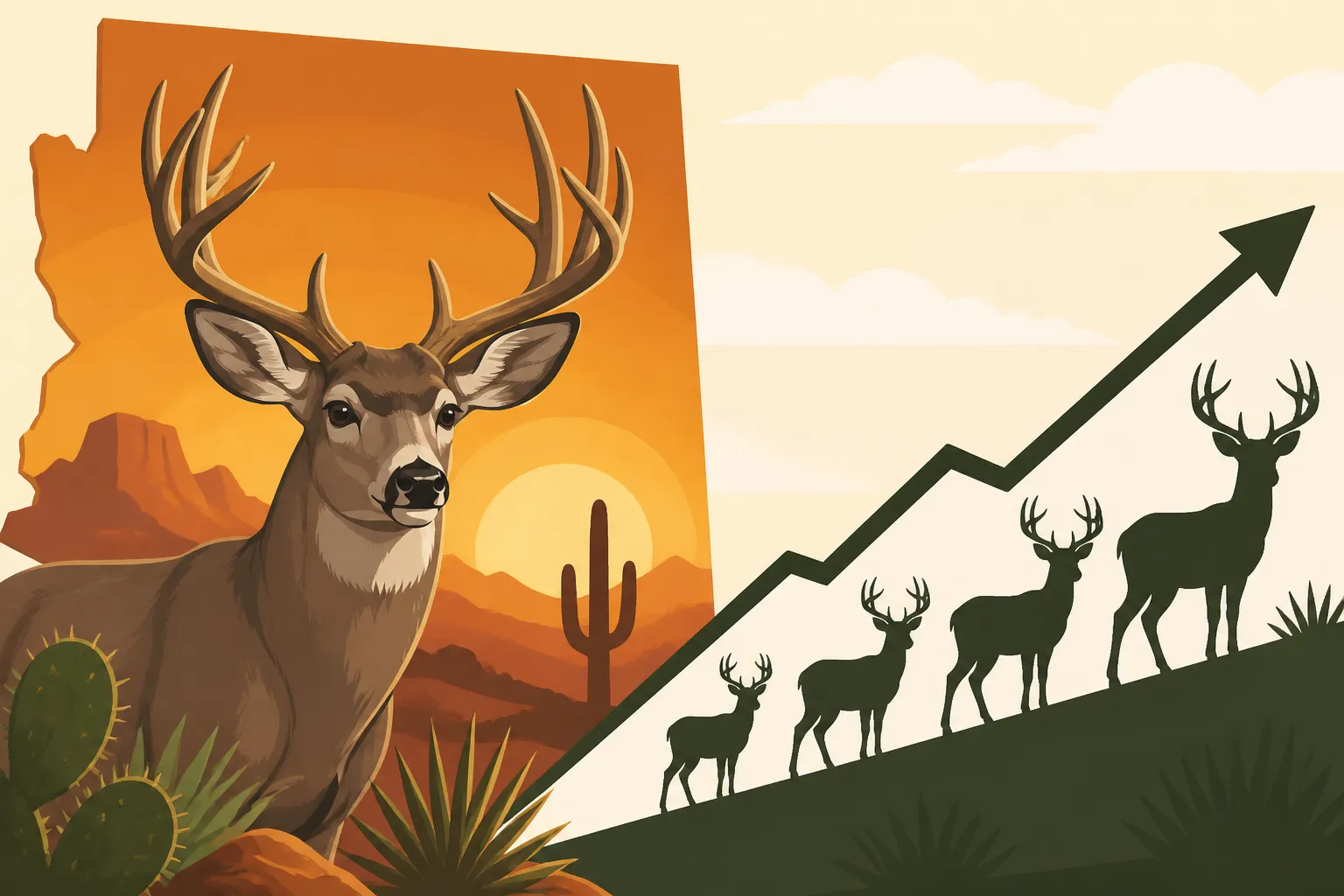
Mule Deer Population Trends Across the Southwest
It can feel like mule deer populations are a moving target in the Southwest, with numbers fluctuating year to year or even unit to unit. One season you're seeing bucks everywhere, and the next it feels like the desert has swallowed them whole. This guide dives deep into the complex factors influencing mule deer trends across Arizona and the broader Southwest, helping you understand the bigger picture behind the tags you draw and the deer you pursue, so you can adapt your strategies and expectations.
Understanding the Rollercoaster: Key Factors Driving Mule Deer Trends
Mule deer populations don't just exist in a vacuum; they're constantly reacting to a complicated dance of environmental conditions, human activity, and natural pressures. If you've spent any time chasing these gray ghosts across the arid landscape, you know that a good year can turn into a tough one faster than you can say "shed hunt." It's not always about hunter numbers; often, the answers lie much deeper in the ecosystem itself.
The Critical Role of Precipitation and Habitat
When we talk about mule deer in the Southwest, the conversation almost always starts with water. This isn't just about a stock tank for a quick drink; it's about the very foundation of their food source. Years of consistent, timely rainfall mean robust forage growth, which translates directly to healthier deer, better fawn survival, and stronger antler growth.
Think about it: a sparse monsoon season means less new growth on palatable forbs and shrubs. This directly impacts the does, who might not be able to put on enough fat reserves to carry fawns to term or produce enough milk to sustain them through their vulnerable early weeks. Then, those fawns that do survive are smaller, weaker, and more susceptible to predation or harsh conditions. Conversely, a wet winter followed by a strong monsoon can create an explosion of forage, allowing deer to thrive. This cyclical nature of rainfall is perhaps the most significant long-term driver of mule deer numbers in this arid region. It's why hunters constantly check precipitation maps and historical data when planning their hunts or even just trying to understand "why the deer are so few this year." Understanding How Drought Affects Desert Deer Numbers is fundamental to comprehending these patterns.
Predator Pressure and Disease Dynamics
While habitat quality sets the stage, predators and disease play active roles in shaping the cast. Mountain lions, coyotes, and even bears can have a significant impact on mule deer, particularly fawns and sick or injured adults. In areas where predator populations are robust and deer numbers are already stressed by drought or poor habitat, predation can become a limiting factor, preventing populations from rebounding.
It's a balance. A healthy ecosystem includes predators, but when conditions favor predators disproportionately over prey, you'll see a noticeable decline. Similarly, diseases can sweep through a population, especially when deer are concentrated or stressed. Epizootic Hemorrhagic Disease (EHD) or adenovirus outbreaks, though less common for mule deer than some other species, can decimate local herds. While Chronic Wasting Disease (CWD) has not been widely detected in Arizona's mule deer, it remains a looming concern for wildlife managers across the West, leading to ongoing monitoring and carcass transport rules to prevent its spread. Knowing How Chronic Wasting Disease Testing Works is crucial for hunters to participate in monitoring efforts. These factors often work in tandem; a deer weakened by poor nutrition is far more susceptible to a predator or a disease than a healthy, robust animal.
Human Impact: Development, Fire, and Access
Our presence, even unintentional, leaves a mark on mule deer. Urban and exurban development encroaches on crucial winter range and migratory corridors, fragmenting habitat and forcing deer into smaller, less productive areas. A new subdivision on the edge of town isn't just reducing open space; it's often cutting off a vital path deer have used for generations to move between summer and winter grounds.
Wildfires, while a natural process, have also become more intense and frequent in some areas, driven by changing climates and past fire suppression policies. While some fires can create new browse by clearing out old growth, others can destroy vast swaths of critical habitat, leading to short-term displacement and long-term changes in vegetation structure. Lastly, increased human recreation, even hiking and mountain biking, can sometimes push deer into less accessible or less favorable areas, especially during sensitive times like fawning or severe winter conditions. On the flip side, conscious efforts to manage public lands, like the construction of wildlife water catchments or habitat restoration projects, can significantly bolster local populations.
Regional Spotlights: Arizona's Mule Deer Hotbeds and Challenges
Arizona is a state of incredible diversity, and its mule deer populations reflect that. From the famed plateaus of the north to the rugged desert mountains of the south, these deer navigate vastly different landscapes, each presenting unique opportunities and challenges for their survival and for the hunters who pursue them.
The Kaibab Plateau and Arizona Strip: Trophy Potential and Population Swings
When you hear "Arizona mule deer," images of massive bucks from the Kaibab Plateau often spring to mind. These areas, particularly the celebrated Unit 9 and parts of the Arizona Strip, are legendary for their trophy potential. The habitat here—dense ponderosa pines, mixed with aspen and mountain mahogany—offers superb forage and cover. However, even these prime areas are not immune to population fluctuations.
The Kaibab, for instance, has a history of dramatic boom-and-bust cycles, largely driven by winter severity and habitat carrying capacity. A mild winter means more deer survive, and numbers can swell, but a series of harsh winters, especially with deep snow, can drastically reduce the population. The Arizona Strip, while different in its more arid, rugged terrain, also sees its ups and downs. Access can be a challenge on the Strip, and those seeking to hunt these areas often spend years building points, knowing that even in these prime units, the deer numbers can vary. For those fortunate enough to draw, understanding Strip and Kaibab Mule Deer Reputation involves appreciating both the immense potential and the inherent unpredictability of these wild populations.
Central and Southern Arizona: Desert Survivors and Patchy Populations
Move south into the central and southern parts of the state, and the mule deer adapt to a more classic Sonoran Desert environment. Here, you'll find deer in the saguaro forests, mesquite flats, and rugged mountains of the Mazatzals, the Superstitions, or the Catalinas. These populations are often more dispersed and tied directly to available water sources and quality browse.
These desert mule deer are incredibly resilient, but their populations are more susceptible to prolonged drought. When the rains don't come, the sparse forage becomes even scarcer, and fawns struggle to survive. Hunting these areas requires extensive glassing and a deep understanding of how deer use the terrain and water in arid conditions. While they may not produce the sheer numbers or the colossal racks of the northern plateaus, these desert mule deer offer a unique, challenging hunt. Hunters need to be diligent in scouting for Water Sources That Concentrate Arizona Desert Game to increase their odds of success.
Factors Influencing Regional Differences
Several elements contribute to these regional population variations:
- Elevation and Climate: Higher elevations typically receive more precipitation and have different vegetation communities, supporting denser deer populations than the hotter, drier low deserts.
- Habitat Diversity: Areas with a rich mix of forage, cover, and water sources tend to sustain healthier populations than monoculture landscapes.
- Land Ownership and Management: Large blocks of public land, like those managed by the Forest Service or BLM, often provide more contiguous habitat and less human disturbance compared to areas with checkerboard private land. Tools like GoHunt often provide detailed land ownership maps, which can be invaluable for understanding potential access and habitat continuity in a unit.
- Hunting Pressure: While not the sole factor, persistent high hunting pressure in certain accessible units can also impact local deer densities and age structures over time.
Table: Factors Influencing Regional Mule Deer Population Trends
| Factor | Northern Plateaus (e.g., Kaibab, Strip) | Central/Southern Desert (e.g., Mazatzals, Catalinas) |
|---|---|---|
| Primary Limiting Factor | Winter severity, habitat carrying capacity | Drought, forage availability, water scarcity |
| Habitat Type | Ponderosa, mixed conifer, aspen, shrub | Sonoran Desert scrub, mesquite, saguaro, oak brush |
| Population Density | Can be high in good years, prone to swings | Generally lower, more dispersed, tied to resources |
| Trophy Potential | Renowned for large bucks | Good bucks, but less consistent trophy production |
| Human Impact | Road access, recreation, some development | Urban encroachment, water development, recreation |
| Predator Influence | Mountain lions, coyotes, bears | Mountain lions, coyotes |
Reading the Tea Leaves: How Hunters Can Interpret Population Data
As hunters, we're naturally curious about where the deer are and why. Understanding population trends isn't just for biologists; it's a powerful tool for planning your hunts, setting realistic expectations, and becoming a more informed conservationist. You don't need a degree in wildlife management to interpret the signs.
How Biologists Count Deer and Why It Matters
Wildlife agencies use various methods to estimate deer populations, and these numbers, while never perfectly exact, provide crucial insights. Techniques include aerial surveys, trail camera studies, fawn recruitment surveys, and harvest data analysis. Each method has its strengths and weaknesses, but together they paint a picture.
For instance, fawn recruitment rates—the number of fawns that survive to be yearlings—are a critical indicator of population health and future trends. A consistently low fawn recruitment rate signals a struggling population, often due to poor habitat, high predation, or disease. Understanding Why Fawn Ratios Predict Next Season can help you anticipate whether deer numbers are on an upward or downward trajectory. Conversely, strong fawn survival points to a population that's either stable or growing. When you see wildlife agencies adjusting tag numbers, these biological data are almost always the driving force behind those decisions. These reports are often published and accessible to the public, providing valuable insights into specific units.
Utilizing Harvest Data and Draw Odds
Perhaps the most accessible data for hunters are harvest statistics and draw odds. Wildlife agencies meticulously track harvest success rates, age structures of harvested animals, and hunter effort. This information, often broken down by specific units and hunt codes, can reveal patterns about a unit's mule deer population.
If a unit shows consistently high harvest success for mature bucks, it suggests a healthy, well-managed population with good age structure. If success rates are declining despite consistent hunter numbers, it could indicate a shrinking herd or increased pressure. Similarly, draw odds for permits are a reflection of both hunter demand and tag availability, which in turn is often dictated by population estimates. A unit whose draw odds are getting progressively tougher for residents and non-residents alike often signals that biologists are reducing tag numbers, perhaps due to a perceived decline in the population. Resources like GoHunt specialize in compiling and analyzing this kind of public data, making it easier for hunters to research units and forecast their draw chances. It's a goldmine of information for planning your strategy. You can also dive into Where Arizona Publishes Unit Harvest Statistics to get raw data directly.
E-Scouting and Boots-on-the-Ground Observations
Beyond official data, your own e-scouting and field observations are invaluable. Satellite imagery from tools like Google Earth or dedicated hunting apps allows you to study habitat changes over time, identify potential bedding areas, water sources, and travel corridors. Look for signs of recent fires, new development, or changes in vegetation density. You can learn a lot about a unit's potential before you ever set foot in it by Reading a Unit Before You Ever Walk It and looking for the terrain that holds deer.
When you're actually in the field, pay attention to more than just deer sightings. Look for rubs, scrapes, tracks, and droppings. How fresh are they? What do the deer you are seeing look like—healthy and robust, or thin and struggling? Are you seeing fawns with the does? Are you finding sheds, and what condition are they in? These "ground-truthing" observations are crucial for confirming or challenging what the official data might suggest. Combining detailed E-Scouting an Arizona Unit Before the Season with physical reconnaissance gives you a holistic understanding of local mule deer trends.
Conservation Efforts and the Future of Mule Deer Hunting
The future of mule deer hunting in the Southwest depends heavily on ongoing conservation efforts and the willingness of hunters and non-hunters alike to support wildlife management. It’s not just about managing populations for hunting opportunity, but ensuring the long-term health and resilience of the species itself.
Habitat Restoration and Connectivity
One of the most impactful conservation strategies involves restoring and enhancing mule deer habitat. This can range from prescribed burns that rejuvenate forage to removing invasive species that outcompete native plants. A significant focus is also on improving habitat connectivity—creating and maintaining corridors that allow deer to move safely between different areas, especially between summer and winter ranges.
Imagine a critical migration route bottlenecked by a new fence or road. Conservation groups often work to remove old fences that act as barriers, install wildlife-friendly crossings over highways, or ensure that new developments consider wildlife movement. These efforts are crucial for ensuring genetic diversity and allowing deer to access different resources throughout the year, especially during periods of drought or extreme weather. When you see discussions about Water Development Projects Built for Wildlife, understand that these are direct investments in improving habitat quality for mule deer and many other species.
Hunter Contributions to Conservation
Hunters are, and always have been, a cornerstone of wildlife conservation. Our license fees and excise taxes on hunting equipment (through the Pittman-Robertson Act) provide the vast majority of funding for state wildlife agencies. This money directly supports habitat projects, disease monitoring, law enforcement, and research—all of which benefit mule deer.
Beyond financial contributions, hunters often volunteer their time for habitat restoration projects, participate in citizen science programs (like reporting deer sightings or CWD samples), and advocate for sound wildlife management policies. Every time you fill out a harvest report accurately or support a wildlife organization, you're directly contributing to the future of mule deer. This commitment is vital, as it ensures that the species remains healthy and huntable for generations to come. Groups like the Mule Deer Foundation are working tirelessly to ensure the future of mule deer populations.
Looking Ahead: Challenges and Opportunities
The Southwest's mule deer face ongoing challenges, not least of which is a changing climate that may bring more frequent and intense droughts, impacting forage and water availability. Increased human population growth will continue to put pressure on habitat, requiring innovative solutions for land use and wildlife corridors.
However, there are also significant opportunities. Advances in technology, from satellite tracking to improved survey methods, allow biologists to understand mule deer more precisely than ever before. Collaborative efforts between state agencies, federal land managers, conservation organizations, and private landowners are crucial. For example, some land trusts are working to secure easements that protect critical winter range or migration routes from development. As hunters, staying informed, advocating for sound science-based management, and participating actively in conservation are the best ways to ensure that the iconic gray ghost of the Southwest continues to thrive for many years to come.
Disclaimer
This article is for general informational purposes only and does not constitute professional advice. Laws, prices and regulations vary by location and change over time. Consult a qualified professional for guidance on your specific situation.