Where Elk Water During Early Archery
Early archery season in Arizona is a test of patience, grit, and understanding the land. One of the biggest challenges hunters face, especially during the sweltering August and September months, is consistently locating elk, which are often dictated by a single, critical resource: water. If you've ever spent a scorching afternoon glassing an empty hillside, wondering where all the animals are, you know the frustration. This guide is all about honing in on where elk quench their thirst during Arizona's early archery season, giving you a crucial edge in finding those elusive bulls.
Understanding Arizona's Early Archery Season Climate and Elk Behavior
Arizona's early archery season for elk typically kicks off in late August and runs into September, sometimes with a second season later in the year. If you've ever been in Arizona during these months, you know it's not for the faint of heart. Temperatures routinely soar into the triple digits in the lower elevations and often stay comfortably warm well into the 80s and 90s even at higher altitudes where elk thrive. This intense heat, coupled with the often-arid environment, makes water an absolute lifeline for all wildlife, especially large-bodied animals like elk.
The Harsh Reality of August/September Heat
Imagine carrying a heavy pack, climbing a steep ridge in the middle of a hot summer day. You're sweating, your mouth is dry, and all you can think about is that next sip from your water bladder. Now, imagine being an elk, covered in a thick hide, constantly on the move, and trying to regulate your body temperature in that same heat. It's a grueling existence. The thermal stress on elk during these early seasons is immense. They aren't just drinking for pleasure; they're drinking for survival. This fundamental need drives much of their daily routine, particularly how far they travel and when they move.
The monsoons, if they come, might offer some temporary relief, creating scattered puddles, but often these are fleeting. Many areas, even those that received significant winter snow, can be bone dry by late summer. This forces elk to concentrate around reliable water sources, turning these spots into potential hotspots for hunters. Understanding this environmental pressure is the first step in unlocking their patterns. For more on preparing for the heat, check out our piece on Heat Management on an Arizona Early Season Hunt.
Why Water Becomes a Magnetic Pull
Elk are massive animals, and their metabolic processes require a significant amount of water. They need it not only to hydrate but also to aid in digestion, regulate body temperature, and facilitate nutrient absorption. During hot periods, elk can lose substantial amounts of fluid through respiration and evaporation. This increased demand for water means they can't afford to be far from a reliable source for long. A bull might graze for hours, but the thought of water is always in the back of his mind.
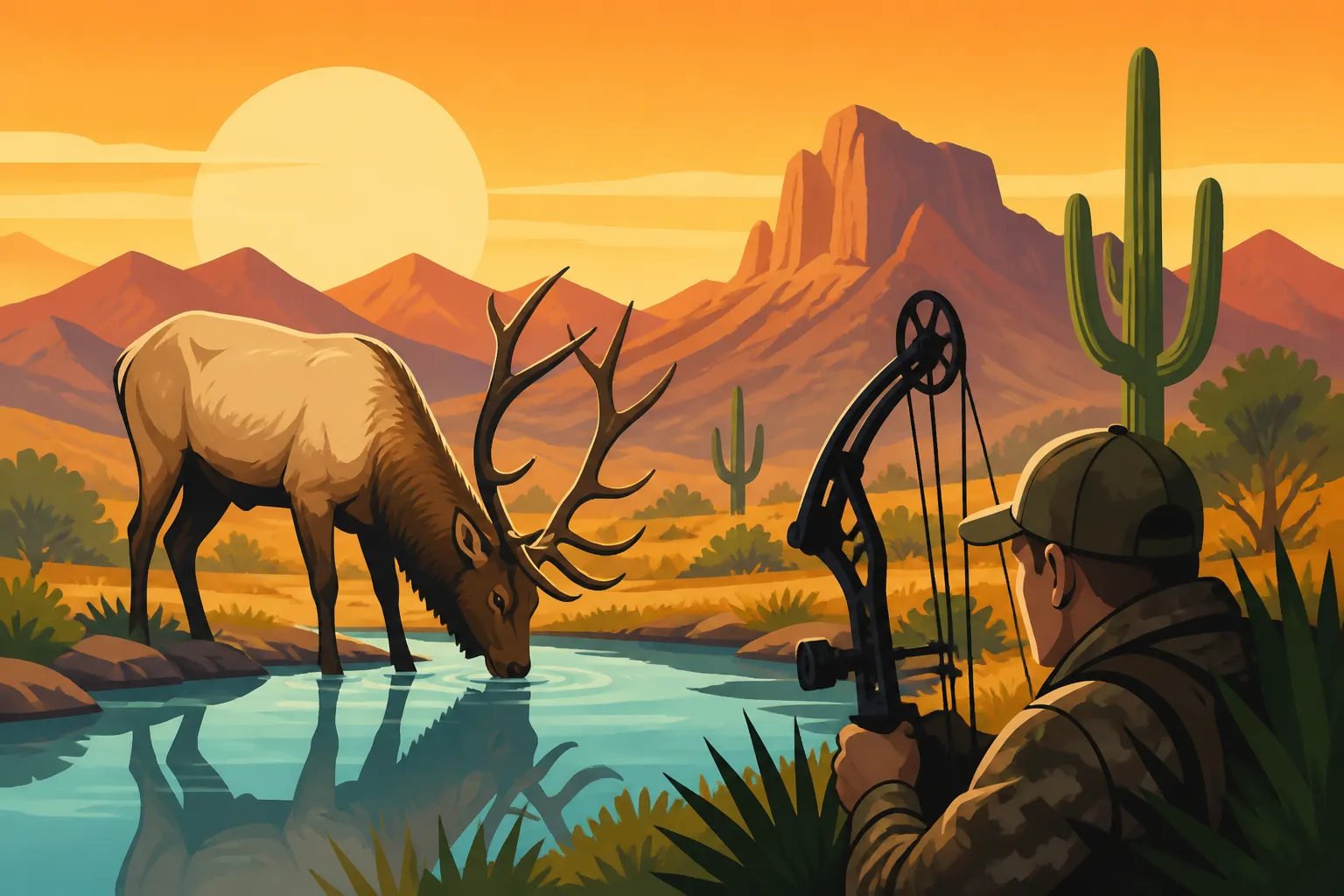
This magnetic pull to water means that even if a prime bedding area or feeding ground is miles away, elk will still make the journey to drink, often multiple times a day. Their routes to and from water become predictable travel corridors. For bowhunters, this predictability is gold. It narrows down vast landscapes into manageable choke points where an ambush might be possible. It's a stark contrast to later seasons where cooler temperatures and widespread moisture allow elk to be much more dispersed and less tethered to specific locations.
Diurnal Movement Patterns Around Water
Elk, like most big game, are most active during the cooler parts of the day – dawn and dusk. This holds especially true in the early archery season. You'll often find them moving towards water in the morning after feeding and bedding, or in the late afternoon, just before heading out to feed through the night. However, during periods of extreme heat, their need for water can override their usual nocturnal tendencies, leading them to water sources even in the middle of the day, particularly if those sources are well-shaded and secure.
These movement patterns aren't always a direct line. Elk are cautious animals. They'll often approach water sources slowly, staging in nearby cover, scent-checking the area, and observing for threats before committing to drink. This staging behavior is critical for hunters to understand. It means setting up too close to the actual water's edge might only give you a fleeting glimpse as they come in. Sometimes, the best ambush point is a hundred yards or more away, along a well-used trail leading to the water, where elk feel more secure and are moving at a more relaxed pace. Being able to read these subtle cues of approach and departure is key to successful waterhole hunting.
Key Water Sources to Scout for Early Archery Elk
Arizona is a land of extremes, and its water sources reflect that. While some areas boast perennial streams, vast tracts of elk habitat rely on more ephemeral or man-made water points. Knowing what to look for and how to find these vital locations is paramount. Remember that in such dry country, identifying Water Sources That Concentrate Arizona Desert Game is invaluable.
Natural Seeps, Springs, and Potholes
These are the hidden gems of the desert. Natural seeps and springs often occur where underground water tables intersect with the surface, typically on hillsides or in canyon bottoms. They might not look like much – sometimes just a perpetually damp patch of earth, a trickle no wider than your finger, or a small, stagnant pool – but to an elk, they're an oasis. These natural sources often have thick vegetation around them, providing crucial cover and forage for thirsty animals. The challenge is finding them. They rarely show up on standard maps, and their flow can vary dramatically with rainfall.
Potholes, also known as tinajas in the Southwest, are natural depressions in rock formations that collect rainwater. These can be incredible resources immediately after a monsoon rain, holding water for days or even weeks. However, they are highly dependent on recent precipitation and can dry up quickly. Hunting these requires excellent timing and prior knowledge of the area. The elk know these spots intimately, passed down through generations. A seasoned hunter will often find these by walking drainages, following game trails, or by using satellite imagery to spot lush patches of greenery in otherwise barren landscapes, indicating a potential seep.
Man-Made Stock Tanks and Wildlife Catchments
In a state like Arizona, where water is scarce, human intervention plays a massive role in wildlife management. Stock tanks and wildlife catchments (sometimes called "guzzlers") are deliberately constructed water sources designed to provide reliable water for livestock and wildlife. Stock tanks are typically earthen dams that collect runoff, creating ponds of varying sizes. Guzzlers are more sophisticated, often consisting of a large rainwater collection apron that funnels water into an underground storage tank, from which it's piped to a small drinker. These are engineered to be highly dependable.
These man-made sources are incredibly valuable for early archery elk hunters because they are often the most reliable water in a unit, especially after extended dry periods. They are also often marked on maps, making them easier to locate through e-scouting tools like GoHunt, or even simple forest service maps. However, their visibility also means they can receive more hunting pressure. Success often comes down to scouting these specific locations, understanding elk approach and exit routes, and being able to identify how human activity might influence elk behavior around them. Sometimes, the most remote or hardest-to-reach tanks will be the most productive. Remember, even though they're man-made, these are critical habitats, and ethical behavior around them is paramount.
Perennial Streams and River Drainages
While not as common as in more verdant states, Arizona does have perennial streams and river drainages, particularly in its higher elevations like the Mogollon Rim and the White Mountains. These larger water bodies provide consistent water, often flowing through deep canyons or dense timber, offering elk security. Hunting these areas can be tricky due to the terrain and dense cover, but they can be extremely productive.
Elk using these drainages will often stick close to the water, moving up and down the riparian zones. Their travel will be dictated by available cover and forage, but they will never be far from a drink. Focus on areas where smaller side canyons or draws intersect the main drainage, as these often create natural funnels for elk movement. Look for rub lines, wallows, and heavy game trails indicating consistent use. Even if the stream isn't flowing strongly, damp banks and residual pools can still be a draw. Our article on Finding Water in Arizona's Dry Country offers more specific advice on locating these crucial spots.
Table: Types of Arizona Water Sources for Early Archery Elk
| Water Source Type | Description | Reliability in Early Archery | Hunting Challenge | Key Indicators for Scouting |
|---|---|---|---|---|
| Natural Seeps/Springs | Small, often subtle emergence of groundwater. | Moderate to High | Hard to locate, can be slow flow. | Green vegetation in dry areas, faint game trails. |
| Potholes (Tinajas) | Rock depressions collecting rainwater. | Low (rain dependent) | Very sporadic, dries quickly. | Found in rocky drainages, after rain events. |
| Stock Tanks | Man-made earthen dams collecting runoff. | Moderate to High | Can have human activity, exposed. | Marked on maps, often visible on satellite. |
| Wildlife Catchments | Man-made collection aprons funneling to underground tanks. | High | Often remote, can be overlooked by hunters. | Less obvious from satellite, may be marked on wildlife maps. |
| Perennial Streams/Rivers | Continuously flowing water. | High | Dense cover, difficult terrain, limited locations. | Riparian vegetation, established game trails. |
Strategies for Locating and Hunting Water Sources
Successfully hunting elk around water during the early archery season isn't just about finding the water; it's about understanding how elk use it and then positioning yourself effectively. It's a game of chess, anticipating their moves before they make them. For instance, Sitting Water for Javelina and Deer uses similar principles, just scaled up for elk.
E-Scouting and Topographic Map Interpretation
Your scouting begins long before you ever set foot in the unit, often from the comfort of your home. Modern e-scouting tools, like those offered by GoHunt, allow you to pour over satellite imagery and topographic maps. Start by identifying obvious water sources: perennial streams, large stock tanks, and even known guzzler locations. Pay close attention to terrain features around these spots. Look for saddles, benches, and gradual slopes that would facilitate easy travel for elk. These often become primary travel corridors.
Beyond the obvious, use the satellite view to zoom in on drainages and canyon bottoms. Look for any areas that appear greener or lusher than their surroundings, especially in dry country. These could indicate a hidden seep or spring. Trace game trails leading to and from these water sources. GoHunt also allows you to layer public and private land boundaries, ensuring you're hunting legally. Don't forget to study the topography for potential bedding areas (north-facing slopes, dense timber) and feeding grounds (open parks, oak brush flats). Once you've identified potential water sources, you can cross-reference them with elevation data and access roads to prioritize your boots-on-the-ground scouting. For more detailed e-scouting tips, read our guide on E-Scouting an Arizona Unit Before the Season.
Boots-on-the-Ground Reconnaissance
There's no substitute for getting your boots on the ground. Once you've identified promising water sources through e-scouting, it's time to visit them. Do this well before the season opens, ideally weeks or even months in advance. Your goal is to confirm water availability, identify actual elk usage, and pinpoint ideal ambush locations. Look for fresh tracks, droppings, rub lines on small trees, and most importantly, wallows. Elk love to wallow in muddy areas near water, both to cool off and to coat themselves in mud to deter insects. Fresh wallows are a huge indicator of current use.
When you're at a water source, don't just focus on the water's edge. Walk the trails leading to and from it. Look for areas where elk might stage before drinking – dense pockets of timber, small rises that offer a vantage point. Identify possible bedding areas nearby. Test the wind direction at different times of day, as thermals can shift dramatically in mountain and desert terrain. Consider various wind scenarios for your setup. For a deeper dive into unit scouting, check out Reading a Unit Before You Ever Walk It.
Setting Up for Success
Once you've found an active water source and understand the elk's likely approach and exit routes, it's time to plan your setup. Concealment is paramount. A pop-up ground blind or a well-constructed natural blind from brush and fallen limbs can provide the cover you need. Ensure your blind allows for clear shooting lanes in the most likely areas of approach, but don't over-clear, as this can make your setup obvious. Always be mindful of the wind. Elk have an incredible sense of smell, and a shifting wind can quickly betray your presence. Position yourself downwind of their expected travel path.
Consider the time of day. Morning hunts are often productive as elk come off feeding grounds to drink before bedding. Evening hunts can also be excellent as they water before heading out to feed. Sometimes, during the hottest parts of the day, a well-shaded waterhole can still draw a thirsty bull. Be patient and commit to long sits. Elk can be unpredictable, and it might take hours for an animal to show up. Having a comfortable setup and plenty of water for yourself is essential for these prolonged waits.
Being Ethical and Respectful Around Water
Arizona's water sources, especially in arid regions, are vital to all wildlife and often to livestock. It's crucial to approach hunting around these areas with the utmost respect and ethical consideration. Never contaminate water sources. Pack out all your trash, including spent broadheads and food wrappers. Minimize your impact on the surrounding vegetation and terrain. If you arrive at a waterhole and another hunter is already set up, back out quietly and find an alternative spot. These resources are shared, and courtesy goes a long way.
Furthermore, recognize that while water is a key attractor, it's also a place where animals are at their most vulnerable. Make clean, ethical shots a priority. Practice your shooting at various distances and angles, especially from a seated position if you plan to hunt from a blind. Ensure you know Arizona Legal Shooting Hours for Big Game and adhere to them strictly. Leaving a wounded animal to suffer near a critical water source is not only unethical but also detrimental to the resource and the reputation of hunters. Remember, the goal is a respectful harvest, not just a filled tag.
Disclaimer
This article is for general informational purposes only and does not constitute professional advice. Laws, prices and regulations vary by location and change over time. Consult a qualified professional for guidance on your specific situation.