Arizona Legal Shooting Hours for Big Game
There’s nothing quite like that pre-dawn chill in an Arizona deer or elk camp, right? You’re hyped, you’re ready, but in that early morning darkness, or as the sun dips below the horizon, a common worry always creeps in: Am I legally allowed to take this shot? Understanding Arizona’s legal shooting hours for big game is absolutely critical, not just to avoid breaking the law, but to ensure you’re making ethical decisions in the field. This guide will meticulously break down everything you need to know about when you can legally hunt in the Grand Canyon State.
Understanding Arizona's General Shooting Hours for Big Game
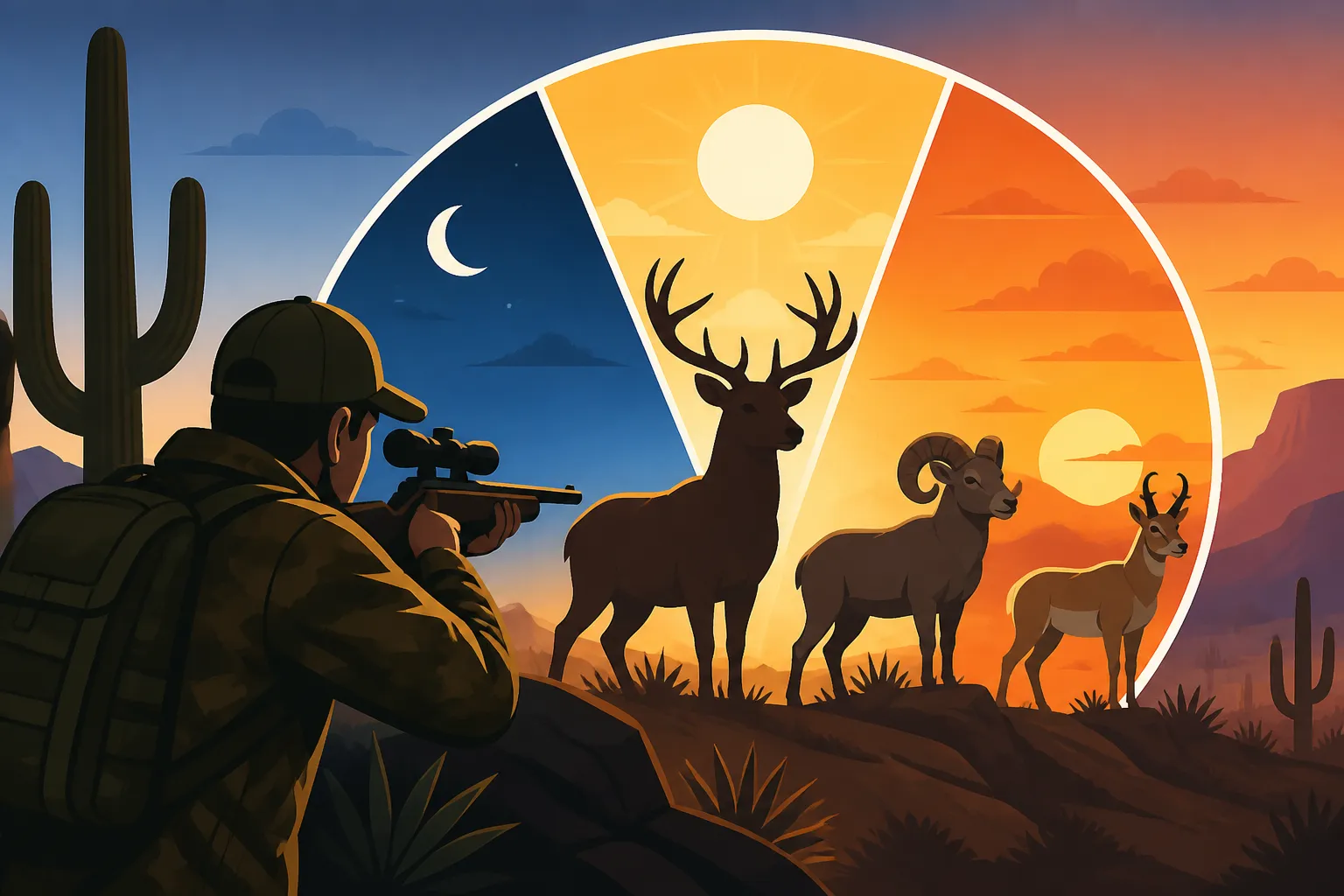
Let's get straight to the point: for the vast majority of big game hunting in Arizona, the rule is pretty straightforward. You are legally allowed to hunt from 30 minutes before official sunrise to 30 minutes after official sunset. This isn't just a guideline; it's a hard and fast regulation set by the Arizona Game and Fish Department (AZGFD). It applies across the board for species like deer, elk, javelina, bear, and lion, ensuring a consistent framework for all hunters.
The rationale behind these specific hours is rooted in both fair chase principles and safety. Hunting in complete darkness or excessively low light conditions can compromise a hunter's ability to positively identify their target, judge shot placement accurately, and even safely track an animal after the shot. Arizona, like many other states, aims to maintain an ethical hunting environment where animals have a fighting chance and hunters can operate responsibly. These hours ensure there's enough ambient light for clear visibility, even on overcast days.
Calculating Sunrise and Sunset Times Accurately
Knowing the general rule is one thing, but pinpointing the exact legal shooting window on your hunt day is another. You might be tempted to just check the weather app on your phone, but be careful. Many standard weather apps provide generic sunrise and sunset times for a large metropolitan area, which might not be accurate for your specific hunting unit, especially if you're deep in the mountains or out in the remote desert. Elevation, longitude, and local topography can all subtly shift the actual moment of sunrise or sunset.
To be absolutely certain, you need to consult official, authoritative sources. The U.S. Naval Observatory provides extremely precise astronomical data for any location, which is what most state game agencies base their regulations on. Many dedicated hunting apps, like GoHunt, also integrate this precise data, often adjusting for your exact GPS location. These specialized apps are invaluable tools because they remove the guesswork, displaying your legal shooting window in real-time. It’s a smart habit to cross-reference multiple reputable sources or verify your app’s accuracy against the AZGFD website before heading out.
When you’re preparing for your hunt, whether it's an early archery deer opener in August or a late-season rifle elk hunt in November, taking the time to confirm these times for your specific unit and date is paramount. Don't just assume. Those precious minutes at either end of the day are often when big game animals are most active, so being ready and legal is key.
The "30-Minute Rule" in Practice
Let's clarify what the "30 minutes before sunrise" and "30 minutes after sunset" truly mean. If the official sunrise for your location on October 15th is, say, 6:45 AM, then legal shooting hours begin at 6:15 AM. Conversely, if the official sunset on that same day is 5:50 PM, then legal shooting hours extend until 6:20 PM. This window is consistent and does not typically change based on daylight saving time; rather, the official sunrise/sunset times themselves adjust. It's crucial to always refer to the official times for that specific day, as the length of day shifts throughout the year. For additional details on this, you might find it helpful to read about Do Shooting Hours Shift Through the Season?.
This consistent application of the 30-minute rule ensures that all hunters are operating under the same conditions, promoting fairness. Imagine you're set up on a ridge overlooking a wash, glassing for desert mule deer. As the light begins to fade, you spot a buck moving out of the palo verde. You need to make a quick decision. Having a clear understanding of the legal cutoff time, down to the minute, means you can focus on making an ethical shot rather than second-guessing the law. It’s also why carrying a good watch or a GPS device with an accurate time display and pre-loaded sunrise/sunset data is just as important as your rifle or bow.
Here’s a practical example of how those times play out in real life, based on approximate Phoenix, Arizona times for simplicity:
| Date (Approx.) | Location (e.g., Phoenix) | Official Sunrise | Legal Shooting Starts | Official Sunset | Legal Shooting Ends |
|---|---|---|---|---|---|
| January 1 | Phoenix | 7:30 AM | 7:00 AM | 5:30 PM | 6:00 PM |
| July 1 | Phoenix | 5:20 AM | 4:50 AM | 7:40 PM | 8:10 PM |
| October 1 | Phoenix | 6:20 AM | 5:50 AM | 6:00 PM | 6:30 PM |
Remember, these are illustrative times. Always verify for your specific location and hunt date using official AZGFD resources or reliable hunting applications.
Specific Considerations for Different Arizona Hunt Types
While the core "30 minutes before sunrise to 30 minutes after sunset" rule is the bedrock for all big game in Arizona, it’s understandable why hunters often wonder if there are subtle differences between weapon types or seasons. The good news is, for big game, the rule is remarkably consistent. However, the implications of hunting in low light can vary slightly depending on your chosen weapon and the specific circumstances of your hunt.
Archery-Only Seasons and Legal Light
During Arizona's expansive archery-only seasons, the 30-minute rule remains firmly in place. Whether you're chasing Coues deer in the Sky Islands during the August season or drawing an archery elk tag in September, your legal shooting light window is identical to any other big game hunt. This means even though you might have a high-tech bow sight with multiple pins and a rheostat light, you still need to be aware of the exact moment legal light begins and ends.
For bowhunters, the low-light edges of the day often present prime opportunities, as animals are frequently on the move during these transition periods. However, the ethical implications of a low-light shot with a bow are arguably even more critical than with a firearm. A marginal shot in dim light can lead to a wounded animal and a difficult, if not impossible, recovery. Therefore, even if it's legally shooting light, if you don't have absolute confidence in your shot placement and target identification, it’s always best to hold off. For those planning an archery hunt, understanding rules like Is Blaze Orange Required for Archery Hunting? is also important, although generally not for archery big game.
The consistency of the shooting hours helps maintain the fair chase aspect of archery hunting. Unlike some firearm setups that might utilize night vision or thermal optics (which are generally illegal for hunting big game in Arizona), archery hunting relies solely on the hunter's ability to see and execute a shot within natural light conditions.
Muzzleloader and General Rifle Hunts
Just like with archery, the legal shooting hours for muzzleloader and general rifle hunts adhere strictly to the 30-minute before sunrise and 30-minute after sunset standard. This holds true whether you're drawing a coveted rifle elk tag on the Mogollon Rim, pursuing mule deer on the Kaibab, or participating in a What a HAM Hunt Actually Is where hunters use specific primitive weapons like muzzleloaders during a special season. The weapon choice does not extend or shorten your legal shooting window for big game.
While modern rifles equipped with high-magnification scopes and muzzleloaders with advanced sighting systems can offer superior light-gathering capabilities compared to the naked eye, these optics do not grant you additional time. You might be able to see an animal clearly through your scope after legal shooting light has ended, but taking a shot would still be a violation. It’s critical to remember that legal shooting hours are defined by ambient light conditions, not by the performance of your optical equipment. Always prioritize the law and ethical shooting over pushing the boundaries of your gear.
Understanding Exceptions and Special Regulations
It’s always a wise move to consider if any specific rules might apply to your particular hunt. While the core shooting hours are consistent for Arizona big game, specific local ordinances or unique hunt structures could potentially have additional stipulations. For example, some small game or predator hunting might have different regulations, but for species explicitly designated as "big game" by AZGFD, the 30-minute rule is universally applied. This consistency is a blessing, as it simplifies planning. However, this doesn't mean you can skip reading the annual regulations. Always pick up the latest Arizona Game and Fish Department Hunting Regulations booklet or check their website. You might find information about Baiting Rules That Apply in Arizona or Trail Camera Rules on Arizona Public Land which are also critical for a legal hunt, even if they don't directly impact shooting hours. Regulations can occasionally be updated, so staying current is part of being a responsible hunter.
Why Adhering to Shooting Hours Is Crucial
Understanding Arizona's legal shooting hours isn't just about avoiding a ticket; it's fundamental to responsible hunting. There are significant legal ramifications and, perhaps even more importantly, deep ethical considerations that every hunter must uphold. Pushing the boundaries, even by a few minutes, can have serious consequences for you, the animal, and the reputation of hunting as a whole.
Legal Ramifications of Violating Shooting Hours
Getting caught hunting outside of legal shooting hours in Arizona can lead to some pretty severe penalties. You could face hefty fines, potentially lose your hunting license for a period, and in some cases, even have your equipment confiscated. These aren't minor infractions; they are violations of wildlife laws designed to protect game animals and ensure fair play. Imagine finally drawing that highly sought-after Arizona elk tag, investing countless hours and dollars into your hunt, only to have it all jeopardized by a shot taken a few minutes too early or too late. It’s a devastating scenario that’s entirely preventable.
Arizona Game and Fish Department officers are highly trained and often patrol during those twilight hours specifically because they know that's when violations are most likely to occur. They use their own precise calculations for legal light and are well-versed in spotting hunters who might be operating outside the legal window. An encounter with a Game and Fish officer in low light, especially if a shot has been fired, will be a thorough investigation. Ignorance of the law is never an acceptable excuse, and claiming your phone app was wrong won't hold up. Always err on the side of caution.
Ethical Considerations and Fair Chase
Beyond the legal aspect, there’s the crucial matter of ethics and fair chase. The 30-minute rule exists to ensure you have sufficient light for positive target identification. This means being able to clearly distinguish between species, sex, and often, size or antler points, depending on the regulations for your tag. Taking a shot in poor light risks misidentification – shooting a cow elk on a bull-only tag, for example, or even worse, shooting the wrong species entirely or a non-game animal. The consequences of such an error are profound, both legally and ethically.
More importantly, low light conditions severely compromise your ability to make a clean, ethical shot. When visibility is poor, judging distance accurately becomes harder, and placing your shot precisely in the kill zone is a gamble. A poorly placed shot often leads to a wounded animal that suffers and may never be recovered. This is the antithesis of ethical hunting, which prioritizes a quick, humane harvest. As hunters, we have a responsibility to ensure we are doing everything in our power to prevent wasted game and unnecessary suffering. After all, the challenge should be in the hunt, not in overcoming self-imposed visibility handicaps. Once an animal is down, remember to also consider guidelines such as Field Dressing in Desert Heat and How Soon You Must Tag a Downed Animal to ensure proper handling and reporting.
Preparing for Low Light Conditions
Being prepared for those critical low-light periods means more than just knowing the times; it means having the right gear and strategy. A high-quality pair of binoculars and a spotting scope can significantly extend your ability to glass effectively in dim light, helping you locate game and plan your approach before legal shooting hours begin or as they are ending. However, remember these tools don't extend your shooting window. A reliable headlamp or flashlight is also essential for safely navigating to and from your stand or hunting location in the dark, well before legal light breaks or after it has faded.
Strategically, this often means getting to your hunting spot well before shooting light and staying until after dark. This gives the woods time to settle around you and maximizes your chances of encountering animals during their most active periods. When you're scouting your unit before the season, perhaps using tools like GoHunt to study terrain and access points, consider how you’ll safely enter and exit your desired hunting areas in the dark. Plan your routes carefully, identifying potential hazards or tricky terrain features. Utilizing resources such as E-Scouting an Arizona Unit Before the Season can help you map out these low-light navigation plans long before you ever step foot in the field.
Staying Informed and Prepared
The world of hunting regulations, even in a generally consistent state like Arizona, isn't static. Rules can and do change, sometimes subtly, sometimes significantly. While the 30-minute rule for big game has been a long-standing staple, a truly responsible hunter makes it a priority to stay informed and prepared every single season. This diligence protects you, the wildlife, and the hunting tradition we all cherish.
One of the most frequent questions people ask is Do Shooting Hours Shift Through the Season?. The answer is that the start and end times for legal shooting hours indeed shift daily with the sunrise and sunset, but the rule itself (30 minutes before/after) remains constant. However, specific seasons or hunt types can sometimes introduce nuances, especially for small game or predator hunting, which might have different frameworks. Therefore, your primary source for accurate and up-to-date information should always be the Arizona Game and Fish Department (AZGFD). Their official website and annual hunting regulations booklet are invaluable resources. Make it a habit to download or pick up the latest regulations every year, regardless of how experienced you are. This ensures you're never caught off guard by a regulation change. Learning to effectively read and interpret these guides, as discussed in Reading an Arizona Hunt Regulations Booklet, is a critical skill for any Arizona hunter.
Beyond the shooting hours, there are many other critical regulations to be aware of, such as Blaze Orange Requirements Through the Season. While blaze orange isn't typically required for archery-only big game hunts in Arizona, it becomes mandatory for hunters during general firearms seasons in certain areas, particularly when specified in the regulations. These rules are put in place for safety, just like shooting hours, and understanding them fully is part of responsible hunting. The AZGFD combines information on these vital topics, often listing Legal Shooting Hours and Blaze Orange in Arizona together in their official guides, underscoring their importance for general big game hunts.
Using reputable hunting apps or digital platforms like GoHunt can also provide quick access to regulations and real-time sunrise/sunset data, adjusted for your specific location. These tools are fantastic for in-the-field reference, but they should always be seen as supplementary to the official AZGFD publications. Ultimately, the burden of knowing and adhering to the law rests squarely on the individual hunter. By committing to staying informed, you not only protect yourself from potential legal issues but also contribute to the ethical and sustainable future of Arizona's rich hunting heritage.
Disclaimer
This article is for general informational purposes only and does not constitute professional advice. Laws, prices and regulations vary by location and change over time. Consult a qualified professional for guidance on your specific situation.