Tonto National Forest Ground in Arizona
The Tonto National Forest is an absolutely massive expanse of rugged, beautiful country, and for many Arizona hunters, it feels like a grand, bewildering labyrinth. Trying to figure out where to start, what game thrives where, and how to even access the hidden pockets of prime hunting ground can feel like an impossible task. This guide is going to walk you through everything you need to know about navigating and successfully hunting the diverse and often challenging terrain of the Tonto, from understanding its vastness to the critical safety precautions you'll need to take.
Understanding the Tonto National Forest for Hunters
When you look at a map of Arizona, the Tonto National Forest jumps out at you. It's not just a big chunk of green; it's a dynamic landscape, a true hunter's paradise that stretches from the desert lowlands up into pine-covered mountains. But with such immense size comes complexity, and understanding its distinct character is the first step to a successful hunt.
Size and Scope of Tonto's Hunting Opportunities
The Tonto National Forest covers an astounding 2.9 million acres, making it the fifth-largest national forest in the United States. Think about that for a moment: nearly three million acres of public land, open for you to explore and hunt. This isn't your small local woodlot; this is sprawling desert, canyons, high-elevation ponderosa, and everything in between. This incredible scale means that hunting opportunities are incredibly diverse, catering to everything from desert javelina enthusiasts to elk hunters seeking high-country solitude.
Because it's so vast, the Tonto actually encompasses several Arizona Game Management Units (GMUs). Depending on the specific unit you draw a tag for, or where you plan to pursue over-the-counter opportunities, you might find yourself in drastically different terrain, pursuing entirely different strategies. It’s crucial to know which unit you're in and what species it's known for. This sheer size also means that hunting pressure, while present, can often be escaped if you're willing to walk a little further or climb a little higher. It rewards those who put in the effort to understand its nuances.
General Terrain and Habitat Overview
The Tonto's habitat diversity is truly its defining characteristic. It literally runs the gamut of Arizona's ecological zones. In its southern reaches, you'll encounter classic Sonoran Desert: saguaros, palo verde, prickly pear, and mesquite. This is the land of javelina and desert mule deer, where glassing open slopes and hunting near water sources during the early archery seasons are key. Water Sources and Ethics in Arizona Desert Hunting is a crucial read for these areas.
As you move north and gain elevation, the landscape gradually transforms. You'll transition through desert scrub and chaparral, then into pinyon-juniper woodlands, and finally, into the cooler, higher elevations dominated by ponderosa pine, Douglas fir, and oak. These higher elevations, particularly along the Mogollon Rim that slices through the northern part of the Tonto, offer prime habitat for elk and bear. The terrain here can be incredibly steep and rocky, with deep canyons and thick timber presenting both challenges and opportunities. Understanding these transitions is vital for pinpointing where your target species will be at different times of the year.
Primary Game Species Found in the Tonto
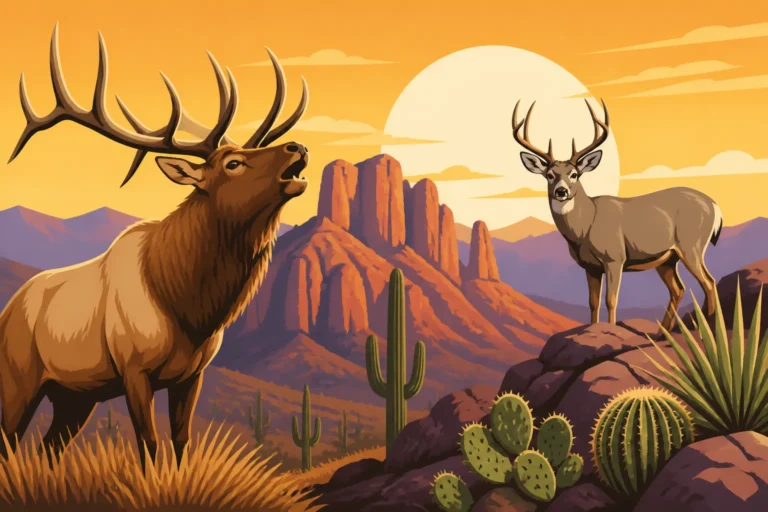
The Tonto National Forest is home to a robust array of big game and small game species, making it a highly desirable hunting destination. For many, it's synonymous with elk hunting, particularly the units along the Mogollon Rim that are well-known for producing impressive bulls. These areas can offer challenging but rewarding hunts, especially during the rut.
Mule deer and Coues deer are also prevalent throughout the Tonto, with mule deer generally preferring the more open, broken country of the desert and mid-elevations, while Coues deer, affectionately known as "gray ghosts," inhabit the brushy, oak-studded slopes and canyons of the lower to mid-elevation Sky Islands within the forest. Javelina are found in abundance across the desert and chaparral regions, offering exciting, fast-paced hunts. Black bears roam the timbered mountains, and mountain lions follow their prey across all habitat types. For small game, you'll find plenty of opportunities for quail, dove, and rabbits, especially in the lower desert and riparian areas.
Here's a quick look at some of the main species and where you're likely to find them within the Tonto:
| Game Species | Primary Habitat in Tonto NF | Typical Elevations | Best Hunting Methods |
|---|---|---|---|
| Elk | High elevation pine forests, aspen groves, riparian areas | 5,000 – 8,000+ feet | Calling, spot-and-stalk, still hunting |
| Mule Deer | Desert flats, mesquite bosques, chaparral, pinyon-juniper | 2,000 – 6,000 feet | Spot-and-stalk, glassing |
| Coues Deer | Oak brush, rocky canyons, steep slopes, juniper thickets | 3,000 – 7,000 feet | Glassing, slow still hunting |
| Javelina | Sonoran Desert, chaparral, washes, prickly pear thickets | 1,500 – 4,500 feet | Spot-and-stalk, calling, sitting water |
| Black Bear | Pine forests, canyons, riparian areas, oak thickets | 4,000 – 8,000+ feet | Spot-and-stalk, still hunting, baiting (where legal) |
| Mountain Lion | Rocky terrain, canyons, dense cover (follows prey) | All elevations | Hound hunting (special permits), calling (limited) |
| Quail (Gambel's) | Desert washes, mesquite, palo verde, dense brush | 1,500 – 4,000 feet | Walk-up, bird dogs |
Accessing Tonto National Forest for Hunting
Getting into the vastness of the Tonto National Forest isn't always straightforward. While it's largely public land, understanding the network of roads, seasonal closures, and designated vehicle use areas is absolutely critical. Ignorance of these rules can not only ruin a hunt but can also lead to citations or even habitat damage.
Navigating Forest Roads and Vehicle Use
The Tonto National Forest has an extensive network of roads, ranging from well-maintained gravel paths to extremely rough, high-clearance four-wheel-drive trails. These roads are your lifeline for accessing vast tracts of hunting ground. However, it's not a free-for-all. The U.S. Forest Service has designated certain routes for motorized travel, and it's your responsibility to know which roads are open to vehicles and which are closed. Motorized Travel Rules on Arizona Public Land are enforced.
Before you ever leave your driveway, you should download or acquire a Motor Vehicle Use Map (MVUM) for the specific district of the Tonto you plan to hunt. These maps are the definitive guide, showing every legal road and trail for motorized travel. Relying solely on older maps or general GPS navigation without the MVUM can lead you astray, potentially onto closed roads or into wilderness areas where motorized travel is strictly prohibited. Apps like onX Hunt are incredibly valuable here, as they often have MVUM layers built right into their mapping, allowing you to see legal routes and private land boundaries at a glance.
Seasonal Road Closures and Their Impact
One of the biggest frustrations for hunters in the Tonto, especially in the higher elevations, is dealing with seasonal road closures. Many forest roads are not maintained for winter travel and are deliberately closed to protect road integrity and prevent resource damage during wet, muddy conditions or heavy snow. These closures can often extend well into spring, and sometimes even into early summer, depending on snowpack and rainfall. Seasonal Road Closures Across Arizona are a fact of life.
These closures can dramatically impact your scouting and hunting plans. A road that's open in September might be locked behind a gate come November or December. Always check the Tonto National Forest website for current road conditions and closure updates before you head out. These closures mean you might have to adapt your plans, hike much further than anticipated, or even choose a different area entirely if your primary spots become inaccessible. Don't be the hunter who drives for hours only to find a locked gate.
Trailheads and Foot Access into Remote Areas
Beyond the vehicle-accessible roads, the Tonto National Forest offers countless trailheads that lead into its vast backcountry and numerous wilderness areas. For those willing to put in the foot miles, these trails provide access to some of the most remote, low-pressure hunting experiences available. Wilderness areas, by definition, restrict motorized and mechanized travel, meaning you'll be relying on your own two feet or pack stock to get around.
These areas are often where the biggest, most mature animals seek refuge from human disturbance. While the hiking can be strenuous, especially in the rugged canyons and steep climbs of the Tonto, the solitude and potential for an unpressured animal are often worth the effort. Always prepare for extended treks by carrying ample water, proper gear, and reliable navigation. Knowing how to read a topographic map is invaluable, as is using a GPS or a mapping app like GoHunt that allows you to pinpoint your location even without cell service.
Permits, Regulations, and Rules Specific to Tonto
Hunting in the Tonto National Forest means adhering to not only Arizona's statewide hunting regulations but also specific rules and guidelines set forth by the U.S. Forest Service. It's a dual layer of responsibility, and understanding both is essential to avoid any legal troubles or ethical missteps.
General Hunting Regulations and Forest Rules
Beyond your Arizona hunting license and specific hunt permit, there are general rules of conduct and use within the Tonto National Forest that all visitors, including hunters, must follow. These typically revolve around preventing forest fires, maintaining cleanliness, and respecting other users. For instance, target shooting generally has restrictions on where you can do it safely and legally, often requiring a suitable backstop and a safe distance from roads, trails, and developed recreation sites.
Always be aware of any fire restrictions in place, especially during the dry spring and early summer months, or during periods of drought. Heat Management on an Arizona Early Season Hunt also means being fire-conscious. These can range from prohibitions on campfires to restrictions on charcoal grills or even internal combustion engines during extreme fire danger. Ignorance of these rules can have severe consequences, both for you and for the forest. Additionally, remember to pack out everything you pack in – leave no trace. This fundamental principle ensures that these beautiful lands remain pristine for future generations of hunters and outdoor enthusiasts.
Camping and Campfire Rules in the Tonto
Dispersed camping is generally allowed throughout much of the Tonto National Forest, offering hunters the freedom to set up camp close to their hunting areas. However, there are important rules to follow. Typically, you need to be a certain distance (often 1/4 mile) from developed recreation sites, water sources, and paved roads. The duration of your stay in one spot is also usually limited, often to 14 days, to prevent long-term residency. Camping on Forest Ground During Hunting Season can be a real game changer for hunt logistics.
Campfire rules are perhaps the most variable and critical. During certain times of the year, usually the driest periods, the Tonto National Forest will implement fire restrictions, sometimes going as high as Stage 2 or 3, which can prohibit any open flames, including charcoal. Always check the current fire restrictions for the Tonto National Forest before you even pack your fire starter. Failure to comply with fire restrictions is a serious offense and can result in hefty fines and even jail time. When fires are allowed, always use existing fire rings if possible, keep them small, and ensure they are dead out before leaving or going to bed.
Water Sources and Ethical Considerations
Water is life in the Arizona desert, and the Tonto National Forest is no exception. Understanding where reliable water sources are located is not only crucial for your own survival but also for locating game. Game animals, especially during dry periods, will often concentrate around tanks, springs, and riparian areas. However, these vital resources must be treated with the utmost respect.
Ethical considerations dictate that you do not contaminate water sources. Do not camp directly next to a spring or tank, and certainly do not field dress an animal where blood or offal could enter the water. These sources are critical for wildlife, livestock, and sometimes even other human users. Always pack in enough water for yourself, and if you plan to filter from natural sources, ensure you have a reliable filtration system and backup treatment options. Recognizing the importance of water, not just for you, but for the entire ecosystem, is a core part of responsible hunting in the Tonto. Water Sources and Ethics in Arizona Desert Hunting delves deeper into this.
Key Hunting Units Within the Tonto National Forest
The Tonto National Forest isn't just one big blob on the map; it's carved into various Game Management Units (GMUs), each with its own character, access points, and specific game populations. Knowing which units fall within the Tonto and what they're known for is paramount when you're looking at drawing a tag or planning an over-the-counter hunt. How Arizona Numbers Its Hunting Units is a good primer for understanding the system.
Units Known for Deer and Elk Opportunities
The Tonto National Forest covers parts of many units, but some are particularly renowned for specific big game. For elk, units like 22, 23, and parts of 21 and 24, which encompass portions of the Mogollon Rim and the rugged country below it, are often high on hunters' lists. Unit 23, for example, is famous for its elk hunting, offering diverse terrain from pine forests to chaparral, and it can be a challenging but rewarding hunt. These units often require significant points to draw, reflecting their quality.
For deer, both mule deer and Coues deer are found throughout the Tonto's units. Units 20A, 20C, 21, and 22 are well-known for their Coues deer populations, particularly in the mid-elevation oak and juniper country. Here, glassing techniques are absolutely critical. Reading an Arizona Game Management Unit Map can help you visualize these areas. Mule deer tend to be more widespread in the lower and mid-elevation units, preferring the more open, scrubby desert areas and broken canyons. Scouting these units beforehand using tools like GoHunt or onX Hunt can give you an edge in understanding terrain and potential animal movements.
Javelina and Predator Hunting Hotspots
Javelina are incredibly prolific throughout the lower and mid-elevations of the Tonto National Forest, making units like 20A, 20C, 21, and 22, particularly their southern portions, excellent choices for pursuing these unique animals. Their range often overlaps with desert mule deer and Coues deer, allowing for combination hunts. The key to javelina hunting often lies in glassing open hillsides early in the morning and late in the evening, or tracking them through thick prickly pear and mesquite where they feed. The year-round archery javelina opportunity in many areas of the Tonto makes it incredibly accessible.
Predator hunting for coyotes and bobcats is also a popular pursuit in the Tonto, and these animals are found across all units. The desert and chaparral sections offer excellent calling opportunities for coyotes. Black bears are more common in the higher, timbered units (22, 23), especially in areas with good mast crops like acorns, or near riparian zones. Mountain lions are present throughout the forest, following deer and javelina, but require significant effort and often specialized methods like hound hunting, which comes with its own set of rules and considerations.
High-Pressure Areas Versus Secluded Backcountry
With its proximity to major population centers like Phoenix and Payson, some areas of the Tonto National Forest experience significant hunting pressure, especially on opening weekends or during easily accessible early seasons. Roads that are well-maintained and lead to popular camping spots will naturally see more hunters. If you're looking to escape the crowds, you'll need to be prepared to work for it.
The good news is that the Tonto's immense size and rugged topography offer ample opportunities to find secluded backcountry. This means getting off the beaten path, hiking into wilderness areas, or venturing down those rougher forest roads that deter less-determined hunters. Using a mapping platform like onX Hunt to identify areas with limited road access, or studying topographic maps for challenging terrain, can reveal hidden pockets of less-pressured game. Remember, a mile or two from a road can feel like a world away in some of the Tonto's steep canyons. These are the places where mature animals often hold up, making the extra effort entirely worthwhile.
Preparation and Safety for Tonto Hunters
Hunting the Tonto National Forest is an incredible experience, but it’s also physically demanding and can be unforgiving if you're not properly prepared. The varying elevations, extreme temperatures, and rugged terrain demand careful planning and a strong emphasis on safety. Preparing Physically for a Desert Hunt is paramount, even if you are hunting the higher elevations, the heat is always a concern.
Essential Gear for Rugged Tonto Terrain
The diverse terrain of the Tonto National Forest means your gear list needs to be adaptable. For the lower desert and chaparral, durable, breathable clothing that can withstand thorns and heat is essential. Good quality hiking boots are a must for navigating rocky, uneven ground and steep slopes; don't skimp here. Choosing Boots for Rocky Desert Ground can make or break a hunt. Carrying plenty of water, or a reliable water filter, is non-negotiable, especially in the dryer parts of the forest. Sun protection (hat, sunscreen, long sleeves) is also critical.
As you move into the higher elevations, layering becomes key. Temperatures can swing dramatically from cold mornings to warm afternoons, and even sudden thunderstorms can bring chilling rain. A good rain shell, insulating layers, and sturdy footwear suitable for rocky or muddy conditions are crucial. No matter where you are in the Tonto, always carry a headlamp, a first-aid kit, a knife, fire starter, and some emergency food. A personal locator beacon or satellite messenger can be a literal lifesaver in areas without cell service.
Navigational Tools and Mapping Resources
In a forest as vast and complex as the Tonto, reliable navigation is not just a convenience; it's a necessity. Cell service is notoriously spotty or nonexistent in many parts of the forest, especially in canyons and remote drainages. Relying solely on your phone's navigation without offline maps is a recipe for getting lost.
Invest in a dedicated GPS unit or, at minimum, a robust mapping app like onX Hunt or GoHunt with downloaded offline maps for your entire hunting unit. These apps allow you to mark waypoints, track your movement, and see property boundaries and topography even without a signal. Always carry a physical map (USGS topo maps or Forest Service maps) and a compass as a backup, and know how to use them. Familiarize yourself with your unit's topography through satellite imagery before your trip; it's an incredible advantage for E-Scouting an Arizona Unit Before the Season. Getting turned around in the Tonto's vastness can quickly become a serious emergency.
Wildlife Encounters and Wilderness Safety
Beyond your target species, the Tonto National Forest is home to a variety of wildlife that requires respect and awareness. Rattlesnakes are common in the desert and mid-elevations, especially during warmer months. Always watch where you step and reach, and consider wearing snake gaiters. Snake Awareness on an August Archery Hunt is important. Bears are present in the higher elevations; carry bear spray and know how to use it, and store food properly in camp to avoid attracting them.
Other wilderness safety concerns include extreme weather, particularly flash floods in desert washes during monsoon season, and sudden thunderstorms in the high country. Always be aware of weather forecasts and avoid camping in washes or low-lying areas during heavy rain. The heat is another major concern; carry more water than you think you need, understand the signs of heat exhaustion, and plan your physical exertion for cooler parts of the day. Finally, always let someone know your detailed hunting plans, including your unit, expected routes, and when you expect to return. This simple step can be the most critical safety measure you take.
Disclaimer
This article is for general informational purposes only and does not constitute professional advice. Laws, prices and regulations vary by location and change over time. Consult a qualified professional for guidance on your specific situation.