Spotting Scope Power for Coues Country
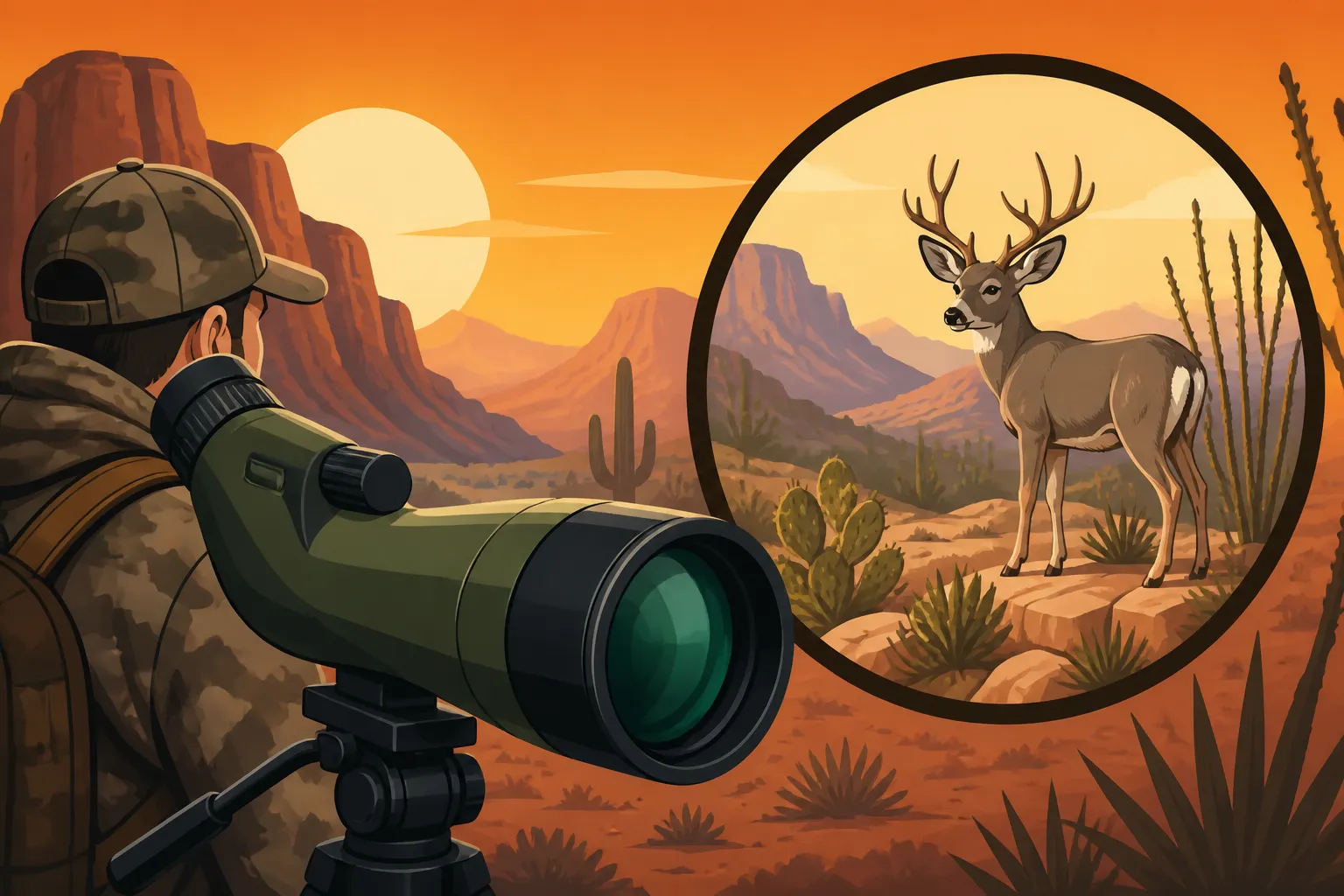
You're out there, squinting at a distant hillside, convinced you saw something move, but your binoculars just aren't cutting it. That’s the quintessential Coues deer hunting experience in Arizona – they're notoriously tiny, masters of camouflage, and often inhabit vast, rugged landscapes where seeing is truly believing. This guide is all about helping you cut through the haze and make confident identifications by understanding the optimal spotting scope power for tackling Coues country.
Why Optics Are King in Coues Country
Hunting Coues deer, affectionately known as the "Gray Ghost" of the desert, is a game of ounces, not pounds. These aren't your heavy-bodied elk or the broad-shouldered mule deer of the high country. Coues deer are delicate, often weighing under 100 pounds, and their coats blend seamlessly into the oak brush, juniper, and rocky outcroppings of Arizona's Sky Island mountain ranges. This unique challenge makes your optics arguably the most important tool in your arsenal, far surpassing the role they might play in other big game hunts.
The "Gray Ghost" Challenge
Imagine trying to find a perfectly camouflaged, medium-sized dog hidden in a vast, cluttered living room. That's a bit like hunting Coues deer. Their "gray ghost" moniker isn't just a catchy phrase; it's a testament to their incredible ability to disappear into their surroundings. They're not just small; they are exquisitely designed for invisibility. Finding a Coues often starts with discerning the subtle flick of an ear, the horizontal line of a back contrasting with vertical brush, or a slight shift in color that doesn't quite match the surrounding environment. Without powerful, clear optics, these subtle clues are simply lost to the human eye, leaving you glassing aimlessly. This isn't a game of chasing tracks; it's a game of picking apart every square inch of a distant mountain face. You might find yourself wanting to dive deeper into Why Coues Deer Reward Patience Over Movement as you realize how critical methodical glassing truly is.
The Vastness of Arizona's Sky Islands
Arizona's Coues habitat is characterized by its "Sky Islands" – isolated mountain ranges rising dramatically from the desert floor. These areas, like the Chiricahua, Huachuca, or Santa Rita Mountains, offer expansive, long-range views. You'll often find yourself on one mountain, glassing across a canyon to an opposing slope miles away, or picking apart a distant ridgeline. The sheer scale of these landscapes means that anything less than top-tier optics with adequate magnification will leave you feeling like you're missing half the picture. The ability to scan these colossal environments effectively and then zoom in on minute details is what separates successful Coues hunters from those who spend days seeing nothing but rocks and brush. Understanding the terrain you'll be facing is critical, and resources like Glassing Arizona's Sky Islands for Coues Deer can provide an excellent overview of these unique hunting grounds.
The Role of Patience in Coues Hunting
If there's one trait every Coues hunter needs, it's patience, and that patience is intrinsically linked to your optics. You're not just looking for a deer; you're looking for parts of a deer. You'll spend hours, sometimes entire days, glued to your glass, systematically dissecting the landscape. This kind of sustained effort demands optics that don't cause eye fatigue and allow you to resolve fine details without strain. When you finally spot something that might be a deer, you'll need the magnification to confirm it, assess its size, and determine if it's a shooter buck. A powerful spotting scope allows you to stay back, observe, and confirm before making a move, which is crucial for ethical and successful hunting in such open country.
Understanding Spotting Scope Magnification
When it comes to spotting scopes for Coues deer, magnification is often the first thing hunters consider, and for good reason. It’s what brings those distant details into focus. However, simply chasing the highest number isn't always the best strategy. There's a delicate balance to strike between power, clarity, field of view, and stability.
Fixed vs. Zoom Power
Spotting scopes primarily come in two magnification types: fixed power and zoom power.
-
Fixed Power Scopes: These scopes offer a single, unchangeable magnification (e.g., 20x, 30x, 40x). Their primary advantages are often brighter images, lighter weight, and typically lower cost due to simpler optical construction. Because there are fewer moving parts and less glass, they can transmit more light, offering a crisper, clearer image, especially in low-light conditions. For Coues hunting, a fixed 30x or 40x scope can be fantastic if you know you'll be glassing at a fairly consistent range. However, their main drawback is a lack of versatility; you can't zoom out for a wider field of view when initially scanning or zoom in further to really pick apart a distant buck's antlers.
-
Zoom Power Scopes: These are the most popular choice for big game hunters, offering a range of magnification (e.g., 15-45x, 20-60x, 25-75x). The ability to quickly adjust from a wide, lower-power view for scanning to a high-power view for detailed inspection is invaluable in Coues country. You can quickly scan a large area at 20x to locate potential activity, then smoothly dial up to 60x or 75x to confirm if that tan spot is indeed a bedded deer and, if so, whether it's a buck with decent headgear. The trade-off for this versatility can sometimes be a slightly dimmer image at the highest magnifications due to the increased complexity of the lens system, and often a higher price tag. Despite this, the flexibility of a zoom scope is often preferred for the dynamic nature of Coues hunting.
The Sweet Spot for Coues Deer
So, what's the sweet spot for Coues deer? Most seasoned Coues hunters will tell you that a zoom range with a top end of 60x to 75x is ideal.
- The lower end of a 20-60x or 25-75x scope allows for efficient scanning. At 20x or 25x, you get a wider field of view, making it easier to locate deer or areas of interest without constantly having to move your tripod. This is crucial when systematically employing methods like The Grid Glassing Method, Step by Step.
- The higher end, 60x or 75x, provides the necessary resolving power to count antler points, judge mass, and evaluate G-2s and G-3s on a buck that might be half a mile or more away. This level of detail is critical for making a shoot/no-shoot decision without having to commit to a potentially long, exposed stalk. Anything much higher than 75x starts to introduce significant challenges with atmospheric distortion (mirage), light transmission, and stability, making it diminishing returns for most practical hunting scenarios.
Trade-offs: Clarity, Field of View, and Stability
While magnification is important, it's never the whole story. Higher power brings with it several trade-offs you absolutely must consider:
- Clarity and Light Transmission: As you increase magnification, especially on zoom scopes, you generally reduce the amount of light reaching your eye. This means the image can appear dimmer, particularly in low-light conditions (dawn, dusk, or heavily shadowed canyons). Lower quality glass will show this much more dramatically, resulting in a fuzzy or washed-out image. High-quality glass, like that found in top-tier Zeiss or Swarovski scopes, manages to maintain excellent clarity and brightness even at high magnification.
- Field of View (FOV): This refers to how much area you can see through the scope at a given magnification. Higher magnification means a narrower field of view. While a narrow FOV is great for picking apart a specific detail, it makes it incredibly difficult to initially find the deer in the first place, or to follow a moving animal. You'll find yourself constantly panning and searching. That's why the zoom function is so vital – you can scan wide at lower power, then narrow in on your target.
- Stability: This is perhaps the most critical, yet often overlooked, factor with high-power optics. A 60x or 75x spotting scope will show every single tremor, every gust of wind, every slight bump of the tripod. Without a rock-solid tripod and a smooth, stable head (think fluid head, not ball head), that incredible magnification becomes unusable. You'll just see a shaky, blurry mess. Investing in a quality tripod is just as important as investing in a quality scope. Learn more about Tripod Setup for Glassing From a Ridge to maximize your scope's potential.
Matching Power to Your Hunting Style and Terrain
Your personal hunting style and the specific terrain you'll be traversing in Arizona should significantly influence your spotting scope choice. Are you a stationary glasser, or do you prefer to cover ground? Will you be in dense oak brush, or wide-open desert?
Glassing from a Stationary Position
For hunters who adopt a predominantly stationary glassing strategy, often known as "sit and glass," higher magnification is your friend. This approach involves finding a vantage point, setting up your tripod and scope, and systematically picking apart distant hillsides for hours on end. This is common practice in the Sky Islands, where you're overlooking vast canyons and mountainsides.
In this scenario, a 20-60x or 25-75x scope really shines. You can start at the lower end to cover broader areas, then effortlessly zoom in to scrutinize anything that catches your eye, confirming if it's a "gray ghost" or just another rock. The stability of a heavier, more robust tripod is less of a concern for mobility and more about providing a steady platform for sustained, high-magnification viewing. Many hunters, when planning their stationary glassing locations, will use tools like GoHunt's mapping features to identify prime spots with expansive views, which then dictates the need for such powerful optics.
Mobile Glassing and Stalking Scenarios
If your hunting style leans more towards covering ground, "still hunting," or making numerous shorter stalks, then portability and quick setup become higher priorities. While a high-power scope is still beneficial, you might lean towards a slightly lighter setup or consider a scope that balances power with a wider field of view for quick target acquisition.
For example, if you're frequently moving between glassing knobs, packing a huge, heavy scope and tripod can become a burden. In these situations, a compact 15-45x or 20-50x scope might offer a better compromise between power and packability. You're still getting significant magnification over binoculars, but in a lighter, more maneuverable package. You'll still need a good tripod, but perhaps a carbon fiber model that shaves off precious pounds. While hunting, it's always wise to understand How Close a Bowhunter Needs to Get on Coues if you plan to close the distance.
Desert vs. Mountain Terrain Differences
Arizona's diverse landscape means Coues deer can be found from the sprawling, lower-elevation Sonoran Desert up into the rugged, pine-studded Sky Islands.
- Desert Terrain: In the lower desert, views can still be extensive, but the heat often creates significant mirage. This atmospheric distortion makes high magnification very difficult to use effectively, as the shimmering air blurs the image. On a hot, sunny day, you might find that 40x or 50x gives you a clearer image than 75x, simply because the mirage at extreme power makes identification impossible. Here, a scope that performs well at mid-to-high ranges is key, allowing you to dial back if mirage becomes too intense.
- Mountain Terrain (Sky Islands): In the higher elevations of the Sky Islands, especially during cooler mornings or evenings, mirage might be less of an issue. This is where the full capabilities of a 60-75x scope can truly shine. The broken, rocky terrain with varied vegetation provides endless places for Coues deer to hide, making the ability to resolve fine details at long distances absolutely critical. Knowing Reading Wind on a Sky Island Stalk is just as important as your optics choice for these environments.
| Magnification Range | Best Use Case for Coues Deer | Pros | Cons |
|---|---|---|---|
| 15-45x | Mobile hunting, shorter ranges (under 500 yards), dense cover | Lighter, wider field of view at lower powers, easier to acquire targets | Less detail at extreme range, harder to judge antler specifics |
| 20-60x | All-around versatile, balanced approach for most Coues hunting | Excellent balance of scanning and detail, common choice for many hunters | Can still be affected by mirage at highest power, might be heavier |
| 25-75x | Stationary glassing, extreme long range (over 800 yards), open country | Maximum detail for precise antler judging, ideal for patient glassers | Heaviest, most susceptible to mirage and shake, narrowest field of view at high power |
Beyond Magnification: Other Critical Considerations
While picking the right magnification range for your spotting scope is a huge step, it's far from the only factor that will contribute to your success in Coues country. The other components of your optical system, from the glass itself to the stability of your setup, play an equally vital role in turning those distant blurs into identifiable bucks. Many hunters utilize platforms like GoHunt for detailed unit information, helping them understand the typical shot distances and terrain, which in turn influences their complete optics setup.
Objective Lens Size and Light Gathering
The objective lens is the large lens at the front of your spotting scope, and its diameter (usually measured in millimeters, e.g., 65mm, 80mm, 95mm) directly impacts how much light the scope can gather.
- Larger Objective Lens (e.g., 80mm, 95mm): A bigger objective lens gathers more light, resulting in a brighter image, especially at higher magnifications or in low-light conditions. This is a huge advantage when glassing at dawn or dusk, or when peering into shadowed canyons where Coues often bed. More light means better contrast and color rendition, allowing you to distinguish subtle details. The downside? Larger objective lenses mean bigger, heavier, and more expensive scopes.
- Smaller Objective Lens (e.g., 65mm): These scopes are lighter and more compact, making them easier to pack into rugged terrain. While they gather less light than their larger counterparts, modern optical coatings and high-quality glass can still deliver impressive performance. If you prioritize portability for extensive hiking, a 65mm scope can be a fantastic choice, especially if paired with excellent glass.
For Coues deer, many hunters find a happy medium with an 80mm objective lens, offering a great balance of light gathering and manageable weight.
Tripod Stability and Head Choice
We touched on this earlier, but it truly cannot be overstated: a spotting scope is only as good as the tripod it sits on. Even the most expensive, highest-quality scope becomes useless if it's mounted on a flimsy, unstable platform.
- Tripod Material: Carbon fiber tripods are generally preferred for hunting due to their excellent strength-to-weight ratio and vibration-dampening properties. Aluminum tripods are more affordable but heavier. Invest in a sturdy tripod that can hold your scope steady even in a light breeze.
- Tripod Head: This is where many people make a mistake. Ball heads, while convenient for photography, are not ideal for precision glassing. They tend to "flop" and require constant readjustment. A fluid head or a pan-and-tilt head is far superior. These heads allow for smooth, controlled movements both horizontally (pan) and vertically (tilt), which is absolutely essential for systematically scanning a hillside and then tracking an animal. A good head allows you to lock the scope into position with minimal effort, ensuring maximum stability for those high-magnification views. You'll want to ensure your setup can hold steady for hours on end, so revisiting Binocular Size That Survives an All-Day Session can help you think about your overall glassing kit.
Glass Quality and Coatings
Magnification and objective lens size are just numbers if the quality of the glass itself isn't up to par.
- Glass Quality: High-quality optical glass (often referred to as ED, HD, or fluoride glass) is crucial for transmitting light efficiently, correcting chromatic aberration (color fringing), and producing a sharp, true-to-life image. Inferior glass will produce a blurry, distorted, or hazy image, especially at the edges of the field of view or at higher magnifications. You won't be able to resolve those tiny details that differentiate a rock from a Coues antler.
- Lens Coatings: Modern spotting scopes feature multiple layers of anti-reflective coatings on all air-to-glass surfaces. These coatings minimize light loss due to reflection and maximize light transmission, leading to brighter, clearer images with better contrast. They also protect the lenses from scratches and moisture. Always look for scopes that are "fully multi-coated." These advanced coatings make a significant difference in how effectively you can pick apart the distant landscape and ultimately identify a Coues deer at extreme range. This quality also helps when it comes to Judging an Arizona Coues Buck at Distance, ensuring you see the details needed for an accurate assessment.
By carefully considering all these factors in combination with the right magnification, you'll be well-equipped to face the "gray ghost" challenge head-on and make the most of your time chasing Coues deer in Arizona's stunning, yet demanding, landscapes.
Disclaimer
Please note that hunting regulations, license requirements, and season dates can change. Always consult the latest Arizona Game and Fish Department regulations before planning any hunt. This guide is for informational purposes only and does not substitute for official regulations or professional advice.