Which Outfitter Reviews Are Worth Trusting
Finding the right Arizona outfitter can feel like trying to spot a Coues deer in thick oak brush – you know they're there, but separating the real deal from the shadows is incredibly tough. You pour over websites, scroll through social media, and read countless testimonials, only to be left wondering: which outfitter reviews are actually worth trusting? It's a common frustration, because a guided hunt is a significant investment, and you want to be sure your hard-earned money and precious draw tag are in capable hands. This guide will walk you through how to critically evaluate outfitter reviews, helping you discern genuine insights from mere marketing fluff, and ultimately make an informed decision for your next Arizona adventure.
The Review Landscape: Why It's So Confusing
In today's digital age, everyone has an opinion, and the internet provides a megaphone for every single one of them. This is both a blessing and a curse when you're trying to find an Arizona outfitter. On one hand, you have access to a wealth of first-hand accounts that simply didn't exist a couple of decades ago. On the other, the sheer volume and often contradictory nature of these reviews can leave you more bewildered than when you started. It's a Wild West of information, and you need a good compass to navigate it.
The challenge isn't just about filtering out the occasional disgruntled client or the overly enthusiastic best friend of an outfitter. It’s about understanding the inherent biases and limitations of online reviews themselves. Think about it: how many times have you left a review for something that was merely "fine"? Most people are motivated to share extreme experiences, either exceptionally good or exceptionally bad, which can skew the overall picture. This means the middle ground, where most outfitters probably operate, often gets less airtime.
Furthermore, the hunting industry, like many others, has its own unique ecosystem of word-of-mouth, regional reputations, and often tight-knit communities. An outfitter might have a stellar reputation locally, built over decades, but a minimal online presence. Conversely, a newer outfitter might have heavily invested in digital marketing, leading to a flood of reviews that are harder to verify. It’s not always a clear-cut case of good or bad; it’s often about parsing the nuances.
The Lure of the "Perfect" Review
We all want that fairytale hunting experience, don't we? The giant bull elk that steps out at first light, the perfect shot, the lifelong memory. So, when we see an outfitter with nothing but five-star reviews, effusive praise, and incredible trophy photos, it's incredibly tempting to just jump on board. It feels safe, like a guaranteed success. But pause for a moment and consider if perfection is truly realistic in the unpredictable world of hunting.
Sometimes, these glowing reviews are entirely legitimate. Some outfitters consistently deliver exceptional experiences. However, an unbroken string of flawless reviews can also be a red flag. It might suggest a highly curated review process, where only certain clients are asked to leave feedback, or perhaps there's an incentive involved. No hunt is without its challenges – bad weather, missed opportunities, tough terrain, or simply the animal just not cooperating. What a Guided Arizona Elk Hunt Costs is a significant investment, and even with the best guide, there are no guarantees when dealing with wild animals.
Look for reviews that acknowledge the challenges but highlight how the outfitter handled them. Did the guide still work hard despite slow hunting? Was the camp comfortable even when the weather turned? These kinds of details suggest a more authentic experience, where the outfitter's quality shines through, even when circumstances aren't ideal. The absence of any minor complaints or realistic observations about the difficulties of hunting Arizona can sometimes be more concerning than a few constructive criticisms.
The Echo Chamber of Online Forums
Online hunting forums and social media groups are fantastic resources for connecting with other hunters and getting real-world perspectives. You can often find passionate discussions about specific Arizona units, hunting methods, and, yes, experiences with local outfitters. Someone might ask "Has anyone hunted with X Outfitters for Arizona Elk on the Mogollon Rim?" and suddenly a dozen people chime in. This direct, often unfiltered feedback is invaluable.
However, forums can also become echo chambers, where a few strong opinions, positive or negative, can heavily influence the perception of an outfitter. A single bad experience, amplified by a passionate forum user, can unfairly tarnish a guide's reputation, even if it was an isolated incident or the client had unrealistic expectations. Conversely, a group of friends might all sing the praises of a particular outfitter, making it sound like the only choice, when other excellent options exist.
When consulting forums, pay attention to how consistent the feedback is across multiple threads and over time. Look for users who provide detailed accounts, not just a one-liner like "They're awesome!" or "Stay away!" Try to identify repeat contributors who seem knowledgeable and balanced in their opinions. Remember that online anonymity can also lead to less accountability, so take overly extreme claims, both good and bad, with a grain of salt until you can corroborate them.
Understanding Outfitter Marketing
Outfitters are businesses, and like any business, they want to put their best foot forward. This means their websites, brochures, and even their social media feeds are carefully crafted marketing tools. The stunning photos of trophy animals, the smiling clients, the testimonials carefully placed on their "About Us" page – it's all designed to build trust and entice you to book. And there's nothing wrong with that; it's smart business.
The trick is to understand that these official channels represent the ideal scenario. They are showcasing their successes, not necessarily the average day or the tough hunts where no animals were harvested. Reviews found directly on an outfitter's website, while potentially genuine, should always be cross-referenced with independent sources. An outfitter controls what appears on their own site, so it's inherently less objective.
Platforms like BookYourHunt often serve as third-party aggregators, giving a slightly broader view because they host multiple outfitters and reviews. Still, even on such platforms, outfitters might encourage their happiest clients to post there. The same goes for Google Reviews or Facebook pages. While more open than a company's own site, they still require critical discernment. Consider what aspects of the hunt the outfitter consistently highlights in their marketing versus what clients actually talk about in their reviews. Are they aligned? Or is there a disconnect between what's promised and what's delivered?
Dissecting Reviews: What to Look For (and Beyond)
Moving past the initial confusion, the next step is to become a detective. You need to read between the lines, look for specific clues, and understand that not all reviews are created equal. It's about finding the signal in the noise. Don't just count stars; delve into the narrative.
Think of it like Scouting an Arizona Unit Before the February Deadline. You wouldn't just look at a pretty picture of the mountains; you'd dive into topo maps, satellite imagery, and ground recon to understand the terrain, water sources, and potential animal movements. Reviews are similar – they're just one layer of your research.
Specificity and Detail: The Gold Standard
The most trustworthy reviews are almost always the most detailed. Generic praise like "Great hunt!" or vague complaints like "Bad experience" tell you next to nothing. What you want are specifics. A good review will tell you why it was great or what made it a "bad experience."
For example, a useful review might mention:
- "Our guide, Mike, knew the Elk Country Along the Mogollon Rim like the back of his hand. He put us on a bugling bull on day three after a tough morning of quiet elk."
- "The food in camp was hearty and delicious; the backstraps from the previous client's deer were a highlight."
- "We encountered unexpectedly heavy snow in Unit 23, but the outfitter's 4×4 vehicles handled it well, and they had plenty of extra gear to keep us warm."
- "While we didn't punch a tag, the guides worked tirelessly, glassing from dawn till dusk, and we saw plenty of game. Their effort was undeniable."
Notice how these examples provide context, name individuals (if applicable), describe conditions, and offer concrete observations. These details are much harder to fake and paint a far clearer picture of what you can expect than broad generalizations. They show that the reviewer truly experienced the hunt and is recalling specific events, not just reciting a general sentiment.
Consistent Themes and Red Flags
As you read multiple reviews, start looking for patterns. Consistency is key. If several clients mention the guide's incredible knowledge of Coues Deer in the Southeastern Sky Islands, their unwavering positive attitude, or the quality of the camp, these are strong indicators of a reliable operation. Conversely, if multiple reviews, even those that are mostly positive, subtly mention issues with communication, organization, or consistently late starts, those are themes to investigate further.
Some specific themes to watch for:
- Positive:
- Guide Dedication: Repeated praise for guides who work hard, stay positive, and go the extra mile, even on tough hunts.
- Local Knowledge: Mentions of guides knowing specific terrain, animal behavior, and tracking skills in Arizona's Sky Islands and Where Coues Live.
- Camp Comfort/Logistics: Consistent comments on good food, clean accommodations, well-maintained vehicles, and smooth logistics.
- Safety Focus: Reviews that highlight a guide's attention to safety, whether it's firearm handling, navigating treacherous terrain, or emergency preparedness.
- Red Flags:
- Vague Success Claims: Reviews that boast about "trophy animals" but offer no specifics on units, dates, or individual achievement.
- Inconsistent Communication: Mentions of guides being hard to reach, slow to respond, or changing plans last minute without clear explanation.
- Lack of Effort: Complaints about guides seeming disengaged, not putting in full days, or lacking enthusiasm.
- Unrealistic Expectations: Reviews from clients who clearly seem to have expected a zoo hunt, suggesting the outfitter might not be managing client expectations well from the start.
Balancing Positive and Negative Feedback
It's natural to gravitate towards overwhelmingly positive reviews, but a sprinkle of realistic, even slightly critical, feedback can actually make an outfitter's overall review profile more credible. No business is perfect, and hunting is inherently unpredictable. An outfitter with some mixed reviews, where constructive criticism is met with a professional and respectful response (if the outfitter replies to reviews), often signals a healthy and transparent operation.
A good outfitter might receive a review that says, "We had a really tough hunt; the weather turned sour, and we only saw a few small bucks. But the guides never quit, they tried every trick in the book, and the meals were incredible after a long, cold day." This isn't a five-star review, but it speaks volumes about the outfitter's grit, client care, and ethical approach, even when the hunting is slow. It’s important to read into the spirit of the review rather than just the star rating. Was the criticism about something within the outfitter's control, or an unavoidable aspect of hunting? How did the outfitter respond to legitimate critiques?
Leverage Aggregators and Platforms
While individual reviews need scrutiny, platforms that aggregate reviews can provide a wider net of information. Sites like BookYourHunt are designed to connect hunters with outfitters and often include a review system. These platforms can be a starting point to see a broader spectrum of client experiences. Similarly, dedicated hunting research tools like GoHunt, while primarily focused on drawing odds and unit information, sometimes include outfitter directories or provide links to external reviews.
When using these platforms:
- Look at the total number of reviews: A few glowing reviews are less compelling than dozens of consistently positive ones.
- Check the dates: Are the reviews current, or are they all from five years ago? Outfitter quality can change over time.
- Consider the source: Does the platform verify that the reviewer was actually a client? Some sites have more stringent verification processes than others.
- Read across platforms: Don't rely on just one source. If an outfitter has reviews on BookYourHunt, Google, and their own Facebook page, check all of them. Are the sentiments consistent?
Remember, even on reputable aggregation sites, the advice to look for specificity and consistent themes still applies. These platforms are tools to help you gather data, but you still need to analyze that data critically.
Beyond the Reviews: Due Diligence That Pays Off
Reviews are a fantastic starting point, but they should never be your only source of information. The most crucial steps in vetting an Arizona outfitter happen outside the digital realm. This is where you roll up your sleeves and become proactive. It’s akin to physically Tracking Javelina Through Prickly Pear – you can look at the map all you want, but eventually, you need to get boots on the ground to find the real sign.
A guided hunt is a significant investment of time, money, and sometimes even a coveted draw tag. What a Nonresident Arizona Elk Tag Costs is enough to warrant thorough research. You owe it to yourself to go the extra mile to ensure you're making the best decision. This proactive approach will not only boost your confidence in your chosen outfitter but also help manage your own expectations for the hunt.
The Power of Direct Communication
This is arguably the most important step: talking to past clients and the outfitter themselves. Any reputable outfitter should be happy to provide a list of references – ideally, recent clients who hunted the same species and type of hunt you're interested in (e.g., Guided Arizona Javelina Hunt Pricing versus elk).
When you call references:
- Ask specific, open-ended questions: Don't just ask, "Was it good?" Instead, inquire about the guide's demeanor, their knowledge of the unit, the quality of the food, how they handled unexpected challenges, and whether they would book with that outfitter again.
- Listen carefully: Pay attention to tone, enthusiasm, and any hesitations.
- Be prepared for honest answers: A truly honest reference might share a minor snag, which can actually be reassuring, as it shows authenticity.
- Ask for details on success: Did they tag out? If not, why? What was the general game seen?
Equally important is a thorough conversation with the outfitter. Ask about their hunting philosophy, their guides' experience, emergency protocols, gear recommendations, and what a typical day on your specific hunt would look like. Are they transparent about potential challenges? Do they manage your expectations realistically? A good outfitter will spend ample time answering your questions and making sure you understand what you're signing up for. This initial interaction will tell you a lot about their professionalism and communication style, which is crucial for a successful hunt.
Checking Licenses and Standing
Beyond personal testimonials, you need to ensure the outfitter is operating legally and ethically. This isn't just about avoiding a scam; it's about ensuring they carry the proper permits and insurance, which protects both you and them.
In Arizona, outfitters and guides are typically licensed by the Arizona Game and Fish Department. You should be able to verify their licensing status through the department's public records or by directly contacting them. Ask the outfitter for their license numbers and any special use permits they hold for operating on public lands (like National Forests or BLM land). Special Use Permits Arizona Outfitters Must Hold are non-negotiable for legitimate operations.
Additionally, check with the Better Business Bureau or relevant state consumer protection agencies for any complaints against the outfitter. While a single complaint isn't always damning, a pattern of unresolved issues or significant ethical violations is a major red flag. This due diligence ensures you're dealing with a legitimate business that operates within the bounds of the law and industry standards.
In-Person Meetings and Expos
If geographically possible, meeting an outfitter in person can provide invaluable insight. Many outfitters attend hunting expos and sports shows throughout the year, especially leading up to key application deadlines. This is an excellent opportunity to chat face-to-face, gauge their personality, and see if you feel a good rapport.
An in-person meeting allows you to:
- Read body language: Do they seem genuine, enthusiastic, and knowledgeable?
- Ask follow-up questions: You can have a more dynamic conversation than over the phone or email.
- See their setup (if applicable): Some outfitters bring photos, gear, or even camp mock-ups to shows.
- Meet other guides: Sometimes, an outfitter will have some of their lead guides with them, giving you a chance to meet the people who might actually be leading your hunt.
There's a certain level of trust that can only be built through direct interaction. While not always feasible for every hunter, if you have the opportunity to meet an outfitter at an expo or even visit their base camp, it can significantly boost your confidence in your choice. It's a chance to feel them out, ask direct questions, and get a better sense of their operation and team dynamics.
Trustworthy Review Indicators vs. Red Flags
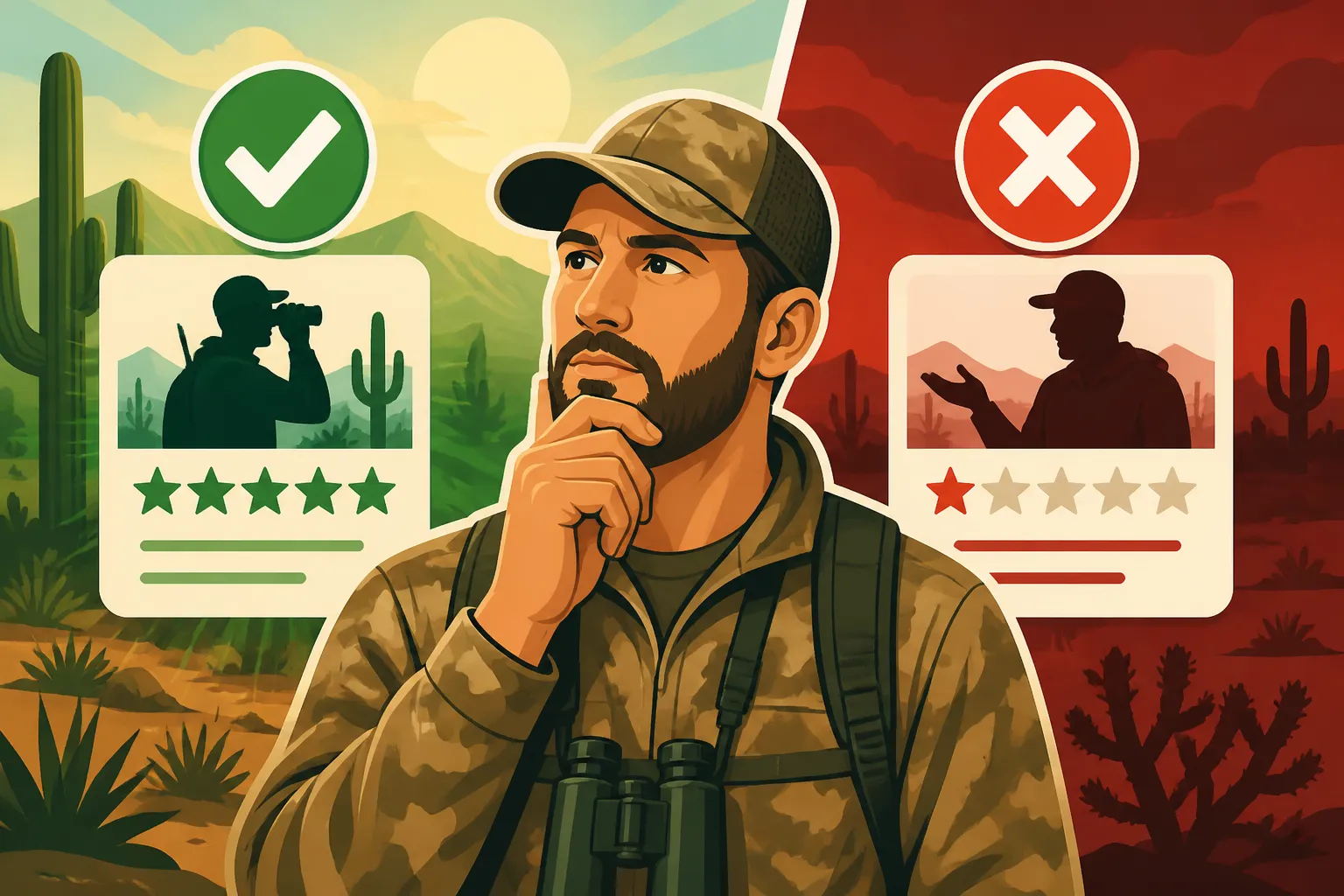
To help summarize, here's a quick reference table for what to look for and what to be wary of when evaluating outfitter reviews:
| Indicator Category | Trustworthy Review Signs (Green Flags) | Red Flags (Be Wary) |
|---|---|---|
| Content Detail | Specific dates, unit numbers, guide names, detailed hunt narratives, weather conditions, animal encounters. | Vague praise ("great hunt!"), generic complaints ("bad experience"), no concrete examples. |
| Emotional Tone | Balanced, realistic (acknowledges challenges), focuses on effort and experience, not just harvest. | Overly effusive or extremely negative, sounds like marketing copy, personal attacks. |
| Consistency | Similar themes across multiple reviews (e.g., guide dedication, camp quality). | Wildly contradictory reviews, sudden influx of only 5-star reviews, all reviews sound the same. |
| Photos/Video | Authentically taken by clients, realistic hunt scenarios, varied angles. | Highly professional, staged photos only, no "in-the-moment" shots. |
| Response | Outfitter responds professionally to all reviews, especially constructive criticism. | No responses, defensive or argumentative responses, ignores negative feedback. |
| Timeliness | Mix of recent and older reviews, showing sustained quality over time. | All reviews are very old, or all reviews are suddenly very new. |
| Sources | Found on multiple independent platforms (Google, forums, BookYourHunt). | Only found on the outfitter's personal website or a single platform. |
Choosing an outfitter for your Arizona hunt is a huge decision, and the internet provides a mixed bag of helpful information and misleading noise. By taking a critical, detailed approach to reviews – looking for specificity, consistency, and a balanced perspective – you can filter out the hype and focus on what truly matters. Combine that with your own proactive due diligence, like calling references and verifying licenses, and you'll be well on your way to selecting an outfitter who can truly enhance your hunting adventure in the Grand Canyon State. Happy hunting!
Disclaimer
This article is for general informational purposes only and does not constitute professional advice. Laws, prices and regulations vary by location and change over time. Consult a qualified professional for guidance on your specific situation.