Drop Camp Against Fully Guided
You're dreaming of an Arizona hunt, picturing those majestic elk or elusive Coues deer, but then the logistics hit you. Should you go fully guided, brave it completely alone, or is there a smart middle path that offers support without the full-service price tag? Deciding between a fully guided hunt and a drop camp can feel overwhelming, especially when you're trying to balance cost, experience, and the level of independence you desire. This guide will break down the crucial differences between fully guided hunts and drop camp options in Arizona, helping you decide which adventure truly fits your style, skill set, and budget.
Understanding the Appeal: Why These Options Exist
The landscape of Arizona hunting is as diverse as its terrain, and so are the services designed to help hunters succeed. For many, the sheer scale and ruggedness of Arizona's backcountry, whether it's the vastness of the Mogollon Rim or the steep, brushy "sky islands" of the south, can be daunting. Both fully guided hunts and drop camps cater to different needs, offering varying degrees of support for those venturing into these challenging environments.
The Challenge of Arizona's Backcountry
Arizona isn't like many other hunting destinations where accessible public land is everywhere and game is always just around the corner. We've got huge tracts of public land, absolutely, but much of it is remote, roadless, and incredibly tough. Imagine trying to navigate thousands of acres of unfamiliar ponderosa pine forest or tracking a Coues deer through unforgiving Chihuahuan Desert scrub without local knowledge. The steep climbs, extreme weather swings, and sheer distances can quickly turn an exciting adventure into a miserable ordeal if you're not prepared. This inherent difficulty is precisely why many hunters seek professional help, whether it's full-service or a strategic assist.
The Spectrum of Support
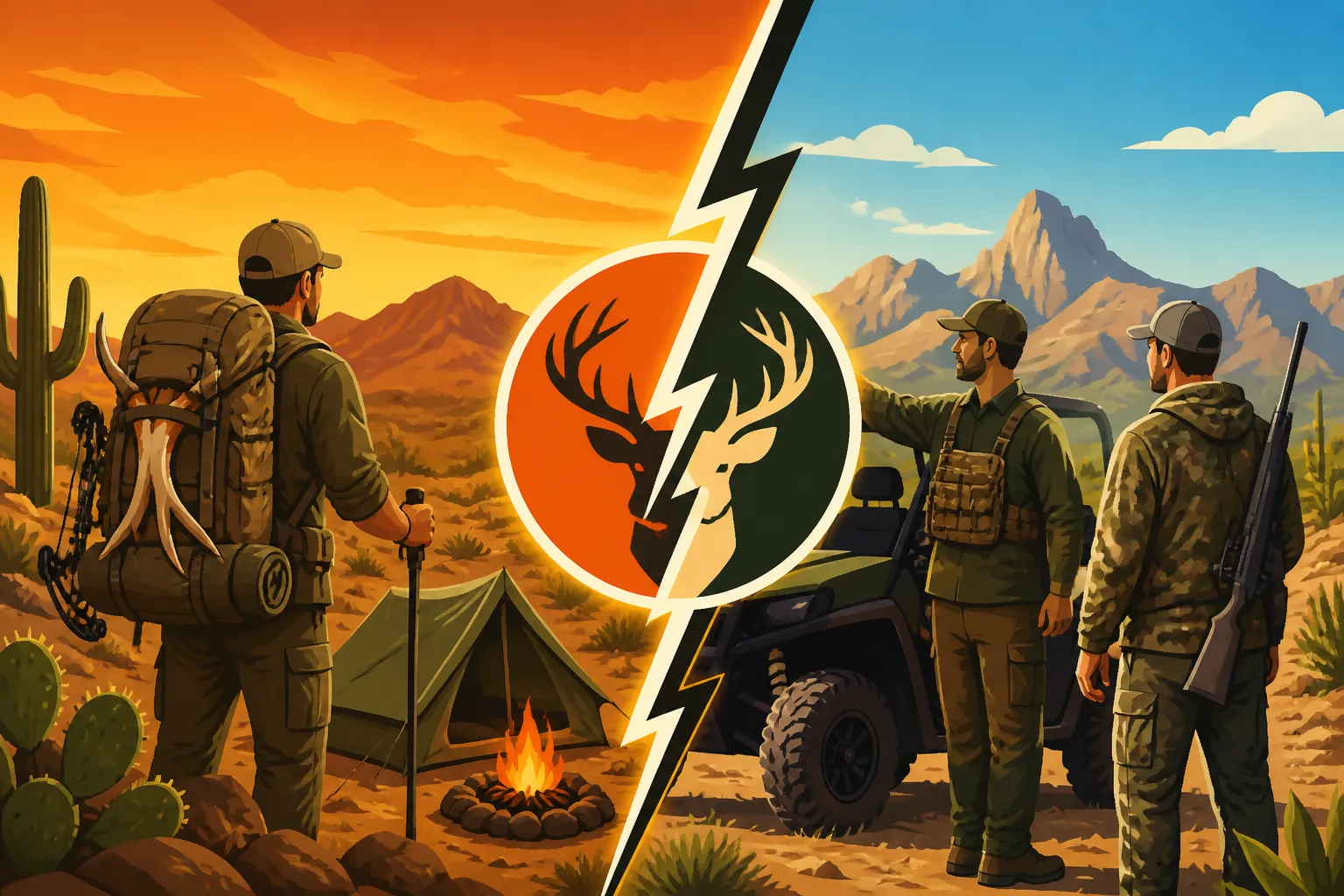
Think of hunting support as a spectrum. On one end, you have the completely DIY hunter, packing everything in on their back, making every decision, and responsible for every aspect of the hunt. This requires immense preparation, physical stamina, and often a deep understanding of the unit. On the other end, you have the fully guided experience, where almost every detail is handled for you. And then, right in the middle, you have the drop camp: a hybrid that offers a significant leg up on logistics while retaining much of the independence of a DIY hunt. Understanding where your comfort level, experience, and budget fall on this spectrum is the first step toward choosing the right Arizona adventure.
The Fully Guided Experience: What to Expect When Someone Else Does It All
A fully guided hunt in Arizona is often considered the "white glove" experience. It's designed for hunters who want to maximize their time in the field, focus solely on the hunt itself, and leverage the deep knowledge and resources of a professional outfitter. While it comes with a higher price tag, it removes many of the logistical headaches that can plague a DIY trip.
The 'White Glove' Treatment
Imagine flying into Phoenix Sky Harbor or Tucson International, getting picked up, and being driven directly to a comfortable camp. Your tent or cabin is already set up, warm, and ready. Meals are prepared, often hearty and delicious, ensuring you're fueled for long days. Before you even set foot in the field, your guide has likely spent weeks, even months, scouting the unit, locating game, and understanding their patterns. You're getting the benefit of their expertise right from the start.
When the hunt begins, your guide is with you every step of the way. They'll navigate the terrain, identify prime hunting spots, glass for animals, and often make the crucial decisions on when and how to approach. If you successfully harvest an animal, they'll assist with field dressing, packing it out, and often arranging for meat processing and taxidermy. The goal is to minimize your worries and maximize your hunting opportunity. It’s like having a local expert, a chef, and a packing crew all rolled into one, allowing you to immerse yourself completely in the hunting experience without the constant logistical demands. For many, especially those traveling long distances or chasing a once-in-a-lifetime tag like an Arizona Desert Bighorn, this comprehensive service is invaluable. You can find many reputable outfitters offering this kind of service on platforms like BookYourHunt, where you can compare what's included.
Services and Inclusions
The beauty of a fully guided hunt is in its comprehensiveness. While specifics can vary between outfitters, here’s a general rundown of what you can typically expect:
- Pre-Hunt Scouting: Extensive scouting by the outfitter to locate game, understand movement patterns, and identify key areas. This can be critical for species like elk during the rut or elusive Coues Deer Are Arizona's Signature Whitetail.
- Accommodations: Comfortable camp setups, which might range from wall tents with wood stoves to cabins or even RVs, depending on the unit and outfitter.
- Meals: All meals, snacks, and beverages are typically provided, from hearty breakfasts to packed lunches and warm dinners.
- Transportation: Travel from a designated meeting point (often a local airport or nearby town) to and from the hunting area, as well as daily transportation within the unit.
- Guiding Services: One-on-one or two-on-one guiding, with your guide actively assisting in spotting, stalking, and decision-making throughout the hunt.
- Game Care: Assistance with field dressing, caping, and packing out your harvested animal. Many outfitters also help arrange meat processing and taxidermy.
- Equipment: Often includes specialized equipment like spotting scopes, high-powered binoculars, and communication devices, especially when hunting Optics Power for Arizona's Long Desert Sightlines.
What's usually not included are your hunting license and tag fees, personal gear (clothing, rifle/bow, sleeping bag if in a tent camp), and gratuities for your guide and camp staff. It's always crucial to review the outfitter's contract carefully to understand all inclusions and exclusions. When you ask Questions Worth Asking Before You Book, this is a prime area to clarify.
The Arizona Drop Camp: Your Basecamp for Backcountry Independence
The drop camp offers a fantastic middle ground for hunters who crave the independence of a DIY hunt but recognize the logistical challenges of hauling all their gear deep into Arizona's remote backcountry. It's a service that provides a strategic advantage, setting you up with a basecamp in a promising area, but then leaving the actual hunting to you.
What a Drop Camp Actually Includes
Think of a drop camp as a foundational support system. An outfitter, often using horses, mules, or specialized vehicles, will transport you and your gear into a pre-selected, remote location that's hard to access on your own. They'll establish a comfortable camp for you – typically a wall tent or multiple tents – complete with cots, cooking stoves, water containers, and sometimes even firewood. This means you don't have to carry in a heavy pack, and you certainly don't have to worry about the multi-day effort of packing in a full camp setup.
Once the camp is established, the outfitter leaves you to your hunt. You are responsible for all aspects of the hunt itself: navigating, scouting daily, cooking your own meals, and, crucially, making all the hunting decisions. If you're successful, the outfitter will return on a pre-arranged date to pack out your game and take you back to your vehicle. It’s a huge relief not to haul in all your camp gear, especially for a week-long hunt for something like Arizona Elk on the Mogollon Rim. This service is detailed further in Arizona Drop Camp Hunts Explained.
The Logistics of Backcountry Delivery
The magic of a drop camp lies in the logistics. Many prime hunting areas in Arizona are deep within wilderness or roadless national forest lands, making vehicle access impossible. This is where Pack String Outfitters Working in Arizona really shine. They use sure-footed horses and mules to carry heavy loads, traversing rugged trails that would be extremely difficult, if not impossible, for a hunter to do solo with a full camp.
Here's how it generally works:
- Meeting Point: You'll meet your outfitter at a designated trailhead or staging area, often at the crack of dawn. You'll transfer your gear – personal hunting pack, food cooler, sleeping bag, rifle/bow – to their pack animals.
- The Ride In: You'll typically ride in on a saddle horse, following your outfitter and the string of pack animals carrying your camp. This can be a several-hour journey, giving you a real taste of the backcountry before you even arrive.
- Camp Setup: Upon arrival at your chosen location (often scouted beforehand for water, game sign, and good hunting access), the outfitter sets up the wall tent(s), unloads your gear, and ensures everything is in working order. This might include a cooking area, a privy, and a bear-safe food storage system.
- The Hunt: You are then left to hunt independently for the duration of your trip. This means planning your daily routes, cooking, and making all hunting decisions.
- The Pack Out: On a pre-determined day, the outfitter returns. If you've harvested an animal, they'll pack out the meat, cape, and antlers, along with your gear, back to the trailhead.
This service is perfect for those who are physically capable hunters, confident in their navigational and hunting skills, but simply lack the pack animals, time, or desire to carry a full camp into the wilderness. The Logistics of a Horseback Drop Camp are complex, making the outfitter's role invaluable.
Cost Comparison: Dollars and Sense for Arizona Adventures
When weighing a fully guided hunt against a drop camp, the financial investment is often a primary factor. While both options streamline certain aspects of a hunt, their cost structures and what they include differ significantly. It's crucial to understand these differences to budget appropriately and avoid unexpected expenses.
Guided Hunt Price Ranges by Arizona Species
Fully guided hunts, due to the comprehensive nature of the service, represent the higher end of the financial spectrum. The cost is directly tied to the level of personal attention, expertise, and logistical support provided. Prices vary dramatically based on the species, the duration of the hunt, the demand for tags in a particular unit, and the outfitter's reputation.
For coveted tags like Arizona elk, especially for trophy bulls in prime units, a fully guided hunt can be a significant investment. You're paying for the guide's extensive scouting, their ability to navigate complex terrain, and their skill in calling or spotting trophy animals. Similarly, for species like Desert Bighorn Sheep, which are often once-in-a-lifetime tags and involve extreme physical demands and remote locations, guided hunts command premium prices. Even for more accessible species like Coues deer, where the primary guiding service might be intense glassing over vast distances, the daily rate for a guide's optics expertise and knowledge of their habits in the Sky Island Ranges That Hold Coues still reflects a substantial investment. Remember, these prices usually don't include your actual hunting license or tag, so be sure to factor that in. The All-In Cost of an Arizona Nonresident Elk Hunt will give you a good idea of the total investment for that specific pursuit.
Drop Camp Costs Against Full Service
Drop camps, by their nature, are typically a more budget-friendly option than fully guided hunts, as they eliminate the daily presence of a guide and the associated labor costs. You're primarily paying for the transportation of your gear and the setup/take-down of a comfortable camp in a remote location.
Here's a breakdown of the cost shape:
- Daily Rate vs. Flat Fee: Drop camps often operate on a flat fee for the delivery and retrieval of your camp, or a lower daily rate compared to a guided hunt.
- What You Provide: With a drop camp, you're responsible for bringing and cooking all your own food, all personal hunting gear, and making all your own hunting decisions. This means your personal gear list will be more extensive, and you'll incur costs for groceries and meal prep.
- Less Overhead: Outfitters running drop camps have less overhead in terms of staffing (no daily guides) and consumables (no food prep for clients). This savings is passed on to you.
The trade-off is clear: you save money, but you take on more responsibility. This makes drop camps a great option for experienced hunters who are confident in their abilities but want to access truly wild, remote areas without the enormous physical burden of packing in a full camp. They are a fantastic way to stretch your budget while still getting into productive, less-pressured areas.
| Feature | Fully Guided Hunt | Drop Camp Hunt | DIY (Do-It-Yourself) Hunt |
|---|---|---|---|
| Cost (Relative) | Highest | Moderate | Lowest (excluding personal gear purchase) |
| Services Incl. | Guide, camp, meals, transportation, game recovery | Camp setup/take-down, gear/game transport in/out | None |
| Hunting Help | Active guiding, spotting, stalking, decision-making | None (you hunt independently) | None (you hunt independently) |
| Camp Setup | Handled by outfitter | Handled by outfitter (then you're on your own) | All your responsibility |
| Meals | Prepared by outfitter/cook | Prepared by hunter | Prepared by hunter |
| Gear Transport | Usually included | Outfitter transports in/out | All your responsibility (backpack, ATV, horse) |
| Game Recovery | Assisted/handled by guide | Outfitter assists with pack out on retrieve day | All your responsibility |
| Independence | Low | High | Highest |
| Experience Req. | Low (guide handles most decisions) | High (must be self-reliant, good navigator) | Very High (all aspects, extensive planning) |
Skill Set and Support: Matching the Hunt to Your Abilities
Beyond the financial considerations, matching the type of hunt to your personal skill set, physical condition, and desired level of independence is paramount. An Arizona hunt can be incredibly demanding, and choosing the wrong approach can lead to frustration or even unsafe situations.
When a Guide is Truly Worth the Investment
There are several scenarios where a fully guided hunt isn't just a luxury, but a strategic advantage or even a necessity:
- First-Time Arizona Hunter: If you've never hunted Arizona before, the terrain, species behavior, and regulations can be a steep learning curve. A guide offers invaluable local knowledge, helping you navigate unfamiliar units like Arizona Unit 23 Elk and Coues Country and understand how to Reading Wind on a Sky Island Stalk.
- Targeting Trophy Animals: For hunters seeking a specific caliber of animal (e.g., a Boone and Crockett bull elk or a record-book Coues buck), a guide's dedicated scouting and expertise significantly increase your odds. They know where these animals live and how to hunt them.
- Limited Time: If you have a short window for your hunt, a guide ensures you hit the ground running, maximizing your effective hunting time rather than spending days learning the area.
- Physical Limitations: While many guided hunts are physically demanding, an outfitter can often tailor the experience to a hunter's physical capabilities, focusing on areas with easier access or providing more direct assistance.
- Once-in-a-Lifetime Opportunity: For rare tags like Bighorn Sheep or Bison, the investment in a guide helps ensure you make the most of an opportunity you might never get again. They also handle the intricate trophy care for such animals.
- Learning Experience: A guided hunt can be an incredible educational experience, allowing you to learn new techniques from seasoned professionals that you can apply to future DIY hunts. Arizona Coues Guides Sell Glassing, Not Ground for a reason – their optics skills are next level.
For those who may feel overwhelmed by the sheer scale of the Arizona wilderness or the specific challenges of a species like the "gray ghost" Coues deer, a guide provides the confidence and expertise to turn a dream hunt into a successful reality.
The Self-Reliant Nature of a Drop Camp Hunter
Drop camps are tailor-made for experienced, self-reliant hunters who possess a strong skill set in backcountry travel and hunting. When you opt for a drop camp, you're essentially signing up for a DIY hunt with a critical logistical boost.
Consider if you fit this profile:
- Strong Navigation Skills: You must be proficient with maps, GPS, and compass, capable of navigating remote areas independently, and comfortable Reading an Arizona Unit Boundary Before You Apply yourself.
- Backcountry Experience: You should have prior experience with multi-day backcountry trips, including setting up camp, managing food and water in remote environments, and being self-sufficient in potentially adverse weather.
- Physical Stamina: While you're not packing in the whole camp, you'll still be covering significant ground daily, often at high elevations and in rugged terrain, while carrying your day pack and rifle/bow.
- Game Processing Knowledge: You must be competent in field dressing and quartering an animal, preparing it for the pack-out, especially in areas where retrieving quickly is important for meat quality. Field Dressing in Desert Heat requires skill and speed.
- Confidence in Decision-Making: All hunting decisions – where to go, when to stalk, when to call – fall on your shoulders. You need to trust your instincts and experience.
- Desire for Independence: You genuinely enjoy the challenge and solitude of hunting on your own terms, without the constant presence of a guide. This is about your hunt, your way.
A drop camp provides a critical shortcut to incredible hunting areas, but it's not a shortcut on the skills required. If you love the challenge of planning and executing your own hunt but want to avoid the back-breaking effort of packing in a full basecamp for a week, then a drop camp might be your perfect Arizona adventure. You're still relying on your knowledge of Reading Fresh Elk Sign in Ponderosa Timber or Finding Water in Arizona's Dry Country.
Making the Choice: Which Arizona Hunt Is Right for You?
The decision between a fully guided hunt and a drop camp often boils down to a blend of budget, experience, and what you ultimately want to get out of your Arizona hunting adventure. There's no single "best" option; rather, it's about finding the right fit for you at this stage of your hunting journey.
Factors to Consider Before Booking
Before you commit, take a moment to honestly assess these crucial factors:
- Budget: This is often the primary driver. Fully guided hunts are significantly more expensive but offer unparalleled convenience and expertise. Drop camps are more affordable, providing access to remote areas without the full price tag. What a Guided Arizona Elk Hunt Costs will be substantially more than a drop camp.
- Experience Level: Are you a seasoned backcountry hunter with years of experience navigating and hunting independently, or are you relatively new to big game hunting or Arizona's unique challenges? An outfitter provides a safety net and accelerates the learning curve.
- Time Commitment: How much time can you realistically dedicate to scouting, planning, and preparing for your hunt? A fully guided hunt requires less personal pre-hunt prep, while a drop camp still demands significant personal planning.
- Physical Condition: Both options demand physical fitness, but a fully guided hunt might offer more flexibility if you have specific physical needs, or if you're chasing high-demand units where the hunting can be brutal.
- Desired Independence: Do you thrive on making all your own decisions and embracing the solitude of the wilderness, or do you prefer the camaraderie and expert direction of a guide?
- Success Odds: While no hunt is guaranteed, a good guide often significantly improves your odds, especially for hard-to-draw, trophy animals. Drop camps give you access to good areas, but your success hinges entirely on your own skills.
- Specific Species and Unit: Some species, like Desert Bighorn, or certain units, like the most remote parts of the Kaibab, inherently lend themselves more to guided efforts due to their difficulty and the value of the tag.
Many hunters start with fully guided hunts to learn the ropes, gain experience, and build confidence, eventually transitioning to drop camps or even full DIY adventures as their skills and comfort grow. Others, with limited time or specific trophy goals, stick with guided hunts year after year.
Researching Outfitters and Services
Once you have a clearer idea of which option suits you, it's time to do your homework. This is where resources become invaluable.
- Online Platforms: Websites like BookYourHunt can be excellent starting points for finding and comparing outfitters that offer both fully guided and drop camp services in Arizona. You can read reviews, look at success rates, and get an idea of the services included.
- Hunting Forums and Social Media: Engage with other hunters. Personal recommendations and candid reviews from those who have used specific outfitters can provide valuable insights.
- Direct Contact: Always call and speak directly with outfitters. Ask detailed questions about their services, what's included, their experience in specific units, and their philosophy on hunting. Don't be shy about asking for references. Vetting an Arizona Outfitter Before You Send a Deposit is a critical step.
- Review Contracts: Carefully read the entire contract, paying close attention to payment schedules, cancellation policies, and what happens if you fail to draw a tag when you Booking Before Arizona Draw Results Post.
- Game and Fish Resources: While they don't endorse specific outfitters, the Arizona Game and Fish Department website can provide draw odds, harvest statistics, and unit information that will help you evaluate the potential of different areas an outfitter might serve. You can also research through resources like GoHunt, which often compile detailed unit statistics.
Choosing the right type of hunt for your Arizona adventure is a personal journey. Whether you opt for the comprehensive support of a fully guided trip or the independent spirit of a drop camp, thorough research and an honest assessment of your capabilities will ensure you have the best possible experience in our incredible state.
Disclaimer
This article is for general informational purposes only and does not constitute professional advice. Laws, prices and regulations vary by location and change over time. Consult a qualified professional for guidance on your specific situation.